Georgia Group Health Insurance Renewal Checklist: 15 Essential Tips

Georgia group health insurance renewal checklist reviews are increasingly important for employers facing rising healthcare costs, changing carrier options, network considerations, and evolving employee needs. Before accepting your next renewal, these 15 areas deserve careful review.
A group health insurance renewal checklist helps Georgia employers answer a question that a renewal notice cannot answer by itself: does this plan still offer the right balance of employer cost, employee affordability and usable coverage?
This Georgia group health insurance renewal checklist gives employers a structured way to evaluate costs, coverage, networks, employee needs and alternative strategies before accepting a renewal.
Imagine receiving a 10% renewal increase. You could accept it, increase employee payroll deductions or request a cheaper plan. Before choosing, check what each decision would mean for your budget, employees’ doctors, prescriptions and financial exposure.
This guide gives Georgia business owners, office managers and benefits decision makers 15 practical checks to complete before accepting a renewal. It also explains when to compare traditional group coverage, level funding, ICHRA, QSEHRA and SHOP.
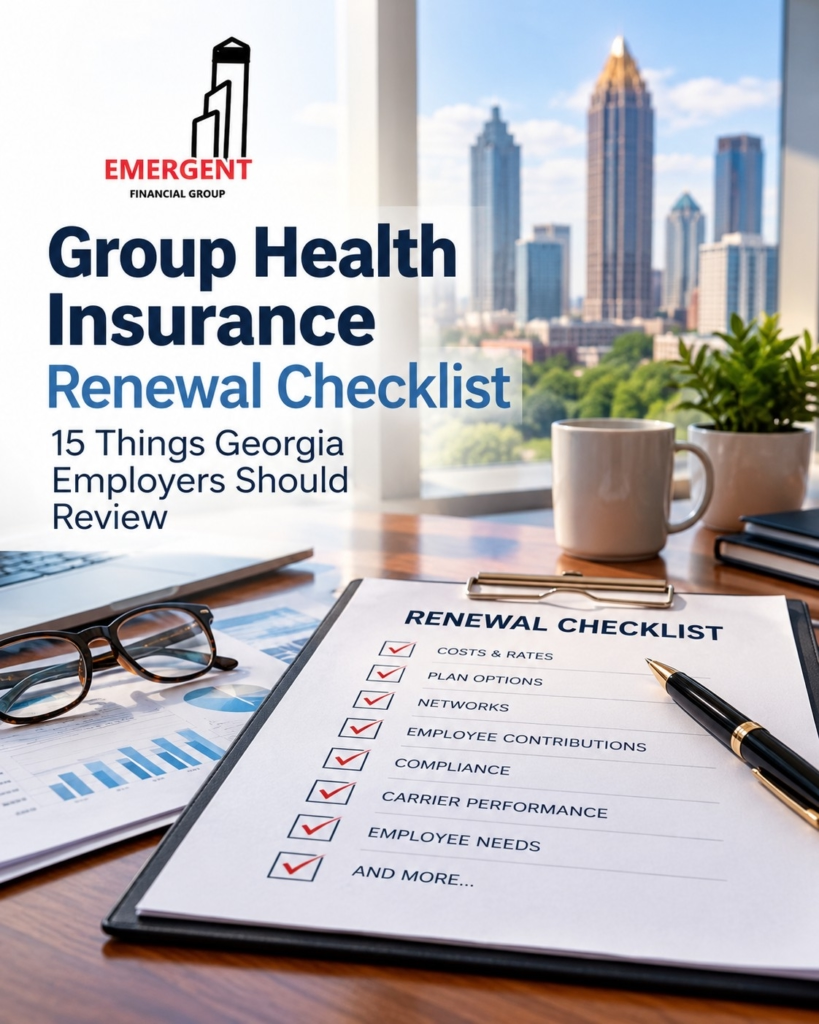
A practical guide for Georgia employers preparing for 2027 renewals. All dollar examples are hypothetical; they are not carrier quotes or savings projections.
👍 Read: 2027 Georgia Group Health Insurance Renewal Stress Test
What Should a Group Health Insurance Renewal Checklist Include?
Review three things together: what the employer pays, what employees pay, and what coverage employees can actually use. Then compare the renewal with realistic alternatives and establish an implementation schedule.
Gather current and renewal rates, plan summaries, employer contributions, employee deductions, enrollment by coverage tier, an updated census, participation information and your benefits budget.
Request the Summary of Benefits and Coverage (SBC) for each finalist. HealthCare.gov explains that this standardized summary helps consumers compare benefits and coverage.
An SBC is a starting point. Review the applicable policy or plan documents, network directory, formulary and administrative terms as well.
Table of Contents
- Checks 1–3: Employer and employee costs
- Checks 4–6: Deductibles, cost sharing and out-of-pocket exposure
- Checks 7–10: Networks, prescriptions, dependents and participation
- Checks 11–14: Contributions and alternative benefit strategies
- Check 15: Employee enrollment and implementation
- Renewal comparison matrix and planning timeline
- Frequently asked questions
- Get help reviewing your renewal
Group Health Insurance Renewal Checklist: 15 Checks Before You Renew
👍 Read: Why Did My Company’s Health Insurance Premium Increase in 2027?
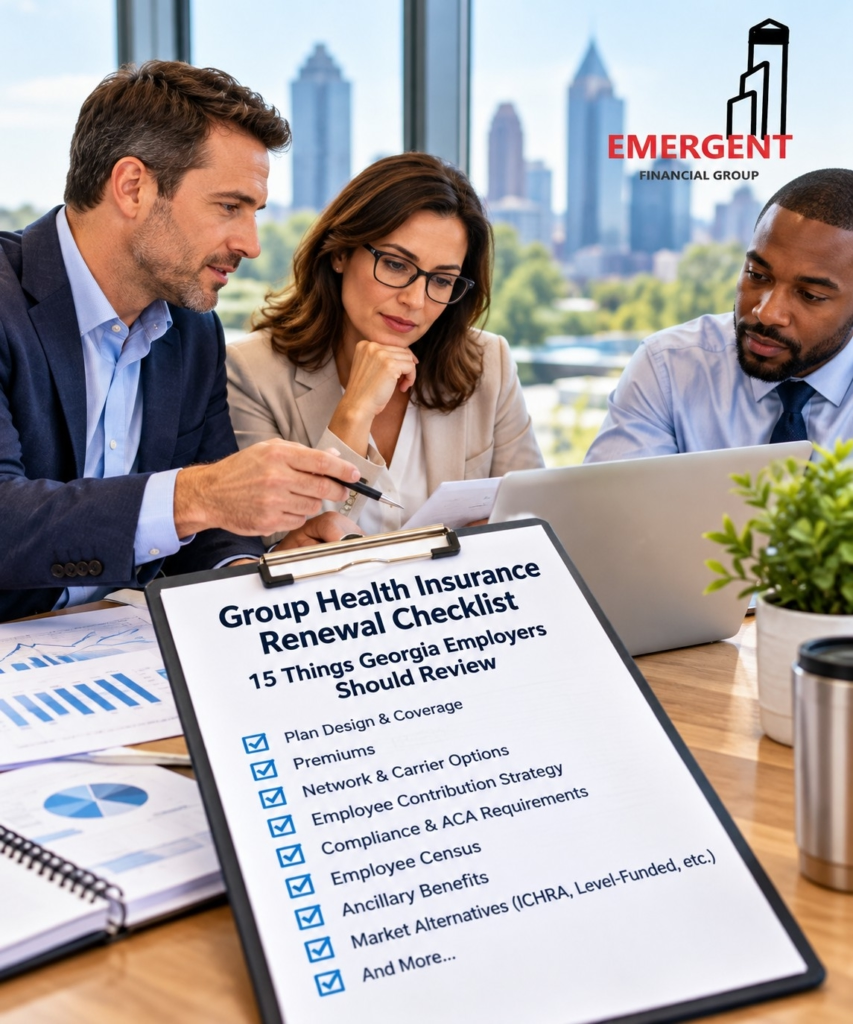
Georgia Group Health Insurance Renewal Checklist: 15 Things to Review
Before accepting a renewal, use this Georgia group health insurance renewal checklist to quickly identify the 15 areas that deserve review. Each item is explained in greater detail below.
| ✓ | Renewal Item | What to Review |
| ☐ | 1. Renewal Rate | Compare the new premium with the current rate and calculate the percentage increase. |
| ☐ | 2. Claims Experience | Review available claims or utilization information that may be influencing pricing. |
| ☐ | 3. Employer Contribution | Determine whether the employer contribution remains affordable and competitive. |
| ☐ | 4. Employee Cost | Calculate how the renewal changes employee payroll deductions. |
| ☐ | 5. Deductibles | Compare individual and family deductibles with the current plan. |
| ☐ | 6. Copays & Coinsurance | Review changes to office visits, specialists, urgent care, ER and coinsurance. |
| ☐ | 7. Out-of-Pocket Maximums | Determine whether employees could face greater maximum annual exposure. |
| ☐ | 8. Provider Network | Confirm that important physicians, hospitals and facilities remain in-network. |
| ☐ | 9. Prescription Coverage | Review formularies, drug tiers, copays and specialty-drug coverage. |
| ☐ | 10. Employee Needs | Consider workforce demographics, utilization and employee feedback. |
| ☐ | 11. Carrier Options | Compare available carriers rather than automatically renewing the incumbent plan. |
| ☐ | 12. Plan Design Alternatives | Compare different deductibles, networks and benefit structures. |
| ☐ | 13. Funding Alternatives | Evaluate fully insured, level-funded and other appropriate funding strategies. |
| ☐ | 14. ICHRA & Other Alternatives | Determine whether an ICHRA or another coverage strategy deserves consideration. |
| ☐ | 15. Ancillary Benefits | Review dental, vision, life, disability and voluntary benefits alongside medical coverage. |
The Georgia group health insurance renewal checklist above provides a starting point, but each item deserves closer examination before an employer makes a final coverage decision.
A renewal is a decision point—not simply an invoice to approve. The sections below walk through each consideration and explain what Georgia employers should evaluate before making a final decision.
The following sections expand on each item in the Georgia group health insurance renewal checklist and explain what employers should consider before accepting their next renewal.
1. Calculate Your Current Annual Employer Cost
Begin with what the business contributes, rather than the carrier’s total premium. Separate employer spending from amounts employees fund through payroll deductions.
If your company contributes $8,000 per month, the annual employer premium contribution is $96,000.
Include all coverage tiers and plans. List employer HSA contributions, administration fees and other separately charged expenses alongside premiums so they remain visible in the comparison.
Action: Establish a documented annual baseline.
👍 Read: How to Set a Strategic Employee Benefits Budget for Your Business
2. Calculate the Renewal’s Annual Employer Cost
Apply the renewal rates to your expected enrollment and contribution formula.
If employer contributions rise from $8,000 to $8,800 per month, annual premium spending increases from $96,000 to $105,600.
That is a $9,600 annual increase.
First compare the same census and enrollment tiers to isolate the rate change. Then model anticipated hiring, departures or changes in family enrollment separately.
Action: Record both the percentage increase and annual dollar impact. Identify whether the difference comes from rates, enrollment, contribution changes or a combination.

3. Calculate What Employees Will Pay
Prepare a comparison for every coverage tier. Show monthly costs and actual payroll deductions so employees can understand the effect on each paycheck.
| Coverage tier | Current employee monthly premium | Renewal employee monthly premium | Monthly increase |
|---|---|---|---|
| Employee only | $125 | $150 | $25 |
| Employee + spouse | $425 | $490 | $65 |
| Employee + child | $350 | $410 | $60 |
| Family | $675 | $790 | $115 |
In this hypothetical example, family coverage increases $1,380 annually, before any change in medical spending.
Action: Identify which tiers experience the greatest increase.
👍 Read: Has Your Employee Benefit Plan Become Unaffordable?
4. Compare Deductibles and How They Work
Check individual and family deductibles, separate prescription deductibles and the services subject to each deductible.
A move from a $1,500 deductible to a $5,000 deductible changes employee exposure even if premiums fall.
Ask whether one family member can satisfy an individual deductible or whether the plan requires a larger family threshold before relevant benefits begin.
Action: Explain how each finalist’s deductible works using its SBC and plan documents. Include any employer account contribution that helps employees fund eligible expenses.
5. Review Copays and Coinsurance
Compare:
- Primary-care visits
- Specialist visits
- Urgent care
- Emergency care
- Diagnostic imaging
- Outpatient surgery
- Inpatient treatment
Determine which services have a fixed copay, which require percentage-based coinsurance and which are subject to the deductible first.
Ask your advisor to explain a few common care scenarios. A similar deductible does not guarantee a similar cost for a specialist visit or hospital stay.
Action: Identify the benefit changes employees are most likely to notice when they use care.
👍 Read: Why Did My Company’s Health Insurance Premium Increase in 2027?

6. Compare Maximum Out-of-Pocket Exposure Without Double Counting
Review individual and family out-of-pocket maximums.
For a high-cost year, a useful starting comparison is:
Annual employee premium contribution + the applicable in-network out-of-pocket maximum.
Do not add the deductible again when it already counts toward that maximum.
For example:
$3,600 in annual employee premiums + a $7,000 out-of-pocket maximum = $10,600.
This is not a cap on every possible household healthcare expense. HealthCare.gov explains the out-of-pocket maximum and exclusions, including premiums, noncovered services and out-of-network spending.
Action: Compare a low-use year and a high-cost year. Explain the limits of each estimate.
As you work through this Georgia group health insurance renewal checklist, remember that the lowest premium does not necessarily represent the best overall value for the employer or its employees.
We provide valuable employee benefit plans
that bring more success in business
7. Verify the Specific Provider Network
Compare the exact network attached to each proposal. A familiar carrier name should not substitute for checking physicians, hospitals and facilities.
Ask employees to verify important providers privately against the proposed plan, including specialists and facilities involved in ongoing treatment.
Confirm the exact plan and effective date with the insurer and provider office, and retain confirmation where possible.
Action: Identify significant access problems before selecting the plan. Ask the carrier about any applicable transition-of-care process if an employee’s treatment could be disrupted.
8. Review Prescription Coverage
For important medications, check:
- Whether the medication is covered
- Formulary tier
- Copay or coinsurance
- Deductible treatment
- Prior authorization
- Step therapy
- Quantity limits
- Specialty-pharmacy requirements
At this stage of the Georgia group health insurance renewal checklist, employers should look beyond premiums and evaluate how network, prescription and plan-design changes could affect employees who actually use the coverage.
Use the proposed plan’s current formulary and carrier tools. Do not assume last year’s prescription coverage carries forward.
Action: Provide a private channel through the advisor or carrier for employees to review medications. Broad employer planning does not require a workplace list of employees’ diagnoses or prescriptions.

9. Examine Dependent Coverage
Compare employee-only pricing with spouse, child and family coverage.
Review employer support for each tier and any applicable dependent eligibility provisions or spouse surcharges.
A proposal may work well for an employee purchasing coverage alone while creating a difficult tradeoff for an employee covering a household.
Action: Model several household situations and ask whether dependent costs fit your compensation goals.
10. Review Participation and Waivers
Count:
- Eligible employees
- Enrolled employees
- Employees waiving coverage
Distinguish employees with another source of coverage from those who report that the employer plan costs too much.
Ask each proposed carrier or administrator how it measures participation and treats waivers. Do not assume every carrier uses the same requirements.
Action: Confirm eligibility, participation and contribution conditions before treating a proposal as implementable.
11. Reevaluate the Employer Contribution Strategy
Compare your existing contribution formula with reasonable alternatives:
- A percentage of premiums
- A fixed dollar amount
- Different support by coverage tier
- An employer HSA contribution where appropriate
Ask how each design affects the employer budget and employees at different pay levels.
Confirm applicable carrier, tax, nondiscrimination and affordability requirements with the appropriate professionals.
Action: Choose contributions intentionally and document the financial and workforce objectives they support.
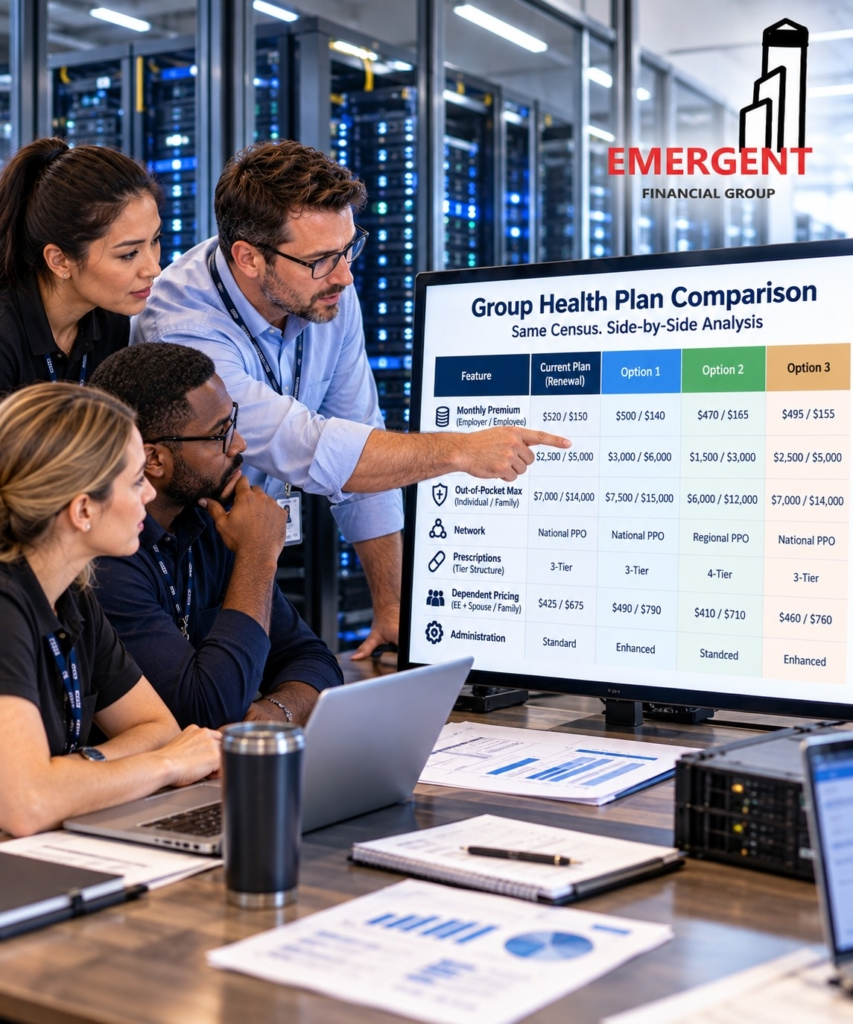
12. Compare Other Traditional Group Health Plans
Request competing proposals when appropriate.
Compare benefits, networks, prescriptions, dependent pricing, administration, and employer and employee spending using the same census.
Explain material differences before describing a proposal as a saving. A cheaper premium accompanied by a higher deductible represents a different benefit design.
Action: Keep the incumbent renewal in the comparison. The existing plan may still offer the best overall fit after review.
13. Determine Whether Level Funding Deserves Consideration
For employers evaluating level funding, review the funding arrangement as carefully as the benefit summary.
Ask how monthly payments are allocated among claims funding, administration and stop-loss protection.
Questions for the proposal review include:
- What employer obligations remain under the contract?
- How do specific and aggregate stop-loss provisions work?
- How are claims handled after termination?
- What underwriting and renewal provisions apply?
- Who receives any surplus, under what conditions and when?
Action: Compare contractual risk and administration alongside price.
👍 Read: Level-Funded Group Health Insurance: A Comprehensive Guide for Small Businesses
14. Compare ICHRA, QSEHRA and SHOP When Appropriate
These arrangements solve different problems. Evaluate their rules and employee outcomes before deciding that a different funding structure is preferable.
ICHRA: Model the Individual Coverage Experience
An individual coverage HRA reimburses qualifying expenses under the arrangement’s rules while employees obtain qualifying coverage.
HealthCare.gov’s employer guidance on individual coverage HRAs provides information about contributions, employee classes, affordability and implementation.
Model employee ages, residential ZIP codes, individual premiums, employer allowances, networks, prescriptions and administration costs.
Review eligibility classes and affordability rules. An employee cannot assume that an employer HRA allowance can simply be added to a Marketplace premium tax credit.
QSEHRA: Confirm Employer Eligibility and Annual Limits
QSEHRA is available to eligible small employers that are not applicable large employers and do not offer a group health plan.
It has annual reimbursement limits and rules governing coverage, notices and premium-tax-credit coordination.
Use HealthCare.gov’s QSEHRA overview and confirm the rules and limits for the applicable year before implementation.
SHOP: Evaluate Potential Tax-Credit Eligibility
SHOP may deserve consideration when qualifying coverage is available and the employer could qualify for the Small Business Health Care Tax Credit.
Eligibility depends on factors such as full-time-equivalent employee count, average wages, qualifying employer contributions and applicable coverage requirements.
Read the IRS guidance on who qualifies for the Small Business Health Care Tax Credit.
Have a tax professional calculate the credit rather than assuming a maximum credit applies.
Action: Compare employer spending and employee outcomes.

👍 Read: Georgia SHOP Health Insurance: When Is the Tax Credit Worth It?
15. Build the Employee Enrollment and Implementation Plan
Before finalizing the strategy, assign responsibility for:
- Employee communication
- Enrollment
- Payroll
- Required documents and notices
- Effective dates
- First payments
Employees should know what changes, why it changes, their costs, available choices, what to verify, the deadline and where to obtain help.
Important timing distinction: A general 30–60-day communication window is not sufficient for every arrangement.
HealthCare.gov describes advance notice requirements for individual coverage HRAs and QSEHRAs, generally involving 90 days before the plan year for current eligible employees, with rules for new eligibility and other circumstances.
Confirm the applicable deadline before scheduling a change.
Verify authorized benefits contacts and use secure methods for employee information. The following guide explains verification and enrollment safeguards relevant when employees obtain individual coverage.
👍 Read: Georgia Access Fraud and Fake Brokers: What Individuals and Small Businesses Need to Know
Action: Create a written implementation calendar and arrange follow-up after enrollment.
Turn Your Group Health Insurance Renewal Checklist Into One Comparison
Use a single matrix to compare the renewal with viable alternatives. Keep assumptions visible rather than presenting different benefit designs as identical.
| Decision factor | What to record for each finalist |
|---|---|
| Employer spending | Annual contribution or funding, account contributions and separate fees |
| Employee spending | Premium contribution by tier; estimated costs under care scenarios |
| Benefits | Deductibles, copays, coinsurance and out-of-pocket maximums |
| Access | Exact provider network and medication coverage |
| Dependents | Premiums, contributions and eligibility |
| Financial risk | Contract obligations, funding exposure and renewal terms |
| Administration | Payroll, enrollment, reimbursement and support responsibilities |
| Implementation | Notice deadlines, elections, effective dates and payments |
Label estimates, assumptions and unconfirmed terms.
For HRA options, employee-level comparisons may be necessary because individual plans differ.
When Should Georgia Employers Start Their Renewal Review?
Begin preparation before final rates arrive.
The following is a suggested planning framework, not a universal legal or carrier deadline:
| Time before renewal | Suggested work |
|---|---|
| 120–180 days | Gather baseline costs, census, workforce priorities and budget |
| 90–120 days | Explore strategies; identify notice requirements and implementation constraints |
| 60–90 days | Compare viable proposals as rates become available; resolve access concerns |
| 30–60 days | Complete elections, communication and payroll work where earlier requirements have already been satisfied |
For SHOP specifically, HealthCare.gov recommends contacting your insurer, agent or broker approximately 45–60 days before coverage ends.
It also notes that insurers may use different renewal timelines.
Work backward from your actual effective date, carrier deadlines and applicable notice obligations.

Review the Broader Benefits Package and Follow Through
Consider dental, vision, life, disability and voluntary benefits alongside medical coverage.
Check whether the combination supports your workforce priorities and budget.
After enrollment, review payroll accuracy, participation, employee questions, provider issues and spending against expectations.
👍 Read: Now That Open Enrollment Is Over—Did Your Plan Actually Work?
Get Help Reviewing Your Georgia Group Health Insurance Renewal
Using a Georgia group health insurance renewal checklist each year can help employers compare their existing coverage with available alternatives rather than automatically accepting the renewal.
Your renewal tells you what it costs to continue the current plan. A structured review helps determine whether that plan still fits the business and workforce.
Emergent Financial Group helps Georgia business owners and decision makers evaluate employer spending, employee costs, contribution strategies and available benefit options.
Take the next step beyond this checklist with our Renewal Stress Test.
A well-structured Georgia group health insurance renewal checklist can help employers turn the annual renewal process into a broader evaluation of cost, coverage, employee needs and available alternatives.
👍 Read: 2027 Georgia Group Health Insurance Renewal Stress Test
Need help getting started? Explore how Emergent Financial Group partners with Business Owners and Decision Makers to bring flexible, tax-efficient benefits tailored to your workforce.
Contact: connect@emergentfingrp.com.
Frequently Asked Questions About the Group Health Insurance Renewal Checklist
Should an employer automatically change carriers after a large increase?
No. Investigate the increase and compare the complete proposals. Another plan could improve value, but a switch may also change networks, prescriptions and employee costs.
Is the lowest-premium plan the best choice?
Not necessarily. Compare employer and employee spending, benefit design, provider access and administration together. Identify what employees gain or give up for the premium difference.
Should I add the deductible to the out-of-pocket maximum?
Generally, no. When the deductible counts toward the applicable maximum, adding it again double counts that expense. Review the plan’s terms and compare premiums separately.
Can employees use an ICHRA and a Marketplace premium tax credit together?
They cannot use both for the same coverage period. Affordability and opting out affect potential tax-credit eligibility. Review the employee’s situation under current rules before making a decision.
How early should a Georgia employer start this checklist?
Start collecting information months before renewal when possible. Final pricing can be added later. Carrier deadlines and required notices determine when specific actions must be completed.
What should employees check before switching plans?
Verify important doctors, hospitals and prescriptions under the exact proposed plan. Review premium contributions, deductibles, cost sharing and family costs before electing coverage.
Carrier products, approvals, networks, eligibility, rates and plan availability can change. Confirm the final proposal, policy documents, provider network, formulary and applicable requirements before enrollment.
This material is provided for educational purposes and is not intended as individualized tax, legal, ERISA, insurance or investment advice. Employers should coordinate plan design and compliance matters with qualified insurance, tax, legal, benefits and financial professionals as appropriate.

"Helping Businesses Build Better Benefits. Helping Employees Build Better Retirements. RIA in Buckhead. Benefit Planning. Wealth Management. Wills. Trusts. Estate Planning."