Why Did My Company’s Health Insurance Premium Increase in 2027?

A health insurance premium increase in 2027 is a growing concern for Georgia small businesses as employers prepare for higher group health insurance renewal costs. Rising medical expenses, prescription drug prices, increased healthcare utilization, workforce demographics, and administrative fees can all contribute to higher premiums. However, not every increase is driven by medical claims alone. Understanding your health plan’s funding structure and comparing traditional group insurance, level-funded plans, and Individual Coverage Health Reimbursement Arrangements (ICHRA) can help employers identify opportunities to control costs while maintaining competitive employee benefits.
A health insurance premium increase in 2027 can create significant financial pressure for Georgia employers, particularly small businesses already managing rising payroll, operating expenses, and employee benefit costs.
However, higher premiums are not always the result of increased medical claims. Healthcare utilization, prescription drug costs, provider reimbursement rates, workforce demographics, insurance funding structures, and administrative expenses can all influence an employer’s renewal.
Before accepting a higher group health insurance premium, employers should understand what is driving the increase, whether their current plan remains competitive, and which alternative funding arrangements could help control costs.
At Emergent Financial Group, we help Georgia small businesses evaluate traditional group health insurance, level-funded plans, ICHRA, and other employee benefits strategies to identify appropriate coverage and cost-management opportunities.
A health insurance premium increase can leave a Georgia business owner wondering what changed—especially when the company has the same employees, the same insurance carrier and a plan that appears almost identical to last year’s coverage.
The increase may reflect higher healthcare prices, prescription spending, changes in enrollment, the insurer’s broader pricing assumptions or the funding arrangement your company uses.
The first step is to separate three different questions:
- Did the insurance carrier increase its rates?
- Did the company’s enrollment or benefits change?
- Did the employer or employee contribution change?
Those are different problems, and they may require different solutions.
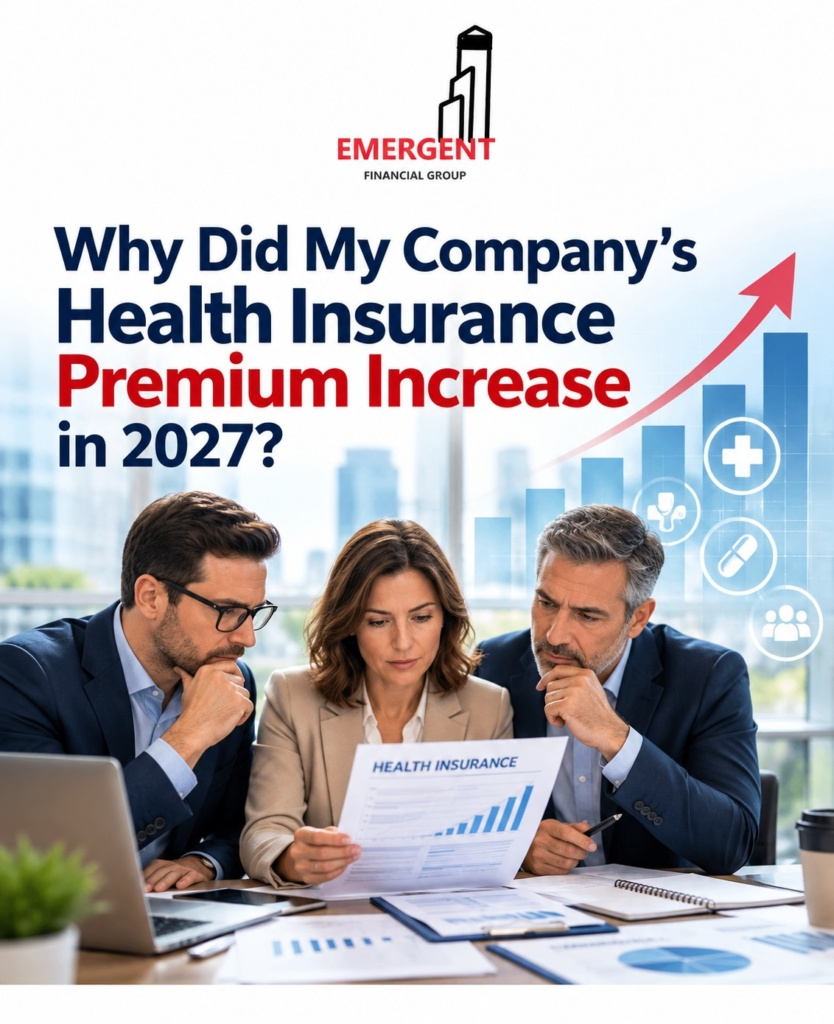
This guide explains 10 reasons your company’s health insurance costs could increase in 2027, what information to request and how Georgia employers can evaluate their next move.
A practical guide for Georgia business owners, office managers and employee benefits decision makers | October 2026
👍 Read: Group Health Insurance Renewal Checklist: 15 Things Georgia Employers Should Review
Health Insurance Premium Increase 2027: What’s Driving Employer Costs?
National forecasts point to continued pressure on employer health benefits.
Marsh’s preliminary employer survey, published through Mercer, projects an 8.2% average increase in total health benefit cost per employee for 2027, after employers’ planned cost-reduction measures. Employers projected an average increase of 11% without those measures.
Separately, PwC’s 2027 medical cost trend research projects 9% medical cost trend for the group market. mercer.com
These figures measure different things. They are not interchangeable, and neither predicts your company’s exact renewal.
| Measure | What it tells you |
|---|---|
| Medical cost trend | Projected growth in the underlying cost of medical care |
| Employer health benefit cost | Employer benefit spending per employee, affected by plan and contribution decisions |
| Your carrier’s renewal | Pricing offered for your specific coverage and enrollment |
| Employee payroll deduction | The portion employees pay under the employer’s contribution formula |
A national forecast provides context. Your renewal documents provide the starting point for explaining your actual increase.

How Your Health Plan’s Funding Structure Affects Your 2027 Renewal
One of the most important renewal questions is:
What type of health plan does our company actually have?
The answer affects how the carrier can price coverage and whether your company’s own claims experience can influence the renewal.
Fully Insured vs. Level-Funded vs. Self-Funded vs. ICHRA
Under CMS market rating rules, ACA-compliant individual and small-group premiums can vary based on permitted factors such as age, geography, family size and tobacco use, subject to applicable restrictions.
Your company’s own medical claims or an employee’s health condition are not permitted rating factors for ACA-compliant fully insured small-group coverage. CMS
Therefore, an explanation such as “your premium increased because one employee had cancer” is not an adequate explanation for that type of plan.
Level-Funded and Other Arrangements
Level-funded, self-funded, large-group and certain older coverage arrangements may follow different pricing rules.
Do not assume that every plan described as “group health insurance” uses the same renewal methodology.
Ask your advisor to identify the funding structure and explain which rating rules apply.
👍 Read: Level-Funded Group Health Insurance: A Comprehensive Guide for Small Businesses
Why Georgia Small Businesses Face Higher Health Insurance Premiums
1. Hospitals and Other Providers Are Charging More
A health plan’s expenses depend partly on the prices paid for medical services.
PwC identifies inflation and provider consolidation as pressures on reimbursement rates in its 2027 outlook. Higher prices can increase expected claims spending even when the number of services remains similar. pwc.com
Ask your advisor: How much of this renewal reflects the carrier’s underlying medical price assumptions?
2. Prescription Drug Spending Is Increasing
Marsh’s research identifies growing use of GLP-1 medications and advances in expensive therapies among the pressures on employer health benefit costs.
That does not establish that a particular medication caused your company’s renewal. It identifies a broader cost driver to investigate. mercer.com
Ask your advisor:
- Did prescription benefits or the formulary change?
- Are pharmacy costs part of the carrier’s renewal explanation?
- What would proposed prescription changes mean for employees?
Compare medication access and employee costs before accepting a cheaper alternative.

3. Increased Healthcare Utilization and Medical Services
Healthcare spending can increase because services cost more, because people use more services, or both.
PwC identifies increased behavioral health utilization among its projected 2027 cost pressures. pwc.com
Ask your advisor: Does the explanation distinguish higher prices from higher utilization?
For a small-group plan, that discussion may concern the insurer’s broader insured population rather than your company’s individual employees.
4. The Age or Geographic Composition of Your Group Changed
Even when headcount remains the same, the people enrolled may be different.
An employee leaving and a new employee joining can change the group’s age composition. Another year of aging can also affect age-rated premiums.
Geographic rating factors may matter where applicable.
Ask your advisor: Can we compare the old and new rates using the same census, then separately show the effect of demographic changes?
This helps distinguish a carrier rate increase from a change in the people being rated.
5. More Employees or Dependents Enrolled
A larger insurance bill does not necessarily mean the carrier raised rates by the same percentage.
Your total premium can increase when:
- More eligible employees enroll.
- An employee adds a spouse.
- Employees add children.
- Enrollment shifts from employee-only to family coverage.
Ask your advisor: How much of the increase comes from rates, and how much comes from enrollment?
Review cost per enrolled employee alongside the total bill. Use the same coverage tiers when comparing years.
6. The Plan or Network Changed
The renewal may not be identical to last year’s coverage.
Check whether the proposal changes:
- Deductibles
- Copays and coinsurance
- Out-of-pocket maximums
- Prescription benefits
- Network access
- Covered services
Request a Summary of Benefits and Coverage for the existing plan and each proposed alternative. This standardized document helps compare coverage. HealthCare.gov
Ask your advisor: Are we comparing equivalent benefits, or did the product change?
A different benefit design should be identified before attributing the entire price difference to inflation.
We provide valuable benefit plans
that bring more success in business
7. The Carrier Changed Its Broader Pricing Assumptions
An insurer’s renewal can reflect expectations about future expenses across its applicable insurance pool.
CMS explains that insurers must maintain separate statewide single risk pools for the individual and small-group markets, subject to the applicable rules. cms.gov
That helps explain why an ACA-compliant small employer can receive an increase even when its own employees had little medical care.
For relevant products, CMS rate review resources provide access to rate filing information and explanations of significant pricing factors. CMS
Ask your advisor: Is there a carrier explanation or applicable rate filing that helps explain this renewal?
A proposed or average filing increase still may not equal your company’s final increase.
8. Claims Experience Affected a Plan That Uses Underwriting
If your arrangement uses group-specific underwriting or experience-based pricing, claims information may influence the renewal.
For example, a level-funded proposal review should ask whether the administrator or stop-loss insurer changed its expectations about future claims.
Ask your advisor:
- What claims information was considered?
- Which renewal components changed?
- Does the explanation concern past claims, expected future claims or both?
- What contractual provisions govern the renewal?
This explanation must fit the actual arrangement. Do not apply it automatically to an ACA-compliant fully insured small-group policy.
Employers should use appropriately authorized, privacy-protective reporting rather than requesting employees’ private medical details.
9. Stop-Loss Pricing or Protection Changed
For an arrangement with stop-loss insurance, review that component separately.
The Self-Insurance Institute of America explains that stop-loss protects the self-insured employer against qualifying claims above specified levels; it does not replace the employees’ health plan. Self-Insurance Institute of America, Inc.
Ask your advisor:
- Did the stop-loss premium increase?
- Did attachment points or other terms change?
- Are exclusions or individual limitations different?
- Are payment timing and termination provisions unchanged?
A lower monthly proposal should be evaluated alongside the protection and obligations it provides.

10. Rising Health Insurance Administration Fees and Other Charges
Some arrangements separately identify administration, network access, stop-loss, claims funding or other expenses.
If you have itemized charges, compare each component rather than treating the entire monthly amount as a conventional insurance premium.
Ask your advisor: Can we receive a line-by-line comparison of last year’s charges and this year’s proposal?
Also check for billing corrections, enrollment discrepancies and changes in separately charged services.
An administrative explanation should identify an actual charge—not serve as a substitute for explaining the renewal.
How to Reduce Group Health Insurance Costs in 2027
Employees may describe a higher payroll deduction as an insurance increase even when part of the change comes from the employer’s contribution decision.
Consider this hypothetical employee-only example:
| Item | Current plan year | Renewal year |
|---|---|---|
| Monthly premium | $800 | $880 |
| Employer contribution | $560 | $560 |
| Employee contribution | $240 | $320 |
The carrier premium increased 10%.
The employer kept its contribution fixed.
The employee’s monthly contribution increased $80, or approximately 33.3%.
The employee would pay an additional $960 annually in premiums.
Both descriptions can be accurate: the premium increased 10%, while the employee’s share increased by a much larger percentage.
Before communicating changes, calculate the effect on each coverage tier and paycheck.
👍 Read: How to Set a Strategic Employee Benefits Budget for Your Business
How to Calculate the Actual Cost of Your Health Insurance Premium Increase
Translate the renewal percentage into annual dollars.
Suppose your business contributes $6,000 per month toward employee premiums.
Your annual employer contribution is:
$6,000 × 12 = $72,000.
If the renewal raises that contribution to $6,720 per month, the new annual amount is:
$6,720 × 12 = $80,640.
The annual employer increase is:
$8,640.
This hypothetical calculation assumes the contribution amount rises as shown. Your actual result depends on enrollment and your contribution formula.
Then calculate employee increases separately. Do not assume the employer and employee shares rise by the same percentage.
👍 Read: Has Your Employee Benefit Plan Become Unaffordable?

Seven Questions to Ask Before Accepting Your 2027 Health Insurance Renewal
Request clear answers to these questions:
- What funding structure and rating rules apply to our plan?
- What is the increase using an unchanged census and equivalent benefits?
- How much comes from enrollment or demographic changes?
- Did the network, formulary or benefit design change?
- What will the employer and employees spend annually?
- Which competing proposals are realistic for our workforce?
- What deadlines, notices and implementation steps apply?
Ask for a written comparison that identifies estimates, assumptions and unresolved terms.
“Healthcare costs are going up” may explain the market environment. It does not fully explain your company’s proposal.
Should You Change Carriers After a Large Increase?
Possibly—but compare the full employee experience before deciding.
A competing proposal may offer a better fit. It may also involve:
- Different doctors or hospitals
- Higher deductibles
- Different prescription coverage
- Higher dependent costs
- Greater administrative responsibilities
- Different contractual risk
The existing carrier may still win after comparison.
The objective is to determine whether the renewal remains competitive and appropriate.
👍 Read: 2027 Georgia Group Health Insurance Renewal Stress Test
Compare Traditional Group Insurance, Level-Funded Plans, and ICHRA
A difficult renewal can be a reason to compare different benefit structures. None should be assumed to produce savings before evaluating the employer and workforce.
Level-Funded Health Insurance
Evaluate the complete proposal: monthly funding, underwriting, claims obligations, stop-loss terms, network, benefits and administration.
Compare risk alongside price.
👍 Read: Level-Funded Group Health Insurance: A Comprehensive Guide for Small Businesses
ICHRA
An individual coverage HRA can allow an employer to establish a reimbursement benefit while eligible employees obtain qualifying coverage.
Use HealthCare.gov’s employer guidance to review the applicable structure, employee classes, affordability and implementation rules.
Model individual premiums, employer reimbursement, employee costs, networks and prescriptions. An HRA offer can affect eligibility for Marketplace premium tax credits. HealthCare.gov
QSEHRA
Eligible small employers that do not offer a group health plan may consider QSEHRA.
It has different eligibility requirements, annual limits and tax-credit coordination rules. Review HealthCare.gov’s QSEHRA guidance before implementation. HealthCare.gov

Georgia SHOP Health Insurance and Small Business Tax-Credit Eligibility
For qualifying employers, the Small Business Health Care Tax Credit can affect the net cost comparison.
Review the IRS eligibility guidance, confirm applicable coverage requirements and have a tax professional calculate any available credit. Internal Revenue Service
👍 Read: Georgia SHOP Health Insurance: When Is the Small Business Tax Credit Worth It?
Prepare Employees Before Enrollment Begins
Employees need to understand what changed and what they should review.
Provide:
- Premium deductions by coverage tier
- A clear explanation of benefit changes
- Exact plan and network information
- Instructions for checking prescriptions
- Enrollment deadlines
- A reliable support contact
When a strategy involves individual coverage, identify authorized enrollment assistance and use secure methods for employee information.
👍 Read: Georgia Access Fraud and Fake Brokers: What Individuals and Small Businesses Need to Know
Get Help Reviewing Your Company’s 2027 Health Insurance Increase
A renewal increase deserves an explanation that matches your company’s actual plan.
Emergent Financial Group helps Georgia business owners and decision makers compare employer costs, employee contributions, benefit designs and available alternatives.
Start by gathering your current rates, renewal proposal, contribution formula, plan summaries and updated enrollment information.
👍 Read: Group Health Insurance Renewal Checklist: 15 Things Georgia Employers Should Review
Is Your Company’s 2027 Health Insurance Renewal Higher Than Expected?
A significant premium increase does not necessarily mean your business must accept the renewal without exploring alternatives.
Emergent Financial Group helps Georgia employers compare traditional group health insurance, level-funded plans, ICHRA, and other employee benefits arrangements.
We can help you review premium increases, employer contribution strategies, employee coverage options, and potential opportunities to control benefits costs.
Schedule a 2027 Group Health Insurance Renewal Review
📅 https://calendly.com/justin-emergentfingrp
Plan availability, underwriting, participation requirements, and potential savings vary by employer and carrier.
Need help getting started? Explore how Emergent Financial Group partners with Business Owners and Decision Makers to bring flexible, tax-efficient benefits tailored to your workforce.
Contact: connect@emergentfingrp.com.
Frequently Asked Questions About 2027 Health Insurance Premium Increases
Is every Georgia employer receiving the same increase?
No. National forecasts are averages or trend estimates. Your renewal depends on the product, funding structure, enrollment, benefits and applicable pricing rules.
Can one employee’s expensive claim raise our small-group premium?
Not as a company-specific rating factor for ACA-compliant fully insured small-group coverage. Other arrangements may use different underwriting or renewal methods. Identify your plan type before accepting a claims-based explanation.
Why did employee deductions rise more than the carrier premium?
The employer may have kept its contribution fixed or changed its contribution formula. Calculate the carrier premium, employer share and employee share separately.
Does a higher premium mean we are receiving better coverage?
No. Compare the actual benefits, network, formulary and plan documents. Price alone does not establish an improvement in coverage.
Should we automatically switch carriers after a double-digit increase?
No. Request competing proposals and compare costs, access, benefits and implementation. A large increase justifies investigation; it does not establish which alternative is best.
Can an ICHRA eliminate healthcare inflation?
No. A defined reimbursement can help an employer set its contribution budget, but individual insurance premiums can still increase. Employee affordability and coverage need their own review.
What should we do first?
Identify the funding structure, verify the census and request a comparison that separates rate changes from enrollment, benefits, fees and contribution decisions.
Carrier products, approvals, networks, eligibility, rates and plan availability can change. Confirm the final 2027 proposal and policy documents for your employer before enrollment.
This material is provided for educational purposes and is not intended as individualized tax, legal, ERISA, insurance or investment advice. Employers should coordinate plan design and compliance matters with qualified insurance, tax, legal, benefits and financial professionals as appropriate.
"Helping Businesses Build Better Benefits. Helping Employees Build Better Retirements. RIA in Buckhead. Benefit Planning. Wealth Management. Wills. Trusts. Estate Planning."