Georgia Group Health Insurance Carriers in 2027: Earlier Departures, Remaining Options, and How to Prepare

For business owners and employees. Information reviewed October 1, 2026.
Georgia group health insurance 2027 planning starts with understanding which employer-sponsored medical plans remain available, how earlier carrier departures affect your choices, and what business owners and employees can do to prepare for renewal.
Georgia employers preparing for 2027 need to understand which group medical products remain available—and what earlier carrier withdrawals mean for their next renewal.
The verified employer-market changes involve Cigna’s withdrawal of traditional fully insured small-group plans in Georgia beginning November 1, 2025, and Humana’s broader employer commercial medical exit announced in February 2023. These are earlier changes that shape the choices employers face in 2027; they should not be described as newly announced 2027 departures.
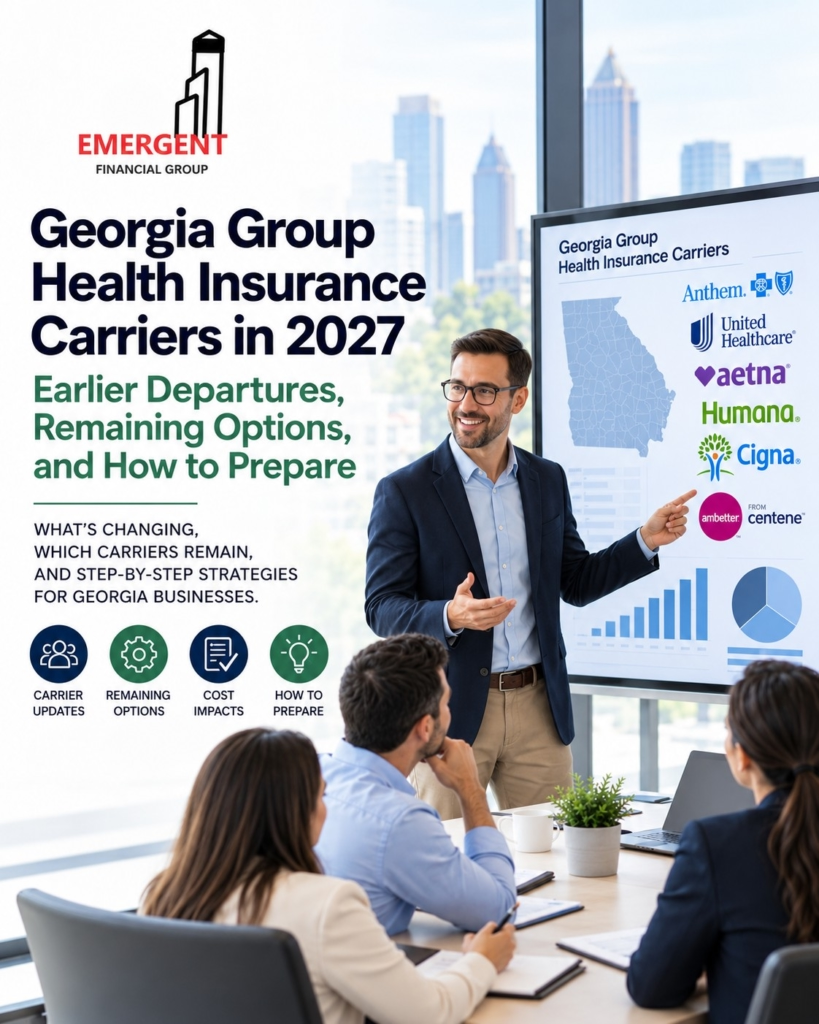
As of this review, the sources examined did not establish a new statewide employer-group medical carrier exit effective January 1, 2027. Employers should still verify their own renewal and termination notices because a particular product can end even when a carrier continues offering other employer services.
This article addresses employer-sponsored group medical coverage exclusively.
What Has Changed in Georgia’s Employer Group Market?
Cigna: A withdrawal from traditional fully insured small-group coverage
Cigna’s official small-group notice states that it stopped offering traditional fully insured small-group plans in Georgia as of November 1, 2025. It also states that existing customers receive coverage through the end of their active policies.
That is a product-specific withdrawal. It does not establish that Cigna has left every employer medical arrangement.
Cigna continues to describe insured and self-funded employer solutions. Its published funding guide lists level funding for 25–999 eligible employees, with availability dependent on group size, location, and product. Employers should obtain written confirmation of Georgia eligibility for their proposed effective date rather than assume that another Cigna product replaces their former plan.
Humana: A broader employer commercial medical exit
Humana’s February 2023 announcement covered fully insured, self-funded, and Federal Employee Health Benefit medical plans, along with associated wellness and rewards programs. The announced transition period was 18–24 months.
For 2027 planning, this is an earlier withdrawal that removed an employer medical option—not a new 2027 event. The announcement said other Humana health plan offerings were not materially affected, so employers should evaluate any separate benefits contracts on their own terms.

Understand the Funding Model Before Comparing Carriers
An insurance company’s name does not tell you who bears the claims risk.
| Arrangement | How it works | What employers should examine |
|---|---|---|
| Fully insured group coverage | The employer buys a policy; the insurer assumes covered claims risk under that policy. | Premiums, benefits, network, participation requirements, and renewal terms. |
| Self-funded group coverage | The employer funds covered claims and generally hires an administrator to manage the plan. | Claims exposure, administration, compliance responsibilities, and stop-loss protection. |
| Level-funded group coverage | A self-funded arrangement combines claims funding, administration, and usually stop-loss premiums into preset monthly payments. | Maximum liability, settlement terms, surplus provisions, and what happens when the contract ends. |
Stop-loss insurance protects the employer or plan against specified claims exposure; it is not the employee’s medical insurance policy. A familiar network can also be used by more than one funding arrangement.
Cigna’s funding guide explains insured and self-funded structures. Its stop-loss overview explains individual and aggregate protection.
👍 Read: Level-Funded Group Health Insurance: A Comprehensive Guide for Small Businesses

Georgia Group Health Insurance 2027: Which Employer Coverage Options Remain?
The following is a planning shortlist, not a guarantee that every carrier will quote every Georgia employer. Group size, employee locations, service area, funding structure, and underwriting can affect eligibility.
For Georgia group health insurance 2027 planning, compare each carrier’s available products, provider networks, funding arrangements, and eligibility requirements.
| Carrier | Evidence and employer options | What to verify for 2027 |
|---|---|---|
| Anthem Blue Cross and Blue Shield | Maintains a Georgia small-business group health offering. | The specific 2027 product, network, benefits, and final quote for your group. |
| UnitedHealthcare | Its Georgia small-group rate-filing narrative explicitly addresses coverage effective January 1, 2027. | The issuing entity, plan design, provider network, and funding arrangement. |
| Kaiser Permanente | Publishes 2027 Georgia small-group summaries of benefits and coverage. | Service-area eligibility, care access, and the specific plan’s network rules. |
| Aetna | Offers Aetna Funding Advantage for small businesses, a self-funded employer option. | Georgia availability, group eligibility, underwriting, and 2027 contract terms. |
| Alliant Health Plans | Its employer page identifies SimpleCare large-group and 4Corners level-funded options. | Which product fits your employer size and locations, and whether it is available for your 2027 effective date. |
| Cigna Healthcare | Continues to publish employer insured and self-funded solutions beyond the withdrawn Georgia traditional small-group product. | Written eligibility confirmation; do not treat broader employer services as proof that the discontinued product remains available. |
The evidence is strongest for specific 2027 products where dated filings or plan documents exist. A current employer webpage alone does not establish the complete 2027 product lineup.
👍Read: Georgia Group Health Insurance Renewal Checklist: 15 Essential Tips
We’re employee benefits-focused
so you can focus on growing your business.
We deliver customized employee benefits strategies that perfectly align your financial goals with our expertise for impressive results.
✓ Efficient and profitable benefit plans
✓ 1,000+ successful businesses
Small employers should also verify SHOP eligibility
The Small Business Health Options Program (SHOP) is a route to qualifying small-employer group coverage. It is not a separate funding model.
Georgia’s SHOP guidance identifies Kaiser Permanente as its only SHOP insurer for 2026. Employers considering 2027 should verify the updated SHOP lineup and qualifying plan before relying on a tax credit.
👍 Read: Georgia SHOP Health Insurance: When Is the Small Business Tax Credit Worth It?

How Earlier Departures May Affect Business Owners and Employees
Fewer options within a particular category
A withdrawal can reduce the number of comparable quotes available within the affected product category. That can limit an employer’s ability to preserve the same funding model, network, and benefit design while changing carriers.
However, the available evidence does not quantify how much these earlier withdrawals changed Georgia’s 2027 premiums. It would be misleading to attribute a particular renewal increase to carrier departures without supporting actuarial evidence.
Healthcare costs still drive renewal pressure
UnitedHealthcare’s 2027 Georgia small-group filing identifies higher medical prices, increased service use, and more expensive technology among the factors behind its requested rate action. It also explains that age, location, and plan selection can affect renewal premiums.
That means an employer needs its actual quote. Neither a general market headline nor a carrier-wide filing average establishes what a particular company will pay.
👍 Read: Why Did My Company’s Health Insurance Premium Increase in 2027?

Employees may experience changes in access and spending
When an employer changes plans, employees should check whether their doctors, hospitals, and medications remain covered under the exact replacement product.
The U.S. Department of Labor’s Summary of Benefits and Coverage resources provide a standardized comparison framework and glossary:
- Deductible: The amount an employee may owe for covered care before the plan begins paying for applicable services.
- Copayment: A fixed amount paid for a covered service.
- Coinsurance: The employee’s percentage share of a covered service’s allowed cost.
- Out-of-pocket limit: The maximum applicable cost sharing for covered services under the plan’s rules; premiums generally do not count toward it.
A lower premium should therefore be evaluated alongside employee cost sharing and care access.
What Do These Changes Tell Us About Carrier Business Models?
Humana framed its departure as a strategic decision: employer commercial medical coverage no longer supported its long-term plans. It said the exit would let it focus resources on government-funded and specialty businesses and integrated care capabilities.
Cigna’s small-group notice does not explain the financial rationale for its Georgia withdrawal. Its broader employer offerings demonstrate continued participation in other funding structures, but they do not prove that profitability caused the withdrawal.
The practical inference is that carriers can narrow one product line while retaining others. Employers must assess the exact contract—not assume that a carrier is either entirely available or entirely absent.

Georgia Group Health Insurance 2027: Eight Ways Business Owners Can Prepare
- Begin the review 90–120 days before renewal. This is a practical planning recommendation. Request the renewal, any discontinuation notice, current benefit documents, and a complete employee census.
- Ask precisely what is ending. Confirm whether the change affects a product, network, funding arrangement, or the entire medical relationship. Obtain the last coverage date and replacement enrollment deadlines in writing.
- Request comparable quotes. Hold benefits and employer contributions as consistent as possible so differences in cost and coverage are visible.
- Compare annual dollars. Calculate employer contributions and employee payroll deductions. For example, an employer contribution rising from $6,000 to $6,600 monthly adds $7,200 annually. This is an illustration, not a market forecast.
- Evaluate level funding carefully. Ask for maximum employer liability, stop-loss terms, exclusions, surplus conditions, renewal treatment, and responsibility for claims processed after termination. A fixed monthly payment does not answer every risk question.
- Protect ongoing care. Invite employees to raise provider or medication concerns privately with the advisor or carrier. Request written guidance about transition-of-care procedures and prior authorizations.
- Explain employee costs before enrollment closes. Show paycheck deductions, deductibles, copays, and coverage differences in plain language. Provide the replacement Summary of Benefits and Coverage.
- Confirm implementation before ending existing coverage. Verify the new effective date, enrollment acceptance, payment requirements, payroll updates, and member access. Coordinate the transition to avoid a coverage gap.
👍 Read: 2027 Georgia Group Health Insurance Renewal Stress Test

👍 Read: Strategic Employee Benefits Budgeting Guide
Employees reviewing Georgia group health insurance 2027 options should compare payroll deductions, prescription coverage, and access to their preferred doctors.
What Employees Should Do Before a Plan Change
Employees should request the new plan documents and:
- Confirm doctors and hospitals using the exact product and network name.
- Check prescription coverage, tiers, specialty-pharmacy rules, and authorization requirements.
- Ask whether existing authorizations must be submitted again.
- Confirm how deductible and out-of-pocket accumulations will be handled, particularly for a midyear change.
- Compare dependent coverage and payroll deductions.
- Verify enrollment and member identification before the effective date.
Do not assume credits or authorizations transfer automatically. Ask the new plan for written confirmation.
👍 Read: What Are Employee Benefits? A Complete Guide for Businesses

Plan Your 2027 Benefits Review
A Georgia group health insurance 2027 review can help your business compare employer costs, employee needs, and available coverage before renewal.
Georgia employers still have meaningful group medical options to investigate. Earlier withdrawals make a careful comparison more valuable, especially when the replacement involves a different funding arrangement.
Emergent Financial Group can help business owners review employer costs, employee spending, provider access, and available group coverage.
Need help getting started? Explore how Emergent Financial Group partners with Business Owners and Decision Makers to bring you flexible, tax-efficient benefits tailored to your workforce.
Please don’t hesitate to contact us here: connect@emergentfingrp.com.
Frequently Asked Questions
Are these newly announced 2027 carrier departures?
The confirmed withdrawals discussed above began earlier: Cigna’s Georgia traditional fully insured small-group withdrawal began November 1, 2025, and Humana announced its broader employer commercial medical exit in February 2023. These changes affect 2027 planning but should not be described as new 2027 departures.
Can an employer still consider Cigna for other group arrangements?
Potentially. The withdrawal concerns a specific fully insured small-group product. Other employer arrangements require confirmation of eligibility, location, funding structure, and effective date. See Cigna’s funding solutions guide.
Does changing carriers mean employees must change doctors?
It depends on the replacement plan’s exact network. Employees should verify their doctors, hospitals, and prescriptions before enrollment, even when the new plan uses a familiar carrier name.
Is level funding the same as fully insured coverage?
No. Level funding is a self-funded arrangement with preset monthly payments and typically stop-loss protection. Employers should review maximum liability, settlement provisions, and termination terms. Read EFG’s level-funded group health insurance guide.
When should employers begin their Georgia group health insurance 2027 renewal review?
A practical target is 90–120 days before renewal. This allows time to compare proposals, verify employee care access, explain changes, and coordinate enrollment.
Carrier products, approvals, networks, and eligibility can change. Confirm the final 2027 proposal and policy documents for your employer before enrollment.
This material is provided for educational purposes and is not intended as individualized tax, legal, ERISA, or investment advice. Retirement-plan contribution limits and rules can change. Business owners should coordinate plan design with qualified tax, legal, retirement-plan, and financial professionals.
"Helping Businesses Build Better Benefits. Helping Employees Build Better Retirements. RIA in Buckhead. Benefit Planning. Wealth Management. Wills. Trusts. Estate Planning."