Before You Accept Your 2027 Group Health Insurance Renewal: A Georgia Small-Business Renewal Stress Test

What Georgia Employers—and Their Employees—Should Compare Before Renewing Group Health Insurance
Every year, thousands of Georgia small-business owners receive a familiar email or renewal packet from their health insurance company.
Your group health insurance plan is renewing.
The premium has changed.
The employee rates have changed.
Sometimes the deductible, copays, prescription coverage, or provider network have changed too.
And suddenly the business has only a few weeks to decide:
Do we renew—or is there a better option?
For many employers, that is the wrong time to begin asking the question.
A group health insurance renewal should not simply be treated as a bill that needs to be accepted, negotiated, or replaced.
It should be treated as an opportunity to conduct a Group Health Insurance Renewal Stress Test.
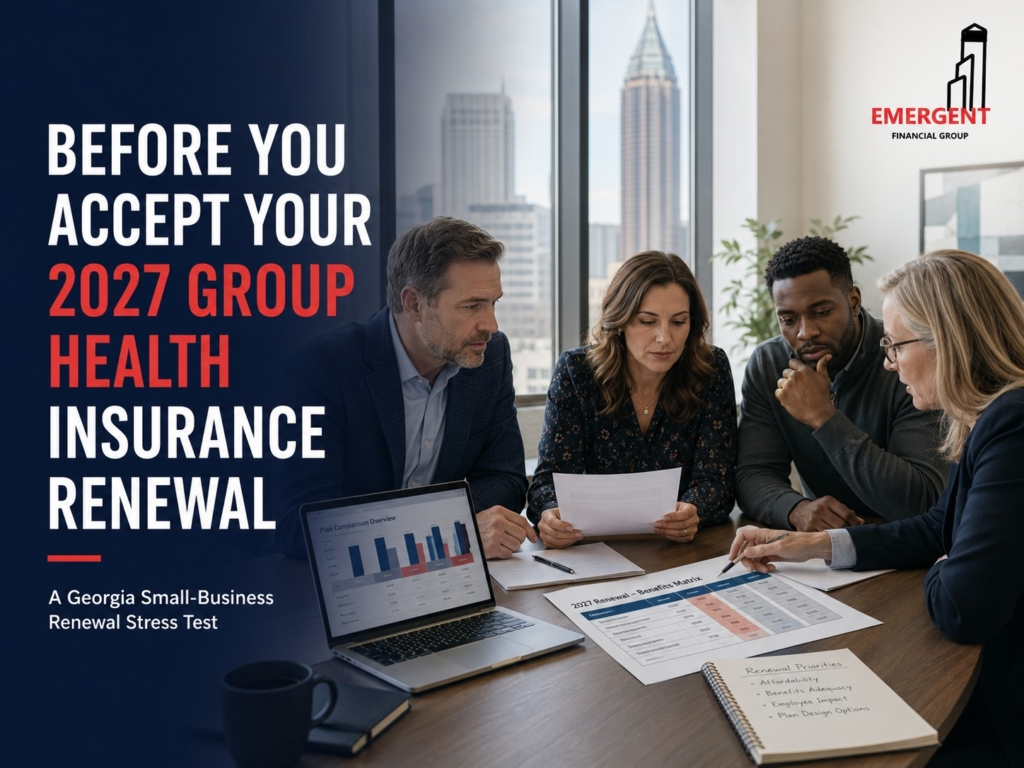
For Georgia small businesses, that means comparing the existing group plan against the realistic alternatives available to the company before determining what should happen for 2027.
Depending on the employer, those alternatives may include:
- Renewing the existing group health plan
- Moving to another traditional small-group carrier
- Changing plan design
- Adjusting employer and employee contributions
- Evaluating level-funded health insurance
- Evaluating an Individual Coverage HRA, or ICHRA
- Considering Georgia SHOP coverage
- Considering QSEHRA when appropriate
- Coordinating medical coverage with dental, vision, disability, life, accident, critical illness, and other benefits
The objective shouldn’t simply be to find a lower premium.
It should be to determine which benefits strategy produces the most appropriate balance of:
Employer cost
Employee cost
Provider access
Benefits
Predictability
Compliance
Recruiting and retention value
and
Long-term sustainability
If your company is approaching a 2027 renewal, you can request a Group Health Insurance Review from Emergent Financial Group or email connect@emergentfingrp.com.
Why 2027 Group Health Renewals Deserve More Attention
Healthcare costs continue to place pressure on employers and employees nationally.
According to Mercer’s National Survey of Employer-Sponsored Health Plans, average employer-sponsored health benefit cost reached $17,496 per employee in 2025, an increase of 6%.
Mercer projected total employer health-benefit cost to rise another 6.7% in 2026, pushing average cost above $18,500 per employee.
Those are national figures and should not be interpreted as a forecast of what a particular Georgia small group’s renewal will be.
Your actual renewal could be higher, lower, or relatively flat.
But the broader trend is important.
Healthcare remains a significant operating expense, and employers are increasingly looking for ways to control costs.
Mercer’s 2027 Health and Benefit Strategies research also found that many employers expect to make changes to deductibles, copays, and other plan features that could increase employees’ out-of-pocket costs.
For a small business, that creates two simultaneous pressures:
The employer needs benefits it can afford.
And:
Employees need healthcare they can afford to actually use.
A renewal strategy should address both.
What Is a Group Health Insurance Renewal Stress Test?
A renewal stress test asks a simple question:
If we were designing our employee health benefits from scratch today, would we choose the same plan and funding strategy we currently have?
That is very different from asking:
“Is this renewal increase acceptable?”
The renewal percentage is only one piece of the analysis.
A comprehensive review should examine at least five alternatives.
Option 1: Renew the current plan
Sometimes staying is the right answer.
Option 2: Quote competing traditional group plans
Another carrier or plan design may improve the economics.
Option 3: Evaluate level funding
Some groups may benefit from examining a different funding structure.
Option 4: Evaluate ICHRA
The employer may prefer a defined-contribution approach in which eligible employees select individual coverage.
Option 5: Evaluate SHOP
Certain small employers may find SHOP especially worth investigating when the federal Small Business Health Care Tax Credit could apply.
The purpose isn’t to force a company toward one of those options.
The purpose is to compare them before making the decision.
Step 1: Determine What It Actually Costs to Stay
Start with the existing plan.
Do not look only at the percentage renewal increase.
Calculate the employer’s actual annual cost.
For example:
If the employer currently contributes:
$6,000 per month
the company’s annual health insurance contribution is:
$72,000
If the renewal changes that contribution to:
$6,600 per month
the new annual cost is:
$79,200
The actual annual increase is:
$7,200
That number is more useful to a business owner than simply saying:
“The renewal went up 10%.”
Now determine what employees will pay.
If the employer keeps its contribution strategy unchanged, how much more will come out of employees’ paychecks?
This is where an employer-cost problem can quickly become an employee-retention problem.
Step 2: Look Beyond the Premium
A cheaper health plan isn’t necessarily a better health plan.
When reviewing a renewal, compare changes to:
- Deductibles
- Copays
- Coinsurance
- Maximum out-of-pocket limits
- Prescription benefits
- Specialist costs
- Emergency-room costs
- Hospital benefits
- Provider networks
- Dependent coverage
- HSA eligibility
- Employee payroll deductions
Employees often experience a health plan through these features—not through the employer’s total premium.
A company could technically reduce its premium while leaving employees with significantly greater financial exposure.
That isn’t necessarily a savings.
It may simply be a transfer of cost from the company to the workforce.
What Employees Should Look for in a 2027 Renewal
If you’re an employee reading this because your employer is changing health insurance, don’t focus exclusively on the name of the insurance company.
Ask:
Is my doctor still in network?
Networks can differ even between plans offered by the same insurance company.
Is my preferred hospital in network?
This can be especially important for employees receiving ongoing treatment.
Are my prescriptions covered?
Review the new plan’s formulary and the applicable tier.
What is my paycheck deduction?
Compare the employee contribution for the coverage tier you actually need.
What is my deductible?
Then determine whether it applies to prescription drugs, office visits, hospital care, or other services.
What is my maximum out-of-pocket exposure?
This is particularly important when comparing lower-premium plans.
What will family coverage cost?
The least expensive employee-only option isn’t necessarily the least expensive option for a household.
Is an HSA available?
Depending on the plan, an HSA can become an important part of an employee’s healthcare and long-term financial strategy.
For additional national context about employer-sponsored health coverage, employees and employers can review the widely cited KFF Employer Health Benefits Survey.

Step 3: Quote the Traditional Small-Group Market
Receiving a renewal from your current insurance company does not mean you have to accept it without comparison.
A small-business benefits review can examine other available group plans.
That comparison should include:
Monthly premium
Employer contribution
Employee contribution
Network
Plan design
Deductible
Out-of-pocket maximum
Prescription coverage
and
Dependent cost
The lowest premium may not win.
A slightly more expensive plan could have a materially stronger network or significantly lower employee out-of-pocket exposure.
Conversely, an alternative carrier could sometimes offer a structure that better matches the company’s workforce.
If your benefits are already becoming difficult to afford, read:
👍Read: Has Your Employee Benefit Plan Become Unaffordable?
Step 4: Determine Whether Level Funding Deserves a Quote
Traditional fully insured group health insurance isn’t the only group funding structure available to some employers.
A level-funded health plan generally combines elements of self-funding with stop-loss insurance and predictable monthly funding.
The employer typically pays a level monthly amount composed of several components, which may include:
- Expected claims funding
- Administrative expenses
- Stop-loss insurance
- Other plan costs
Level funding can sometimes deserve consideration for employers seeking alternatives to fully insured coverage.
It is not automatically cheaper.
And it isn’t appropriate for every workforce.
The employer should understand:
Potential savings
Claims risk
Stop-loss protection
Contract terms
Renewal methodology
Network
Plan design
and
Whether any surplus or refund mechanism exists
before making a decision.
For a more complete explanation:
👍Read: Level-Funded Group Health Insurance: A Comprehensive Guide for Small Businesses
Step 5: Stress-Test the Renewal Against ICHRA
For some Georgia employers, the most important alternative may not be another group health plan at all.
It may be an Individual Coverage Health Reimbursement Arrangement, commonly called an ICHRA.
Georgia Access for Business specifically supports ICHRA as one of the health-benefit models available for Georgia employers.

Strategically-Crafted Benefit Plans
Through an ICHRA, an employer establishes a defined reimbursement amount for eligible employees rather than purchasing one traditional group health plan for everyone.
Employees can then use the arrangement with qualifying individual health insurance, subject to the applicable ICHRA rules.
The federal government provides additional background through its CMS guidance on Individual Coverage HRAs.
👍 Read: Why Did My Company’s Health Insurance Premium Increase in 2027?
Why ICHRA Can Change the Renewal Conversation
Under traditional group health insurance, an employer can be heavily influenced by the pricing and structure of the group plan.
ICHRA changes the contribution discussion.
Instead of asking:
“What percentage of this insurance premium should we pay?”
the employer can ask:
“How much are we prepared to contribute toward employee health benefits?”
That difference can make budgeting more predictable.
But ICHRA isn’t simply a cost-cutting mechanism.
A proper comparison needs to determine what happens to employees.
That means modeling:
- Employee ages
- Residential ZIP codes
- Individual-market premiums
- Employer reimbursement
- Employee net premium
- Provider networks
- Prescription coverage
- Family needs
- ACA affordability where applicable
Georgia Access itself explains that its business platform is designed to help employers compare ICHRA and SHOP with off-exchange commercial group plans.
You can review the state’s information at Georgia Access for Business.
For EFG’s detailed explanation, read:
👍Read: ICHRA vs. QSEHRA vs. SHOP: Which Health Benefits Strategy Is Best for Georgia Small Businesses?
Don’t Just Ask Whether ICHRA Saves the Employer Money
A credible ICHRA review should answer five questions.
1. What will the employer spend?
Determine the annual defined contribution.
2. What will employees spend?
Calculate individual employee premium responsibilities after the employer benefit.
3. What plans will employees actually be able to choose?
Review the individual-market choices available where each employee lives.
4. What happens to doctors and hospitals?
Network analysis is essential.
5. What happens to prescriptions?
An employee with an expensive medication may evaluate the market very differently from an employee who rarely uses healthcare.
This is why simply saying:
“ICHRA saves 15%”
or
“Group health insurance is better”
isn’t enough.
The answer needs to come from the workforce data.
Step 6: Determine Whether Georgia SHOP Changes the Economics
Georgia employers with up to 50 full-time equivalent employees can potentially qualify for SHOP coverage.
According to Georgia Access’s SHOP guidance, qualifying employers generally must satisfy requirements including offering coverage to eligible full-time employees and meeting the applicable participation standard.
For Plan Year 2026, Georgia Access currently states that Kaiser Permanente is the only insurer offering Georgia Access SHOP plans, while other insurers offer off-exchange small-group coverage.
So why include SHOP in a renewal stress test?
The Small Business Health Care Tax Credit.
Certain qualifying small employers with fewer than 25 FTEs may be eligible for the federal tax credit.
For those companies, the appropriate analysis isn’t simply:
SHOP premium vs. traditional-group premium.
It is:
SHOP’s potential net employer cost after considering the possible tax credit vs. the alternatives.
Employers should coordinate actual tax-credit eligibility and calculations with their CPA or qualified tax professional.
For more information:
👍Read: Georgia Access — Small Business Health Options Program
and
👍Read: HealthCare.gov — Small Business Health Care Tax Credit
Step 7: Very Small Employers Should Consider QSEHRA Too
Businesses with only a handful of employees may have another possible strategy.
The Qualified Small Employer Health Reimbursement Arrangement, or QSEHRA, can allow an eligible small employer that does not offer a group health plan to reimburse employees for qualifying healthcare expenses within federal limits.
QSEHRA works differently from ICHRA.
Among the distinctions:
QSEHRA has federal annual reimbursement limits.
ICHRA does not have the same federal dollar cap.
ICHRA permits certain employee-class structures.
QSEHRA is generally designed for eligible employers with fewer than 50 full-time employees that don’t offer group coverage.
The correct choice depends on the employer’s size, objectives, workforce, contribution budget, and need for flexibility.
For a side-by-side discussion:
👍Read: ICHRA vs. QSEHRA vs. SHOP for Georgia Small Businesses
The Most Important Number May Be the Employer Contribution
Businesses often become so focused on the insurance premium that they overlook another powerful lever:
Contribution strategy.
Suppose the employer pays 75% of employee-only coverage today.
Is 75% still the right contribution?
Maybe.
But that should be evaluated rather than automatically carried forward every year.
An employer may be able to establish a more sustainable strategy using:
- A fixed percentage
- A fixed-dollar contribution
- Contribution tiers
- Defined-contribution reimbursement through ICHRA
- Different plan choices
- An employer-funded HSA contribution where appropriate
The contribution structure affects both:
The company’s budget
and
Whether employees perceive the health plan as affordable.
That makes contribution design part of the benefits strategy—not merely an accounting decision.
A Hypothetical Georgia Renewal Stress Test
Consider a Georgia professional-services firm with 12 employees.
Its current employer health insurance contribution is:
$9,000 per month
or:
$108,000 annually.
The renewal would increase the company’s contribution requirement to:
$10,000 per month
or:
$120,000 annually.
The company could simply renew.
Its additional annual employer cost would be:
$12,000.
But instead, the company performs a renewal stress test.
Current Plan
Annual employer cost: $120,000
Employee network: Strong
Employee payroll deductions: Increasing
Alternative Traditional Group Plan
Annual employer cost: $113,000
Employee network: Different
Plan design: Comparable
Level-Funded Alternative
Projected annual employer funding: $105,000
Risk structure: Different
Additional analysis required: Yes
ICHRA
Employer-defined annual contribution: $96,000
Employee individual-market choices: Vary by employee
Network analysis required: Yes
SHOP
Employer cost: To be quoted
Tax-credit eligibility: Must be evaluated
Network: Must be evaluated
None of these numbers tells the company which strategy to choose.
That’s the point.
The stress test turns one renewal into multiple strategic alternatives.
This example is hypothetical and does not represent actual insurance premiums, savings, quotes, or tax-credit eligibility.

The Cheapest Employer Option Isn’t Necessarily the Best Option
Suppose ICHRA lowers employer spending by $20,000 annually.
That sounds compelling.
But then the analysis discovers that several employees would face significantly higher premiums or lose preferred network access.
The employer may decide the savings aren’t worth the disruption.
Alternatively, suppose another group carrier costs $8,000 less but has a substantially narrower network.
Again, the employer needs to determine whether the savings justify the employee impact.
Or suppose SHOP costs slightly more before taxes but the employer qualifies for a meaningful Small Business Health Care Tax Credit.
That could change the result yet again.
This is why the proper objective is not:
Find the cheapest plan.
It is:
Find the strongest overall benefits strategy for the company and its employees.
Why Employees Should Be Part of the Analysis
Employees don’t need to choose the company’s benefits strategy.
But employers should understand how that strategy affects them.
Before changing health plans, it may be useful to identify:
Which hospital systems employees use
Whether employees have ongoing specialist relationships
Whether expensive prescriptions are common concerns
How many employees cover dependents
Whether employees value lower payroll deductions or lower deductibles more
Whether HSA compatibility matters
An employer doesn’t necessarily need individual medical information to perform a thoughtful benefits review.
What it needs is an understanding of the workforce’s broad priorities.
Rising Deductibles Matter to Employees
Premium isn’t the only financial pressure employees face.
The KFF 2025 Employer Health Benefits Survey found that among workers at smaller firms in its survey, 53% of covered workers were enrolled in plans with a general annual deductible of $2,000 or more for single coverage.
That is a national statistic and doesn’t describe every Georgia small-group plan.
But it illustrates an important point:
Employees increasingly experience healthcare costs both through:
Payroll deductions
and
Out-of-pocket expenses when they use healthcare.
A renewal strategy that reduces premium by dramatically increasing the deductible may solve one affordability problem while creating another.
Provider Networks Need Their Own Stress Test
For many employees, the most important question is not:
“Which carrier do we have?”
It is:
“Can I continue seeing my doctor?”
Provider networks can vary significantly.
An employee may want to check:
- Primary-care physician
- Pediatrician
- OB/GYN
- Behavioral-health provider
- Cardiologist
- Oncologist
- Other specialists
- Preferred hospital
- Urgent-care centers
- Pharmacies
This becomes especially important when comparing traditional group coverage with individual-market policies under ICHRA.
Employees shouldn’t assume a physician participates merely because the insurer’s name is familiar.
The specific plan and network matter.
Prescription Coverage Can Change the Winner
Prescription benefits deserve a separate review.
Before changing coverage, employees with ongoing medications should determine:
- Is the drug on the formulary?
- What tier is it?
- Is prior authorization required?
- Is step therapy required?
- Is there a separate prescription deductible?
- Is specialty-pharmacy fulfillment required?
- Are there quantity limits?
- What is the expected employee cost?
Prescription-drug spending has also become a major employer concern nationally.
Mercer’s employer research reported significant prescription-cost growth and points to expensive new treatments as one of the forces increasing health-benefit spending.
👍Read Mercer’s analysis of employer healthcare costs.

Small Employers Need a Different Benefits Strategy
A 5-person business shouldn’t automatically approach health insurance the same way as a company with 500 employees.
Very small businesses can face:
- Greater sensitivity to premium increases
- Participation challenges
- Limited administrative resources
- Significant age-related premium differences
- A greater effect from one employee joining or leaving
- Greater difficulty absorbing large annual increases
That’s why employers with especially small teams may want to read:
👍Read: Best Health Insurance Options for Small Businesses with 2–10 Employees in 2026
When Should You Begin a 2027 Renewal Review?
Ideally:
Before the renewal arrives.
You don’t necessarily need final renewal rates to begin gathering information.
The company can assemble:
- Current plan
- Current premiums
- Employer contribution
- Employee contribution
- Employee census
- ZIP codes
- Dates of birth or ages
- Coverage tiers
- Current SBC
- Important network concerns
Then, when the renewal becomes available, it can be inserted into an analysis that is already underway.
That is far better than receiving a renewal and beginning from zero with only a few weeks remaining.
What Employers Should Bring to a Group Health Insurance Review
A useful preliminary review generally starts with:
Current plan information
Carrier, plan name, network, deductible, copays, coinsurance, and maximum out-of-pocket limit.
Current rates
Employee-only and dependent tiers.
Employer contribution
How much does the business currently pay?
Employee contribution
How much comes from payroll?
Employee census
Ages or dates of birth and residential ZIP codes are especially important for comparing alternatives.
Coverage tiers
Employee only, employee + spouse, employee + child, and family coverage.
Renewal information
If it has already been released.
Provider considerations
Important hospital systems or network requirements.
With this information, the analysis can begin to move from theory to actual numbers.
The Five Numbers Every Business Owner Should See
Before deciding on the 2027 health-benefit strategy, a business owner should ideally understand:
1. Current annual employer cost
What are you spending today?
2. Renewal annual employer cost
What will you spend if nothing changes?
3. Alternative group cost
What does the broader small-group market offer?
4. Alternative funding or defined-contribution cost
What could level funding or ICHRA look like?
5. Employee cost under each strategy
What will your employees actually experience?
The last number is frequently overlooked.
It shouldn’t be.
The Employee Benefits Decision Matrix
A useful comparison could look like this:
| Consideration | Current Group | Alternative Group | Level-Funded | ICHRA | SHOP |
|---|---|---|---|---|---|
| Employer Cost | Compare | Compare | Compare | Compare | Compare |
| Employee Premium | Compare | Compare | Compare | Compare | Compare |
| Provider Network | Compare | Compare | Compare | Employee-specific | Compare |
| Deductible/OOP | Compare | Compare | Compare | Employee-specific | Compare |
| Budget Predictability | Evaluate | Evaluate | Evaluate | High defined-contribution control | Evaluate |
| Employee Choice | Limited to employer selection | Limited to employer selection | Limited to plan structure | Potentially broader | Plan-dependent |
| Tax-Credit Opportunity | Generally no SHOP credit | Generally no SHOP credit | Generally no SHOP credit | Different tax treatment | Possible for qualifying employers |
| Administrative Complexity | Evaluate | Evaluate | Evaluate | Evaluate | Evaluate |
No column automatically wins.
The objective is to determine which column best matches the company’s priorities.
The Question Employers Should Ask Employees
Rather than asking:
“Do you like our health insurance?”
ask more useful questions:
Is keeping your current doctor important to you?
Which hospital system is most important to your household?
Would you rather pay more per month for a lower deductible or less per month with greater out-of-pocket exposure?
Do you cover a spouse or children?
Is prescription coverage a major concern?
Would having more individual plan choices be valuable?
Those answers give the benefits advisor information that can actually affect the analysis.

Your Renewal Tells You What It Costs to Stay
This may be the most important idea for a small-business owner.
Your renewal does not necessarily tell you:
- Whether another carrier is better
- Whether another plan design is better
- Whether level funding is appropriate
- Whether an ICHRA would work
- Whether SHOP deserves consideration
- Whether your employer contribution is optimized
- Whether employees could receive stronger value elsewhere
It only tells you:
What it costs to stay with that renewal.
A benefits review answers the larger question:
Should you stay?
Get a 2027 Georgia Group Health Insurance Renewal Review
If your Georgia business is approaching a 2027 health insurance renewal, Emergent Financial Group can help compare your current plan with other available strategies.
Depending on the company and workforce, the review may include:
Current Group Health Insurance
Alternative Traditional Group Plans
Level-Funded Health Insurance
ICHRA
QSEHRA
Georgia SHOP
Employer Contribution Strategies
Employee Contributions
Provider Networks
Prescription Coverage
Dental and Vision
Life and Disability
Accident, Critical Illness, and Hospital Indemnity
Request Your Group Health Insurance Review
👍Complete the Emergent Financial Group Group Health Insurance Review Contact Form
Or email:
Do You Have to Leave Your Current Carrier?
No.
A benefits review doesn’t mean the existing plan is bad.
Sometimes the analysis shows that the current carrier and plan remain the strongest solution.
That is still valuable information.
If several alternatives are compared and the current plan wins, the employer can renew with significantly greater confidence.
The purpose of the review isn’t to create change.
It’s to determine whether change is justified.
What If Your Renewal Hasn’t Arrived Yet?
You can still start.
In fact, this can be the ideal time.
A preliminary analysis can review:
- Current benefits
- Workforce demographics
- Employer budget
- Contribution strategy
- Alternative benefit structures
- Employee priorities
Then the renewal can be added once it becomes available.
That creates time to think instead of forcing the employer into a rushed decision.
Read Emergent Financial Group’s recent:
👍Read Emergent Financial Group’s recent: GA Access & Small Business Benefits Monthly Update for Georgia Business Owners and Decision Makers
Five Warning Signs That Your Current Benefits Strategy Needs a Review
1. Premiums are increasing faster than your benefits budget
One difficult renewal may be manageable.
Repeated increases can signal that the underlying strategy deserves attention.
2. Employees are complaining about payroll deductions
The plan may be technically available but increasingly unaffordable.
3. Deductibles keep increasing
Lower premium doesn’t necessarily equal lower employee healthcare cost.
4. You haven’t competitively reviewed the plan recently
The market and available benefits strategies continue to evolve.
5. You’re making hiring or compensation decisions around health insurance costs
At that point, employee benefits have become a broader business-planning issue.
If several of these warning signs sound familiar:
👍Request a Group Health Insurance Review.
What Should Employees Do When Their Employer Changes Plans?
Employees should not wait until they need medical care to understand a new health plan.
During enrollment:
Download or request the Summary of Benefits and Coverage.
Search the provider directory.
Confirm important doctors directly when appropriate.
Review your prescriptions.
Calculate your payroll contribution.
Review the deductible.
Review the maximum out-of-pocket limit.
Compare dependent costs.
Understand whether an HSA is available.
Save your plan information before you need care.
Employees participating through an ICHRA should give the same attention to comparing individual plans rather than selecting solely based on the lowest monthly premium.
External Resources for Georgia Employers and Employees
For additional information, these high-authority resources can help:
Georgia’s official resource for employer options including ICHRA and SHOP.
👍Georgia Access — Small Business Enrollment Options
An overview of the health-benefit models available to Georgia small businesses.
Official Georgia SHOP eligibility and enrollment information.
👍KFF — Employer Health Benefits Survey
One of the country’s most widely cited sources of employer-sponsored health insurance data.
👍Mercer — National Survey of Employer-Sponsored Health Plans
National employer health-benefit cost and strategy research.
👍CMS — Individual Coverage HRA FAQs
Federal guidance concerning Individual Coverage HRAs.
👍HealthCare.gov — Small Business Health Care Tax Credit
Federal information about the SHOP-related tax credit for qualifying small employers.
The Bottom Line
A 2027 group health insurance renewal shouldn’t be viewed as a choice between:
Accept
or
Decline.
Georgia small businesses increasingly have more strategies to evaluate.
A proper renewal review asks:
What does it cost to renew?
What does another group carrier cost?
What would employees pay?
What happens to doctors and hospitals?
What happens to prescriptions?
Does level funding make sense?
Could ICHRA provide better cost control or employee choice?
Could SHOP and the federal Small Business Health Care Tax Credit improve the economics?
Is QSEHRA relevant for a very small employer?
How should the employer contribution be structured?
And ultimately:
Which strategy gives the company the strongest combination of sustainable employer cost and valuable employee coverage?
Your existing renewal tells you what it costs to stay.
A comprehensive benefits review helps determine whether staying is still the best decision.
Request Your 2027 Group Health Insurance Renewal Stress Test
If your company has already received its renewal—or wants to evaluate alternatives before it arrives:
👍Request a Group Health Insurance Review from Emergent Financial Group
Or email:
This article is provided for general educational purposes and should not be interpreted as individualized insurance, legal, tax, accounting, or investment advice. Health insurance premiums, carrier availability, networks, plan designs, eligibility rules, and tax provisions may change. Employers should evaluate current plan documents and rates and consult the appropriate licensed and tax professionals when making benefits decisions.
"Helping Businesses Build Better Benefits. Helping Employees Build Better Retirements. RIA in Buckhead. Benefit Planning. Wealth Management. Wills. Trusts. Estate Planning."