Roth Conversions for Individuals & Business Owners

Turning Tax Timing Into a Strategic Advantage
For many clients, the largest retirement asset they own is not their home.
It is their pre-tax retirement account.
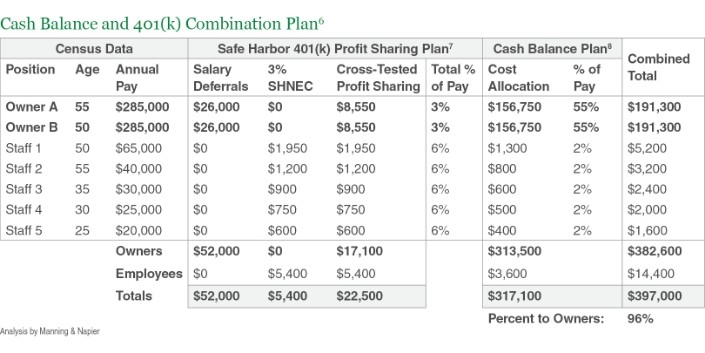
Traditional 401(k)s. SEP IRAs. Profit-sharing plans. Cash balance plans.
All powerful tools — but all taxable later.
A Roth conversion is how you change the future tax profile of those assets.
Done correctly, it is not a tax trick.
It is a tax timing strategy.
Let’s walk through what Roth conversions are, how they work, when they make sense, and how they integrate into a smart business-owner tax bucket strategy.
What Is a Roth Conversion?
A Roth conversion is the process of moving money from a:
- Traditional IRA
- Pre-tax 401(k)
- SEP IRA
- SIMPLE IRA (after 2-year rule)
- Profit-sharing plan
Into a Roth IRA or Roth 401(k).
What Happens When You Convert?
- The converted amount becomes taxable income this year.
- You pay ordinary income tax on the amount converted.
- Once inside the Roth, the money grows tax-free.
- Future withdrawals (if rules are met) are tax-free.
In simple terms:
You voluntarily pay tax now to eliminate tax later.
Why Would Someone Do That?
Because retirement tax risk is real.
If all your assets are pre-tax:
- Required Minimum Distributions (RMDs) start at age 73.
- Withdrawals increase taxable income.
- Medicare IRMAA premiums may rise.
- Social Security taxation may increase.
- Heirs must withdraw inherited IRAs within 10 years (and pay tax).
Roth conversions reduce those future pressure points.
The Three-Bucket Framework
Retirement income planning works best when assets are diversified across:
🔵 Pre-Tax
🟢 Roth (Tax-Free)
🟡 Taxable Brokerage
Roth conversions help rebalance the buckets.
Instead of being overweight in pre-tax assets, you gradually shift toward Roth over time.
This is called tax diversification.
We meticulously handle your finances
so you don’t have to worry.
We find unique financial planning opportunities
that combine your financial goals with our knowledge for notable success.
✓ accepting Accredited & unaccredited investors
✓ Over 1,000 regulation d investments to choose from
When Roth Conversions Are Often Appropriate
1️⃣ Temporary Low-Income Years
Examples:
- Early retirement (before Social Security)
- Business sale gap years
- Post-sale but before RMD age
- Slow income year in a cyclical business
If your tax bracket temporarily drops, you may convert at a lower rate than you would otherwise pay later.
2️⃣ Large Future RMD Projections
If projections show:
- Very large RMDs at 73+
- Income pushing you into higher brackets
- IRMAA exposure
Strategic annual conversions can smooth that future spike.

3️⃣ Estate Planning Goals
Heirs who inherit traditional IRAs must:
- Withdraw within 10 years
- Pay income tax on distributions
Roth IRAs still follow the 10-year rule, but withdrawals are tax-free.
For high-income children, Roth assets can be dramatically more efficient.
Case Study: Small Business Owner
Profile:
- 52-year-old construction business owner
- $450,000 annual income
- 8 employees
- Maxing 401(k) + Cash Balance
- Plans to sell at 62
Phase 1 (Ages 52–60): High Income
Strategy:
- Max pre-tax plans
- Reduce taxable income aggressively
- Build deduction engine
Roth conversions not ideal here due to high bracket.
Phase 2 (Age 62–67): Post-Business Sale
Income drops after exit.
No RMDs yet.
Social Security not started.
This is a conversion window.
Strategy:
- Convert $100k–$200k annually
- Stay within targeted bracket
- Reduce future RMD burden
- Build tax-free retirement income
Phase 3 (73+): RMD Years
Because conversions were done earlier:
- Smaller RMDs
- Lower IRMAA exposure
- More control over taxable income
- More flexibility in drawdown strategy
This is tax engineering across decades.
How Roth Conversions Help Individuals
For individuals (not business owners), Roth conversions can help:
✔ Early retirees
Bridge income years before Social Security.
✔ Medicare-age clients
Reduce future IRMAA exposure.
✔ High-net-worth households
Reduce future estate tax compression.
✔ Clients expecting higher future tax rates
If you believe your future tax rate will be higher than today’s, converting may make sense.
What People Are Trying to Accomplish
Roth conversions are not random.
They are typically used to:
- Smooth lifetime tax brackets
- Reduce future RMD spikes
- Control Medicare premiums
- Improve inheritance efficiency
- Increase tax-free income flexibility
- Hedge against future tax law changes
It is about control, not elimination.
Situations Where Roth Conversions May NOT Be Ideal
- You are in your highest lifetime bracket
- You need liquidity to pay conversion taxes
- You plan to move to a significantly lower-tax state later
- You have short life expectancy concerns
- You expect future tax rates to be much lower
Every situation is math-driven.
Employer & Plan Design Considerations
For small business owners, Roth strategy does not only happen through conversion.
It can also involve:

- Roth 401(k) option inside plan
- Mega Backdoor Roth
- After-tax contributions converted inside plan
- Coordinating Cash Balance + Roth layering
This allows:
- Pre-tax for deduction
- Roth for long-term flexibility
- Taxable for liquidity
How We Structure It
At Emergent Financial Group, we model:
- Current marginal rate
- Future RMD projections
- IRMAA thresholds
- Social Security timing
- Business exit timing
- Estate inheritance exposure
Then we determine:
- How much to convert
- Over how many years
- At what tax bracket target
- Coordinated with overall bucket strategy
This is not about converting everything.
It is about converting strategically.
The Bigger Picture
Pre-tax retirement accounts are powerful tools.
But unmanaged, they can create future tax compression.
Roth conversions:
- Transform taxable retirement assets into tax-free assets
- Improve flexibility
- Improve estate outcomes
- Reduce forced income later in life
For business owners especially, the years between:
Business exit → RMD age
May be the most valuable tax window of their lifetime.
Final Thought
The question is not:
“Should I convert?”
The better question is:
“How much should I convert, and when?”
Because retirement planning is not about maximizing contributions.
It is about engineering lifetime tax efficiency.
Need help getting started? Explore how Emergent Financial Group partners with Retirement Plan providers to bring you flexible, tax-smart options that fit your future.
Please don’t hesitate to contact us here.
"Helping Businesses Build Better Benefits. Helping Employees Build Better Retirements. RIA in Buckhead. Benefit Planning. Wealth Management. Wills. Trusts. Estate Planning."