Profit-Sharing 401(k) vs. SEP IRA: Which Is Right for Your Small Business?

Profit Sharing 401(k) vs SEP IRA—which retirement plan is right for your small business? Both plans can provide significant tax advantages and allow business owners to make substantial retirement contributions, but they differ considerably in employee contributions, employer costs, administrative requirements, contribution flexibility, and long-term planning opportunities.
The Best Retirement Plan Depends on the Situation
Choosing the right retirement plan can have a major impact on your business’s taxes, retirement savings, employee benefits, and long-term financial strategy.
Two popular options for small-business owners are a Profit-Sharing 401(k) and a SEP IRA (Simplified Employee Pension).
Both can provide significant tax advantages and allow employers to make discretionary retirement contributions. But they are not interchangeable.
A SEP IRA generally emphasizes simplicity, low administrative burden, and flexible annual employer contributions.
A Profit-Sharing 401(k), by contrast, can offer considerably more plan-design flexibility, employee contribution opportunities, allocation strategies, vesting options, and retirement-planning opportunities for owners and key employees.
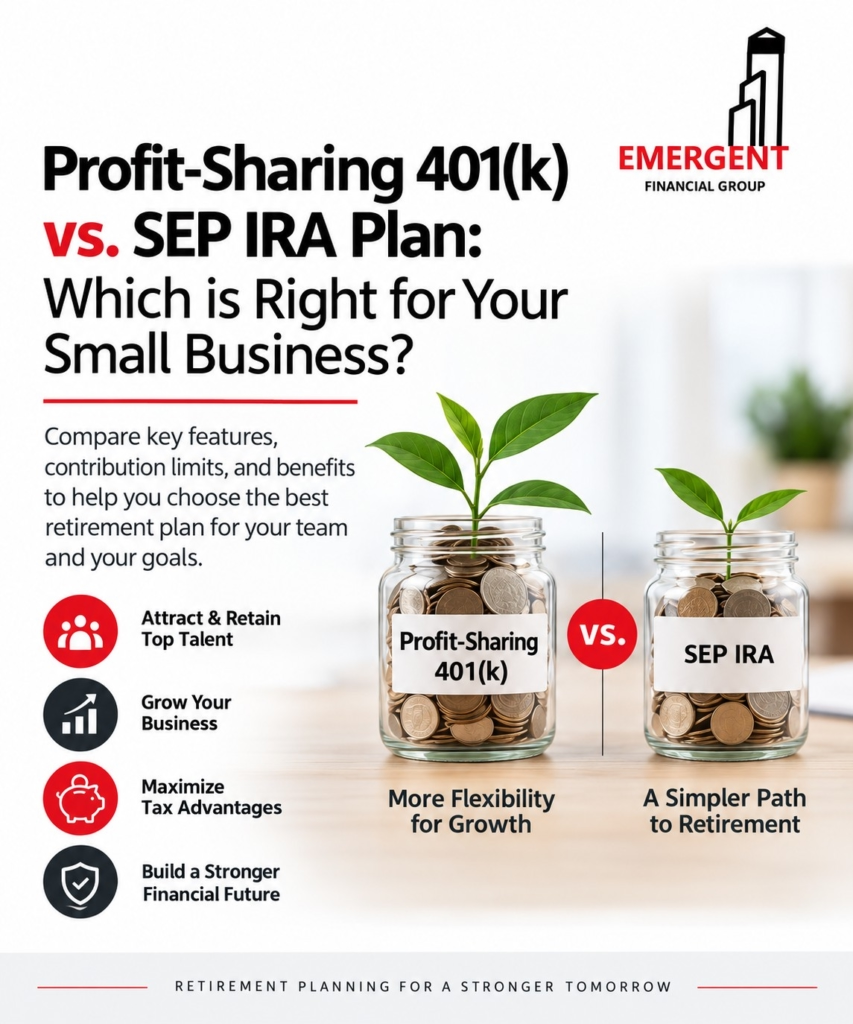
Profit-Sharing 401(k) vs. SEP IRA: Which Is Right for Your Small Business?
The right choice depends heavily on:
- Business profitability and cash flow
- Number of employees
- Employee ages and compensation
- Owner compensation and age
- Employee turnover
- Desired contribution levels
- Tax-reduction goals
- Whether employees should contribute from their own pay
- Administrative complexity the business is willing to accept
👍Read: Profit-Sharing Plans for Small Businesses: When They Are the Smartest 401(k) Strategy
What Is a Profit-Sharing 401(k)?
A Profit-Sharing 401(k) combines employee 401(k) salary deferrals with an employer profit-sharing contribution.
Despite the name, the employer does not necessarily need to have an accounting profit to make a profit-sharing contribution. The contribution is generally discretionary, subject to the plan document and applicable tax and nondiscrimination rules.
👍Discover: Emergent Financial Group Financial Tools
Key Features
Employee contributions are available.
Employees and owner-employees can generally make salary deferrals into the 401(k).
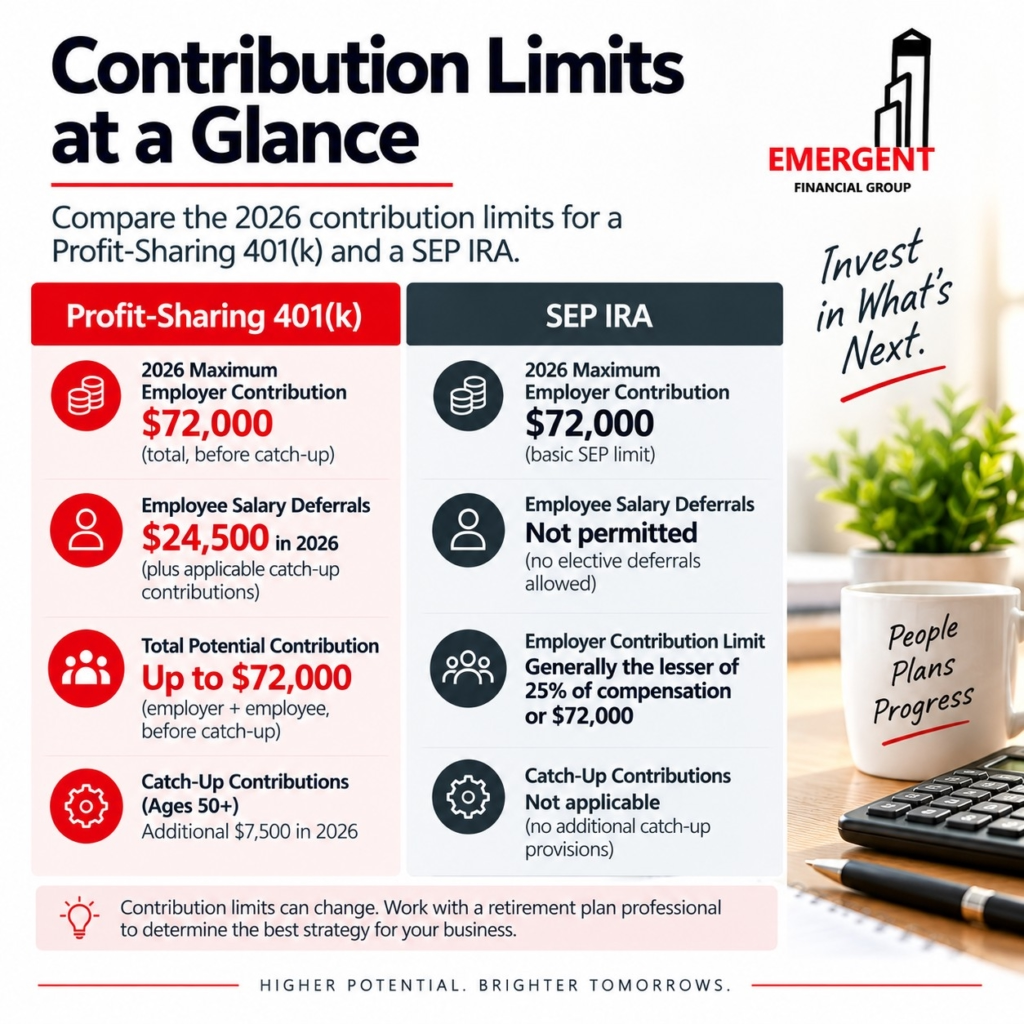
For 2026, the regular employee 401(k) elective-deferral limit is $24,500.
Participants age 50 or older can generally make an additional $8,000 catch-up contribution, while participants ages 60–63 may qualify for the higher $11,250 SECURE 2.0 catch-up limit for 2026.
Employer profit-sharing contributions can be discretionary.
The employer can determine annually whether to make a profit-sharing contribution, subject to the terms of the plan.
High overall contribution potential.
For 2026, total annual additions to a participant’s defined-contribution account generally cannot exceed the lesser of 100% of compensation or $72,000, excluding applicable catch-up contributions.
Flexible allocation methods may be available.
Depending on plan design and nondiscrimination testing, employers may use allocation approaches such as:
- Pro-rata
- Age-weighted
- New comparability/cross-tested allocations
- Permitted employee classifications
This can make a carefully designed profit-sharing plan particularly attractive when owners or key employees are older or more highly compensated than much of the workforce.
Vesting schedules may be available.
Profit-sharing contributions may generally use an appropriate vesting schedule, making the plan useful as an employee-retention tool.
Best For
Businesses seeking:
- High retirement contributions
- Employee salary deferrals
- Greater plan-design flexibility
- Potentially targeted employer allocations
- Employee-retention incentives
- Larger tax deductions during profitable years
- A retirement plan that can grow with the company
👍Learn more: SEP IRA Plans for Small Businesses: When They’re the Best Choice
What Is a SEP IRA?
A Simplified Employee Pension (SEP) is an employer-sponsored retirement arrangement under which an employer makes contributions to traditional IRA accounts established for eligible employees.
👍Learn more: Emergent Financial Group Knowledge Base
Unlike a 401(k), employees generally do not make salary-deferral contributions to a SEP.
Instead, contributions are funded by the employer.
Key Features
Employer-funded.
The employer makes SEP contributions. Employees generally do not make elective salary deferrals into the SEP.
Discretionary annual contributions.
A business does not necessarily have to contribute every year. This can make a SEP attractive to businesses with variable cash flow.
Simple administration.
SEP plans generally have substantially fewer administrative requirements than conventional qualified retirement plans.
No regular Form 5500 filing requirement for the employer.
This is one of the major administrative advantages compared with many qualified retirement plans.
High contribution potential.
For 2026, the maximum SEP contribution is generally limited to $72,000, subject to the applicable percentage-of-compensation and self-employed contribution rules.
Uniform contribution considerations.
A major limitation for businesses with employees is that SEP contributions generally must use a uniform percentage of compensation for eligible participants.
If an owner receives a 20% contribution, for example, eligible employees generally must receive the same contribution percentage.
Best For
SEP IRAs can be especially attractive for:
- Sole proprietors
- Independent contractors
- Consultants
- Owner-only businesses
- Family businesses with few eligible employees
- Businesses prioritizing low administrative costs
- Businesses wanting discretionary employer contributions without operating a full 401(k)
👍Check out: Retirement Plans for Small Business Articles Section
When a Profit-Sharing 401(k) May Be the Better Choice
Although a SEP IRA is simpler, there are circumstances where a Profit-Sharing 401(k) may provide significantly greater strategic value.
1. Financial Conditions
A Profit-Sharing 401(k) may be attractive when:
- The business has strong or growing profitability.
- The owner wants to maximize retirement savings.
- The owner wants to combine personal salary deferrals with employer contributions.
- The business wants flexibility over annual profit-sharing contributions.
- The owner wants greater tax-planning flexibility.
- The business can justify the additional administrative cost.
Example
Consider a profitable professional-services company.
The owner wants to save aggressively for retirement but does not necessarily want to fund the same percentage of compensation for every employee.
A properly designed Profit-Sharing 401(k) may allow the owner to combine:
Employee 401(k) deferral + employer contribution + potentially an age-50+ catch-up contribution
while using an allocation formula designed around the demographics of the workforce and applicable nondiscrimination requirements.
A SEP IRA may be simpler, but the requirement to provide eligible employees with the same contribution percentage can make a large owner contribution expensive.
👍Visit: the Retirement Plans for Small Businesses section of the EFG Knowledge Base
2. Employment Conditions
A Profit-Sharing 401(k) may become especially valuable when:
- Owners are older than employees.
- Owners are more highly compensated.
- The company has key employees it wants to retain.
- Employee turnover is meaningful.
- The business wants employees to save their own money.
- The employer wants a vesting schedule.
- The company wants to use employee classifications when permitted.
Example
Assume a medical practice has:
- Two owners in their late 50s
- Several younger professional employees
- Administrative staff
- Stable profitability
The owners want to accelerate retirement savings during their final working years.
We provide valuable benefit plans
that bring more success in business
With the appropriate plan design and testing, a new-comparability Profit-Sharing 401(k) may potentially allocate a larger percentage of the employer contribution to certain employee groups while still satisfying applicable nondiscrimination requirements.
A SEP IRA generally does not offer comparable allocation flexibility.
3. Incorporation & Ownership Conditions
Sole Proprietor With No Employees
A SEP IRA can be an excellent choice.
Why?
Because there are no employees for whom the owner must fund additional contributions, and administration is simple.
A Solo 401(k), however, should also be evaluated because the employee-deferral component can sometimes allow a self-employed owner to reach a desired contribution with less business income.
S Corporation
A Profit-Sharing 401(k) may become particularly attractive when:
- The owner receives sufficient W-2 compensation.
- The owner wants to make employee 401(k) deferrals.
- The company has non-owner employees.
- The owner wants more sophisticated allocation options.
SEP contributions for an S-corporation shareholder are generally based on the shareholder’s W-2 compensation rather than shareholder distributions.
This makes reasonable compensation and retirement-plan design interconnected planning decisions.
Partnership or LLC Taxed as a Partnership
Either arrangement may work.
The decision often depends on:
- Partner compensation
- Number of employees
- Employee demographics
- Contribution goals
- Desired allocation formula
- Administrative preferences
A sophisticated profit-sharing design can become particularly valuable when partners have different ages, compensation levels, or retirement objectives.
4. Tax-Reduction Conditions
Both plans can generate valuable business deductions, but the structure of those deductions can differ substantially.
A Profit-Sharing 401(k) may be preferable when the business owner wants to:
- Maximize current retirement contributions
- Combine employee deferrals and employer contributions
- Create larger contributions for selected employee classifications where permitted
- Coordinate retirement contributions with broader business tax planning
- Potentially add a Cash Balance Plan later
A SEP IRA may be preferable when the owner wants:
- Straightforward tax deductions
- Minimal administration
- No annual commitment
- A retirement plan that is easy to establish and maintain
When a SEP IRA May Be the Better Choice
More complexity is not always better.
For some businesses, the simplicity of the SEP IRA is its greatest advantage.
👍Learn more: SEP IRA Plans for Small Businesses-When They’re the Best Choice
SEP IRA May Be Better When:
1. You Have No Employees
An independent consultant earning substantial self-employment income may not need a complex qualified plan.
A SEP can provide meaningful tax-deferred retirement contributions with relatively little administration.
2. You Want Minimal Administrative Responsibility
A SEP generally does not require the same ongoing administration and annual government reporting associated with a conventional qualified retirement plan.
3. Your Business Income Fluctuates
SEP contributions are discretionary.
A business can potentially contribute substantially during a strong year and contribute less—or nothing—during a weak year.
4. You Have Very Few Employees
If the employer is comfortable providing the same contribution percentage to eligible employees, the simplicity of the SEP may outweigh the additional flexibility of a Profit-Sharing 401(k).
5. You Do Not Need Employee Salary Deferrals
If the primary objective is simply making employer-funded retirement contributions, the additional infrastructure of a 401(k) may not be necessary.

Why Choose a Profit-Sharing 401(k) Over a SEP IRA?
The biggest advantage isn’t necessarily the headline contribution limit.
It is flexibility.
A Profit-Sharing 401(k) can potentially provide:
👍Visit: Profit-Sharing Plans for Small Businesses: When They Are the Smartest 401(k) Strategy
Employee Salary Deferrals
Employees can contribute toward their own retirement rather than requiring the employer to fund the entire benefit.
Greater Owner Contribution Opportunities
Combining employee deferrals and employer contributions can make reaching a high retirement contribution easier.
Allocation Flexibility
Properly designed profit-sharing formulas may allow different employee groups to receive different contribution percentages, subject to nondiscrimination rules.
Vesting
Employer profit-sharing contributions can potentially be used as a retention incentive.
Roth 401(k) Contributions
A 401(k) can include a designated Roth feature, creating additional tax-diversification opportunities.
Plan Expansion
A business may eventually combine a 401(k)/profit-sharing structure with a Cash Balance Plan for substantially greater retirement and tax-planning opportunities.

Why Choose a SEP IRA Over a Profit-Sharing 401(k)?
The SEP IRA’s strongest advantage is simplicity.
It can offer:
- Easy setup
- Low administrative burden
- No regular employer Form 5500 filing
- Discretionary annual employer contributions
- Significant contribution potential
- Straightforward operation
For a self-employed individual or owner-only company, those advantages can be difficult to beat.
👍Related: U.S. Department of Labor — SEP Retirement Plans for Small Businesses
The problem often emerges when the business begins hiring employees.
At that point, providing every eligible employee the same contribution percentage can become expensive, and the employer may begin placing greater value on the flexibility available through a qualified retirement plan.
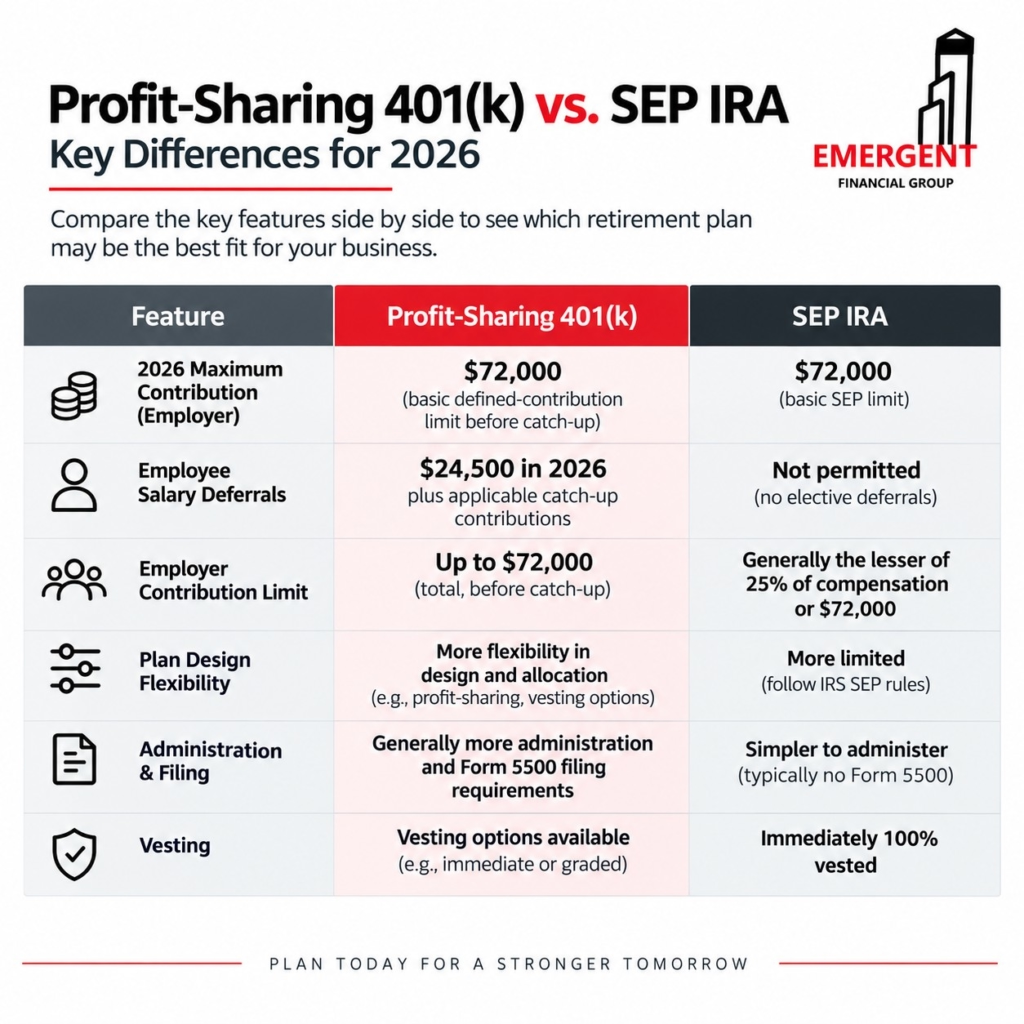
Quick Comparison Chart — Profit-Sharing 401(k) vs. SEP IRA
| Feature | Profit-Sharing 401(k) | SEP IRA |
|---|---|---|
| Employee Salary Deferrals | Yes | No |
| Employer Contributions | Discretionary profit-sharing | Discretionary |
| 2026 Employee Deferral | $24,500 | Not available |
| Age 50+ Catch-Up | Available in 401(k), if eligible | Not available as SEP contribution |
| 2026 Defined-Contribution/SEP Maximum | Generally $72,000 before applicable 401(k) catch-up | Generally $72,000, subject to SEP rules |
| Employer Allocation Flexibility | High | Generally uniform percentage |
| New Comparability | Potentially available | No |
| Vesting Schedule | Potentially available for profit-sharing contributions | Immediate |
| Roth Employee Contributions | Can be offered | No SEP Roth salary deferrals |
| Employee Contributions From Pay | Yes | No |
| Annual Administration | Higher | Low |
| Form 5500 | Generally required, subject to applicable rules/exceptions | Generally not required |
| Nondiscrimination Requirements | Yes | SEP uniformity rules |
| Best For | Growing businesses seeking flexibility and higher owner/employee savings | Self-employed and very small businesses prioritizing simplicity |
| Employee Retention Strategy | Strong | Limited |
| Ability to Add Cash Balance Plan | Excellent combination | May require broader plan redesign/coordination |
| Plan Design Flexibility | High | Low |
| Administrative Cost | Higher | Lower |
A Critical Difference Many Business Owners Miss
Suppose a business owner earns $300,000 and has five eligible employees.
The owner wants the business to make a substantial retirement contribution for the owner.
👍Article: Choosing a Retirement Solution for Your Small Business
With a SEP IRA, providing a high percentage of compensation to the owner generally means providing that same percentage of compensation to eligible employees.
That can become expensive.
A properly designed Profit-Sharing 401(k) may provide significantly greater flexibility through allocation formulas, employee classifications, salary deferrals, vesting, and plan design.
This is why the question should rarely be:
“Which plan has the higher maximum contribution?”
👍Related: Business Making Over Six Figures? How Cash Balance Plans Can Reduce Taxes Fast
A better question is:
“How much does the business need to contribute for employees in order for the owner to reach the desired retirement contribution?”
That calculation can completely change which plan is more attractive.
Profit-Sharing 401(k) vs. SEP IRA: Example
Consider an S corporation with:
- Owner age: 58
- Owner W-2 compensation: $250,000
- Five employees
- Employees primarily ages 25–40
- Strong annual profitability
- Owner wants to accelerate retirement savings
SEP IRA
The SEP offers simplicity.
But if the business uses a substantial contribution percentage for the owner, eligible employees generally must receive the same percentage of compensation.
👍Learn more: Safe Harbor 401(k) vs. Profit-Sharing Plan: Which Is Right for Your Small Business?
The resulting employee cost could make maximizing the owner’s contribution expensive.
Profit-Sharing 401(k)
The business may be able to combine:
- Owner 401(k) salary deferral
- Age-50+ catch-up contribution
- Employer profit-sharing contribution
- Employee salary deferrals
- An appropriate allocation methodology
- A vesting schedule for profit-sharing contributions
The plan requires greater administration, but the potential tax and retirement benefits may substantially outweigh those costs.
Potential Winner: Profit-Sharing 401(k)
A Different Example
Now consider an independent consultant:
- Age 42
- No employees
- $180,000 of self-employment income
- Wants a tax deduction
- Does not care about employee benefits
- Wants minimal paperwork and administration
The ability to create sophisticated employee classifications or vesting schedules provides little value because there are no employees.
A SEP IRA could provide a meaningful retirement contribution without requiring the owner to maintain a conventional qualified retirement plan.
Potential Winner: SEP IRA
However, a Solo 401(k) should also be modeled before making the final decision because employee salary deferrals can make a Solo 401(k) more contribution-efficient at certain income levels.
Which Plan Is Right for Your Business?
👍See: U.S. Department of Labor — Choosing a Retirement Plan for Your Small Business
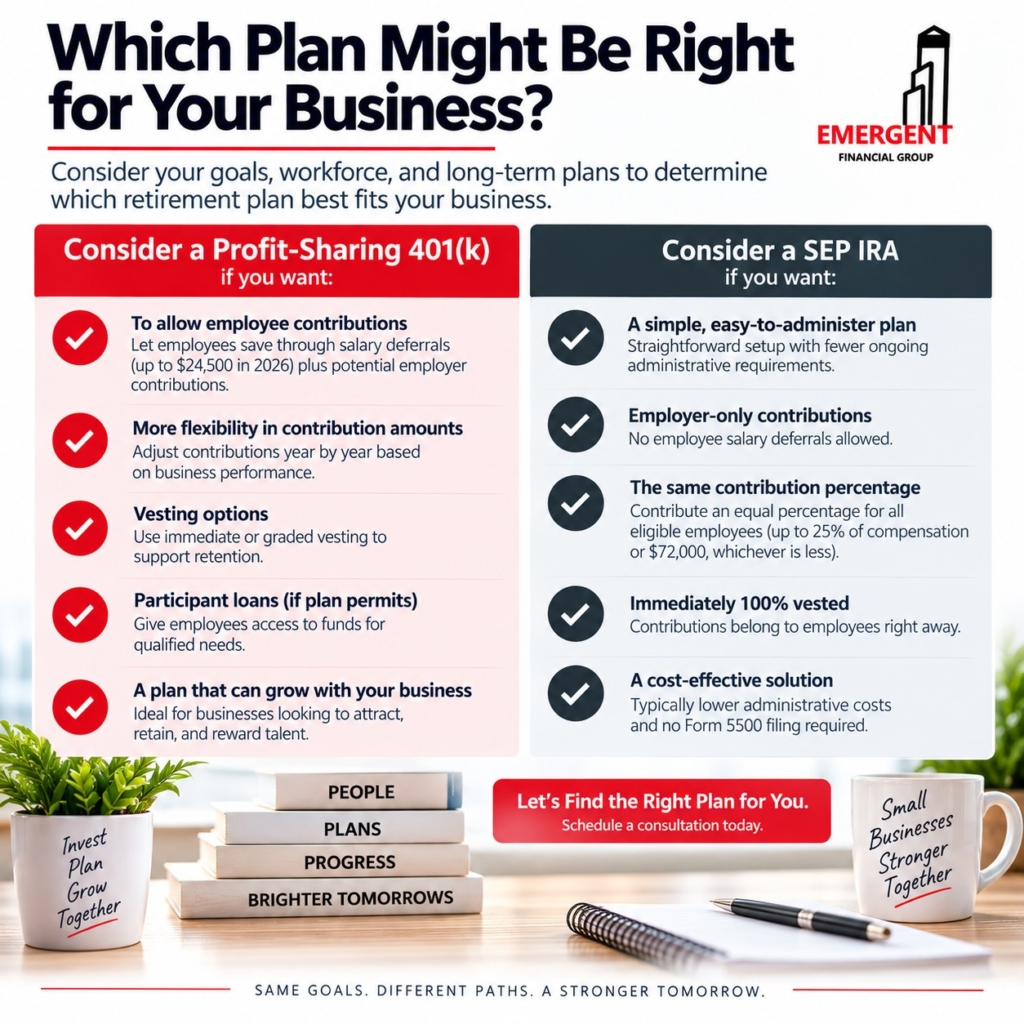
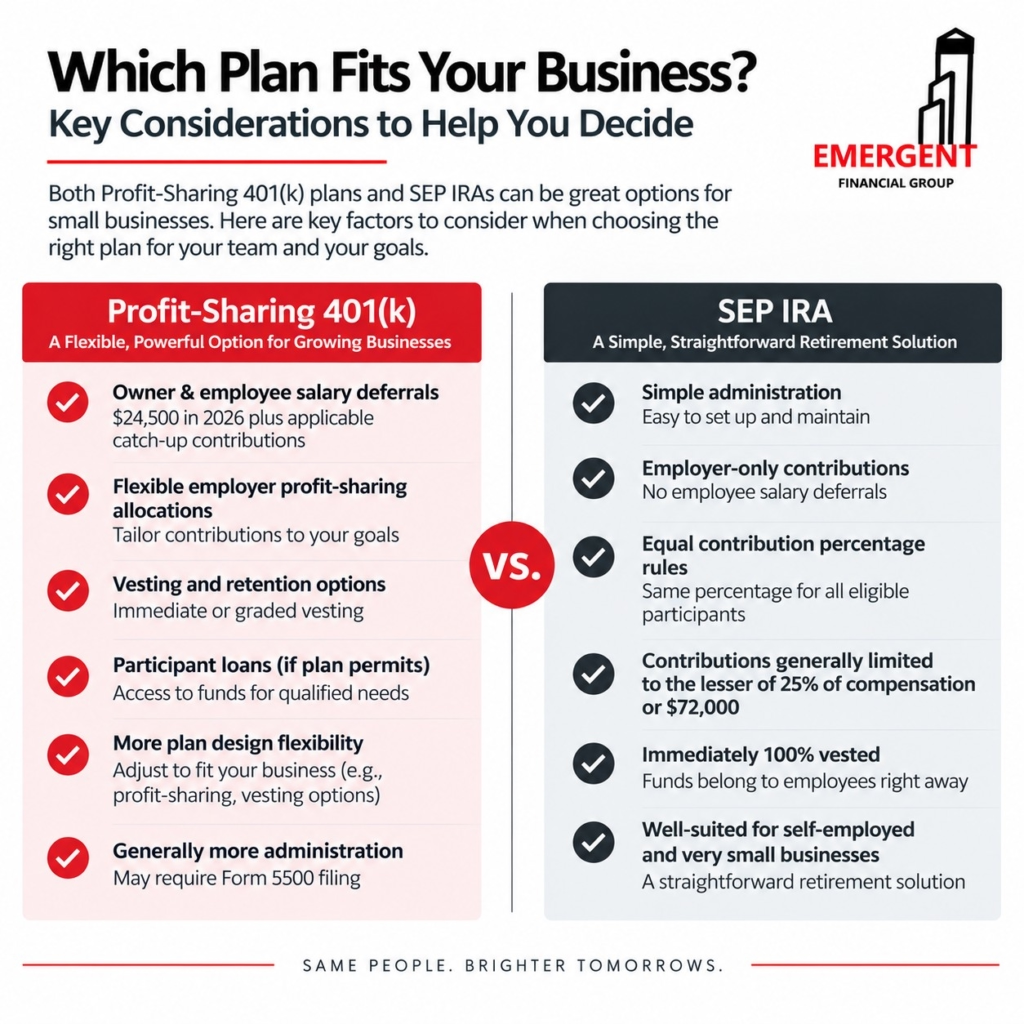
Consider a Profit-Sharing 401(k) when:
- You have employees.
- You want employees to contribute.
- Owners want to maximize retirement savings.
- Owners are older or more highly compensated than employees.
- You want contribution-allocation flexibility.
- Employee retention matters.
- You want vesting options.
- You want Roth 401(k) capabilities.
- You expect the business retirement strategy to become more sophisticated.
- You may eventually add a Cash Balance Plan.
Consider a SEP IRA when:
- You’re self-employed.
- You have no employees or very few employees.
- Administrative simplicity is the priority.
- You don’t need employee salary deferrals.
- You don’t need sophisticated allocation formulas.
- You want discretionary employer contributions.
- You want to minimize ongoing plan administration.
👍Reference: Internal Revenue Service — 401(k) and Profit-Sharing Plan Contribution Limits
Key Points
A SEP IRA isn’t simply a smaller or easier 401(k).
And a Profit-Sharing 401(k) isn’t automatically better just because it offers more features.
They solve different problems.
SEP IRA:
Best when simplicity, low administrative burden, and employer-funded retirement savings are the priorities.
👍Read: Traditional 401(k) Plans for Small Businesses
Profit-Sharing 401(k):
Best when flexibility, employee participation, larger owner-saving strategies, employee retention, and sophisticated contribution design are priorities.
For many growing businesses, the Profit-Sharing 401(k) becomes increasingly attractive as the workforce grows and retirement-plan design becomes part of the company’s broader tax and employee-benefit strategy.
For an owner-only or very small business, however, a SEP IRA may accomplish the retirement objective without unnecessary administrative complexity.
Don’t Compare the Plans by Contribution Limit Alone
For business owners, the more useful analysis is usually:
**Owner Contribution
- Employee Contribution Cost
- Tax Deduction
- Administrative Cost
- Employee Retention Value
- Long-Term Plan Flexibility**
The retirement plan that produces the largest headline contribution is not necessarily the plan that creates the greatest economic benefit for the business owner.
👍Discover: Internal Revenue Service — Retirement Plan COLA Limits
A side-by-side plan illustration can reveal a very different answer.

👍Related: U.S. Department of Labor — Profit Sharing Plans for Small Businesses
The Bottom Line
For a self-employed individual or business with few or no employees, a SEP IRA can provide an excellent combination of simplicity, flexibility, and tax-deferred retirement savings.
As a business adds employees—or as the owner begins looking for more sophisticated ways to maximize retirement contributions, control employee costs, reward key employees, and reduce taxable income—a Profit-Sharing 401(k) can become the more powerful planning tool.
The best way to determine the appropriate structure is to model both plans using your actual employee census, compensation, ages, ownership structure, and desired owner contribution.
Emergent Financial Group
Benefit Planning for Small Businesses.
👍Schedule: a retirement plan consultation with Emergent Financial Group.
Retirement plan design should be coordinated with your business structure, employee benefits, tax strategy, and long-term financial plan.
Emergent Financial Group can help business owners compare Profit-Sharing 401(k), Safe Harbor 401(k), SEP IRA, SIMPLE IRA, Solo 401(k), and Cash Balance Plan strategies to determine which structure best fits the business.
Need help getting started? Explore how Emergent Financial Group partners with Asset Managers and Strategic Accountants to bring you flexible, tax-smart options tailored to your situation..
Please don’t hesitate to contact us here
This material is provided for educational purposes and is not intended as individualized tax, legal, ERISA, or investment advice. Retirement-plan contribution limits and rules can change. Business owners should coordinate plan design with qualified tax, legal, retirement-plan, and financial professionals.

"Helping Businesses Build Better Benefits. Helping Employees Build Better Retirements. RIA in Buckhead. Benefit Planning. Wealth Management. Wills. Trusts. Estate Planning."