The Evolution of Health Insurance: From Sickness Funds to ICHRA

The evolution of health insurance is a story of constant reinvention.
From early commercial sickness funds and disability insurance to prepaid hospitalization plans, employer-sponsored group health insurance, major medical coverage, HMOs, PPOs, and today’s Individual Coverage Health Reimbursement Arrangement (ICHRA), the way Americans finance healthcare has changed repeatedly.
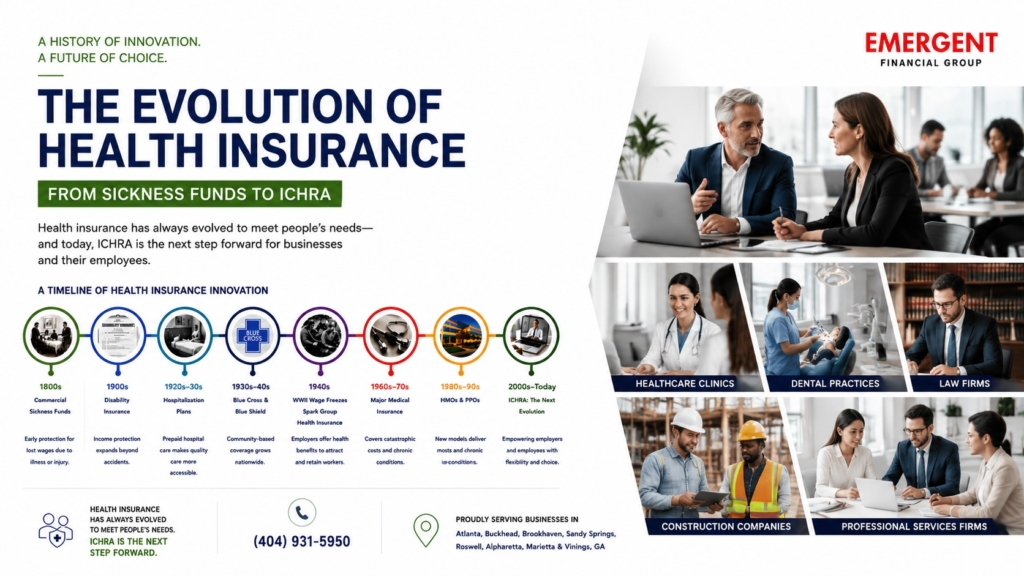
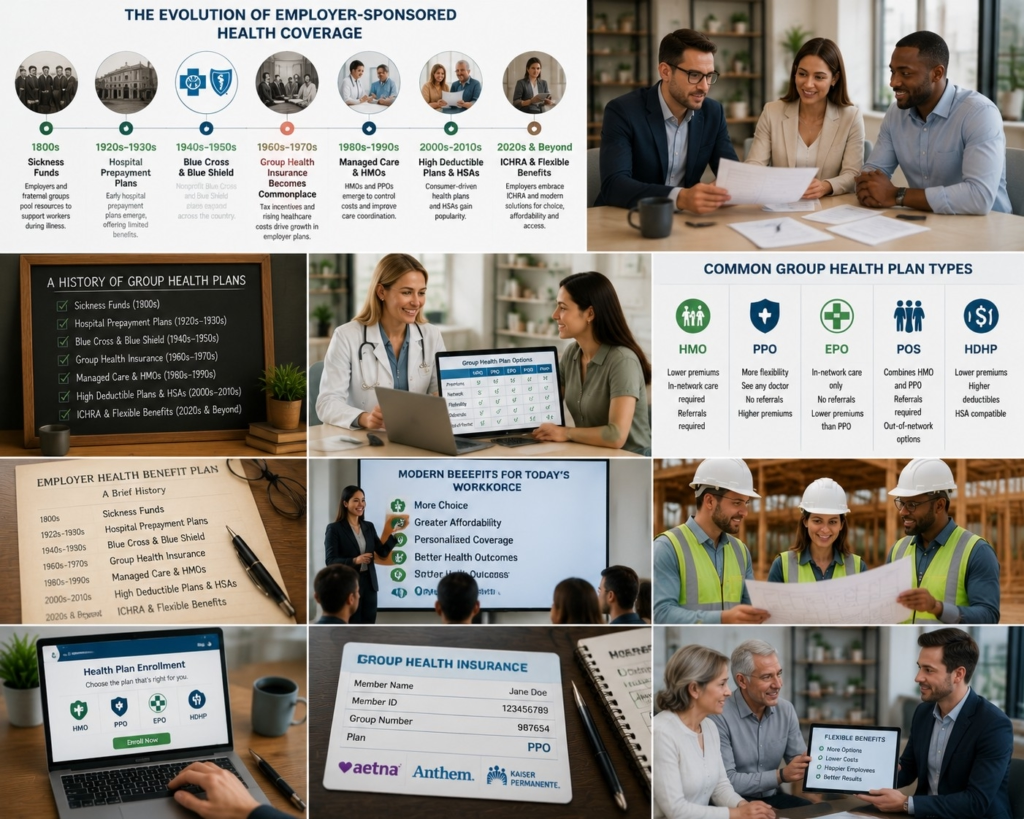
The Evolution of Health Insurance: A Timeline
Commercial sickness and accident funds → Disability income insurance → Hospitalization plans → Blue Cross and Blue Shield → WWII employer-sponsored group health → Major medical insurance → HMOs → PPOs → Level-funded plans → ICHRA
Each major innovation attempted to solve a problem the previous system could not fully address: lost income, unaffordable hospital bills, catastrophic medical expenses, limited provider access, rising employer costs, or the need for greater employee choice.
For small business owners in Buckhead, Atlanta, Brookhaven, Sandy Springs, Roswell, Alpharetta, Marietta, and Vinings, this history offers an important lesson: health insurance has never been static.
It has continually evolved toward broader protection, greater convenience, more consumer choice, and new ways for employers to control costs.
Today, ICHRA may represent the next major step in that evolution.
Health insurance has never been a finished product.
For more than a century, employers, hospitals, physicians, insurers, policymakers, and employees have repeatedly redesigned the way Americans pay for healthcare.
The earliest arrangements did not resemble today’s health insurance at all. Some primarily replaced wages when a worker became sick or injured. Later plans prepaid hospital bills. Major medical insurance expanded protection against catastrophic expenses. Employer-sponsored group health insurance grew rapidly during World War II. HMOs attempted to coordinate care and control costs. PPOs gave employees greater freedom to choose providers.
Each major transition tried to solve a problem left behind by the system that came before it.
Today, employers are confronting another set of problems: rising premiums, unpredictable renewals, employees living and working in different states, differing healthcare needs within the same workforce, and the difficulty of finding one group health plan that works equally well for everyone.
That is why the emergence of the Individual Coverage Health Reimbursement Arrangement, or ICHRA, may be best understood not as an isolated new benefit—but as another chapter in the continuing evolution of American health insurance.
For small business owners in Buckhead and Atlanta, Brookhaven, Sandy Springs, Roswell, Alpharetta, Marietta, and Vinings, that history offers an important lesson:
The way employers provide healthcare benefits has changed many times before—and each major innovation has attempted to deliver broader coverage, greater convenience, more choice, better cost control, or some combination of all four.
Health Insurance Did Not Begin by Paying Hospital Bills
Modern consumers tend to think of health insurance as something that pays doctors, hospitals, pharmacies, laboratories, and other healthcare providers.
That was not how much of the earliest commercial health-related insurance worked.
Commercial accident insurance appeared in the United States during the 19th century. According to historical research published by the Social Security Administration, commercial accident and health insurance was being written in the United States by 1847, initially focusing largely on accidents.
Over time, insurers expanded protection to cover disability caused by sickness.
These early policies often functioned more like income protection than today’s comprehensive medical insurance.
If illness or an accident prevented someone from working, the financial problem was not simply the doctor’s bill.
It was the loss of income.
Early accident, sickness, disability, mutual-aid, and sickness-fund arrangements attempted to protect workers and families from that economic disruption.
The underlying insurance concept was already taking shape:
Many people contribute relatively small amounts so that individuals experiencing an unpredictable financial loss can receive assistance.
But there was still an enormous gap.
Paying someone because they could not work was different from paying the growing cost of medical treatment itself.
That gap would lead to the next major innovation.
The Evolution From Sickness Insurance to Commercial Disability Insurance
As industrial America expanded during the late 19th and early 20th centuries, workers increasingly depended on wages rather than farms, family businesses, or household production.
That made a prolonged illness economically dangerous.
A worker who became sick could face two simultaneous financial problems:
- Medical expenses.
- Lost wages.
Commercial insurers increasingly developed accident and sickness policies that paid cash benefits when covered conditions prevented a person from working.
This was an important step toward modern employee benefits.
But these policies still generally did not function like today’s comprehensive health plans.
The central financial risk being insured was often the inability to earn income, not the full cost of medical care.
That distinction remains visible today.
Modern short-term disability and long-term disability insurance are descendants of this income-protection concept, while health insurance evolved along a separate but related path toward paying medical expenses.
The next major breakthrough came not primarily from an insurance company—but from a hospital trying to solve a business problem.
1929: Baylor University Hospital and the Birth of Modern Hospital Coverage
One of the most important moments in American health insurance history occurred in Dallas, Texas.
In 1929, Baylor University Hospital developed a prepaid hospital arrangement for a group of Dallas schoolteachers.
The concept was remarkably simple.
Teachers paid a small fixed amount in advance. In exchange, they received a defined amount of hospital care if they became ill.
Instead of waiting for a patient to become sick and then hoping the patient could afford the hospital bill, the hospital collected predictable payments from a group of people in advance.
For employees, the arrangement converted an unpredictable hospital expense into a predictable periodic payment.
For the hospital, it created a more reliable stream of revenue.
The idea spread.
Similar prepaid hospital plans appeared around the country and eventually helped give rise to what became Blue Cross plans.
This represented a fundamental shift in health insurance.
Insurance was moving from primarily replacing income lost because of sickness toward directly financing healthcare services.
Blue Cross Solved the Hospital Problem. Blue Shield Expanded the Idea to Doctors.
Hospitalization was only one part of healthcare.
Patients also needed physicians.
In 1939, the California Physicians’ Service was established as an early physician-service prepayment plan and became an important precursor to the Blue Shield model.
The basic evolution was becoming clearer:
Sickness and disability insurance → hospital coverage → physician coverage.
Blue Cross-type plans helped finance hospital care.
Blue Shield-type plans helped finance physician services.
Together, these innovations moved health coverage much closer to what Americans would eventually recognize as medical insurance.
But coverage was still fragmented.
A person might have hospital coverage, surgical coverage, or limited physician benefits without having comprehensive protection against a truly expensive illness.
That problem would eventually produce major medical insurance.

World War II Accidentally Changed American Health Insurance Forever
One of the most consequential developments in American employee benefits did not originate as healthcare reform.
It resulted from wartime economic policy.
During World War II, the United States faced enormous demand for labor while millions of Americans served in the military.
At the same time, policymakers feared that competition for scarce workers could cause wages and prices to spiral upward.
Federal wage controls limited employers’ ability to compete for workers simply by offering substantially higher salaries.
Employers still needed another way to attract and retain employees.
Health benefits became part of the answer.
In 1943, the National War Labor Board ruled that certain employer contributions for insurance and pension benefits did not count as wages subject to wage controls.
That created an extraordinary incentive.
If an employer could not easily say:
“Come work for us and we’ll pay you substantially more,”
it could effectively say:
“Come work for us and we’ll provide valuable health insurance for you and your family.”
Employer-sponsored health insurance became a powerful recruiting and retention tool.

Strategically-Crafted Benefit Plans
Historical research summarized by the National Academies notes that employment-based health coverage tripled by the end of World War II.
The war had unintentionally helped establish one of the defining characteristics of the American healthcare system:
Health insurance became connected to employment.
Why Employer-Sponsored Health Insurance Stayed After the War
Wartime wage controls eventually disappeared.
Employer-sponsored health insurance did not.
Tax policy made the arrangement even more attractive.
The federal tax treatment of employer-sponsored health benefits was eventually codified so that qualifying employer contributions toward employee health coverage generally were not treated as taxable income to employees.
This created a powerful economic advantage.
Imagine an employer deciding between providing an employee additional taxable compensation or providing valuable health benefits.
Health benefits could provide substantial economic value while receiving favorable tax treatment.
For employers competing for skilled workers, health insurance became an increasingly important component of compensation.
For employees, “What are the benefits?” became almost as important as “What is the salary?”
That basic relationship still defines employee benefits today.
The 1950s: The Birth of Major Medical Insurance
By the middle of the 20th century, medical science was advancing rapidly.
Hospitals were becoming more technologically sophisticated.
New surgical techniques, pharmaceuticals, diagnostic tools, and specialty medicine improved healthcare—but also made serious medical treatment increasingly expensive.
Traditional hospital and surgical policies could leave substantial gaps.
The insurance industry responded with major medical insurance.
Early major medical policies emerged around 1949–1951, initially often as supplemental protection layered over basic hospital and surgical coverage. During the 1950s, insurers increasingly developed comprehensive major medical policies that combined broader categories of medical expense under one policy structure.
This was another major conceptual leap.
Instead of insuring only:
- A specific number of hospital days,
- A scheduled surgical benefit,
- A limited physician service, or
- Lost income,
major medical insurance was designed to protect households from a much broader range of potentially catastrophic healthcare expenses.
The familiar concepts of:
- Deductibles,
- Coinsurance,
- Covered medical expenses,
- Maximum benefits, and eventually
- Broader comprehensive medical protection
became increasingly central to health insurance.
Health insurance was evolving from a collection of narrow protections into something closer to a comprehensive financial safety net.
The Next Problem: How Do We Control Healthcare Costs?
Broader coverage solved one problem.
It helped create another.
As insurance paid for more healthcare services and medical technology advanced, healthcare spending increased.
Insurers and employers began searching for ways to coordinate care and manage costs more effectively.
That helped accelerate another major innovation:
The Rise of the HMO
The concept behind the Health Maintenance Organization, or HMO, predates the term itself.
Prepaid group medical practices had existed for decades. One of the most influential examples grew from healthcare programs associated with industrialist Henry J. Kaiser and physician Sidney Garfield.
During major construction projects and later World War II industrial production, prepaid healthcare arrangements were developed to provide coordinated medical services to workers.
The model eventually evolved into what became Kaiser Permanente.
Instead of simply reimbursing every medical bill after treatment occurred, the model attempted to organize:
- Financing,
- Physicians,
- Hospitals, and
- Preventive care
into a more coordinated system.
The federal HMO Act of 1973 encouraged broader development of HMOs.

HMOs attempted to solve several problems:
- Fragmented healthcare.
- Rapidly rising costs.
- Uncoordinated medical services.
- Limited emphasis on prevention.
Members generally received care through a defined network of doctors and hospitals.
The tradeoff was clear.
More coordination and potentially greater cost control—but less freedom to seek care outside the network.
Once again, health insurance had evolved.
But consumers wanted something else.
They wanted more choice.
The PPO: Greater Freedom Without Abandoning Managed Care
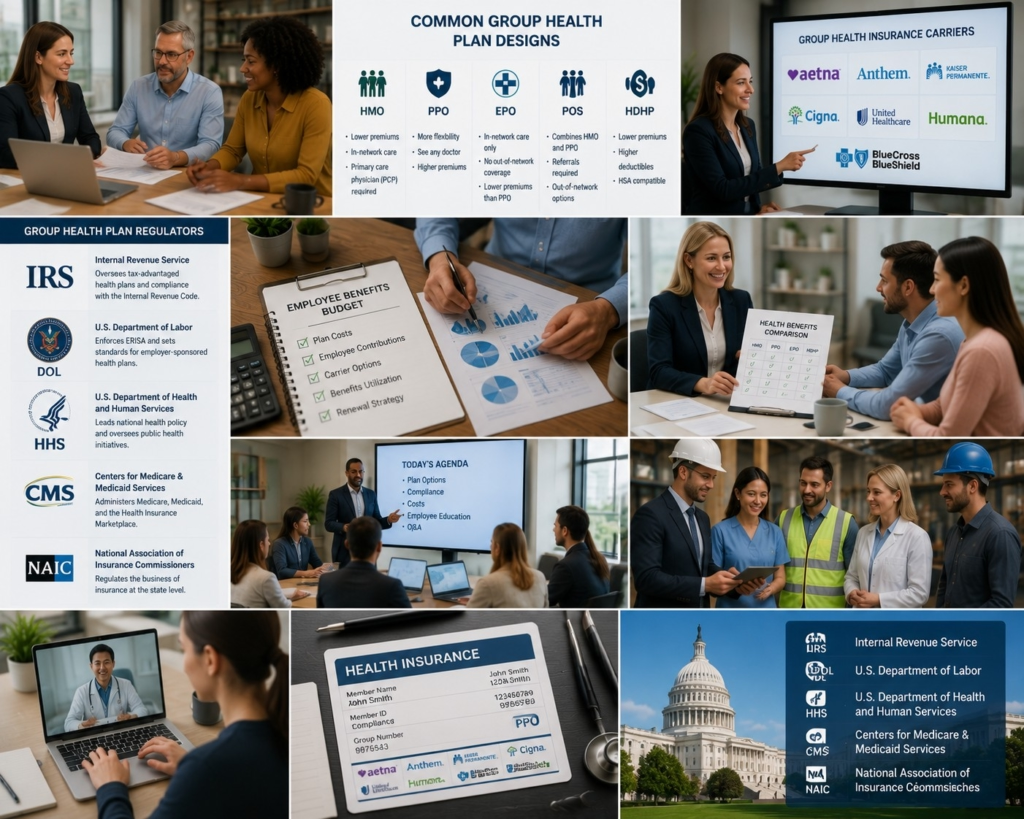
The Preferred Provider Organization, or PPO, emerged as another response to the tension between cost control and consumer choice.
PPOs created networks of preferred physicians, hospitals, and healthcare providers that agreed to negotiated reimbursement arrangements.
Employees typically received:
- Lower costs when using in-network providers.
- Greater freedom to see specialists.
- Some ability to receive out-of-network care, usually at higher cost.
The PPO became extremely popular because it attempted to balance two competing goals:
Cost control and provider choice.
For decades, PPO-style plans became a familiar foundation of employer-sponsored health insurance.
But the underlying structure remained largely the same:
The employer selects one carrier and a limited menu of group plans, and employees choose among the options the employer makes available.
That model works well for many businesses.
For others, it is becoming increasingly difficult.
The Modern Small Business Problem: Can One Group Plan Still Fit Everyone?
Consider a growing Georgia business with employees living in:
- Buckhead,
- Brookhaven,
- Sandy Springs,
- Roswell,
- Alpharetta,
- Marietta,
- Vinings,
or even employees working remotely in entirely different states.
One employee may want a broad PPO network.
Another may prioritize a lower premium.
Another may need a specific hospital system.
Another may have a spouse whose physicians participate with a different carrier.
A younger employee may prefer a high-deductible plan paired with an HSA.
An employee managing a chronic condition may value richer benefits and a lower deductible.
Traditional group health insurance asks the employer to make a difficult decision:
Which plan works best for everybody?

Increasingly, the answer may be:
There may not be one plan that is best for everybody.
This is one reason new health-benefit models have emerged.
Employers comparing today’s options can review our guide to standard group, level-funded and ICHRA health plans.
Rising Renewal Costs Created Another Pressure Point
Traditional fully insured group health plans remain an excellent solution for many employers.
But small businesses frequently face another challenge:
Annual renewal increases.
A business may build its employee-benefits budget around one premium level, only to receive a significant increase the following year.
Healthcare inflation, changes in demographics, carrier pricing, regional costs, and risk-pool dynamics can all affect premiums.
For a deeper discussion, read our analysis of why standard group health insurance renewal rates increase.
Employers began asking the same type of question that has driven health-insurance innovation for more than a century:
Is there another way to do this?
One answer was level funding.
Level-Funded Health Insurance: Another Step in the Evolution
Level-funded plans attempt to combine characteristics of fully insured group coverage and self-funded health plans.
An employer typically pays a predictable monthly amount incorporating:
- Expected claims funding,
- Administrative expenses, and
- Stop-loss protection against unexpectedly high claims.
Depending on the contract, favorable claims experience may create the potential for a surplus or refund.
Level funding can be attractive for certain healthier groups seeking greater cost transparency or an alternative to conventional fully insured renewal cycles.
It is not automatically better for every employer.
Plan suitability depends on workforce demographics, risk, underwriting, plan design, claims expectations, and employer objectives.
Our comprehensive guide to level-funded group health insurance for small businesses explains where this model may fit.
But another innovation would challenge an even more fundamental assumption:
What if an employer did not have to choose the insurance policy for every employee?
ICHRA: The Next Evolution in Employer-Sponsored Health Benefits?
Beginning in 2020, employers gained access to a new framework known as the Individual Coverage Health Reimbursement Arrangement, or ICHRA.
ICHRA changes the traditional employer-health-insurance relationship.
Under a conventional group plan:
Employer → chooses insurance plan → employees enroll.
Under an ICHRA:
Employer → establishes a defined contribution → eligible employees obtain qualifying individual health insurance → employer reimburses eligible expenses according to the arrangement’s rules.
That distinction is significant.
An ICHRA is not itself a health insurance policy.

It is an employer-funded reimbursement arrangement that, when properly structured, can reimburse employees tax-free for eligible individual health insurance premiums and potentially other qualified medical expenses.
The employer defines the benefit budget.
The employee obtains qualifying individual coverage.
That can create a different balance between employer cost control and employee choice.
For a complete explanation, read What Is ICHRA Group Health Insurance? and our introductory guide, What Is an ICHRA?.
Why ICHRA Fits the Historical Pattern of Health Insurance Innovation
Look at the evolution again.
Early Sickness Funds and Disability Insurance
Problem: Workers lost income when sickness or injury prevented them from working.
Innovation: Pool risk and provide cash benefits.
Prepaid Hospital Plans
Problem: Hospitalization created large, unpredictable bills.
Innovation: Prepay predictable amounts for hospital protection.
Blue Cross and Blue Shield
Problem: Hospital and physician expenses needed broader organized financing.
Innovation: Expand prepaid medical coverage.
Employer Group Health Insurance
Problem: Employers needed better ways to compete for scarce workers during wartime wage controls.
Innovation: Health insurance became an employee benefit and form of compensation.
Major Medical Insurance
Problem: Serious illnesses could generate expenses far beyond basic hospital and surgical benefits.
Innovation: Broader catastrophic and comprehensive medical protection.
HMOs
Problem: Healthcare costs and fragmented delivery were increasing.
Innovation: Coordinate financing and healthcare delivery through managed networks.
PPOs
Problem: Consumers wanted more provider choice.
Innovation: Negotiated networks combined with greater flexibility.
Level-Funded Plans
Problem: Employers wanted alternatives to conventional fully insured pricing and renewal structures.
Innovation: Combine predictable monthly funding with elements of self-funding and stop-loss protection.
ICHRA
Problem: Employers want predictable benefit budgets while employees increasingly need individualized insurance choices.
Innovation: Separate the employer’s decision about how much to contribute from the employee’s decision about which qualifying individual health plan to purchase.

That is why ICHRA may represent more than another insurance acronym.
It represents a potentially important change in the architecture of employer-sponsored health benefits.
From Defined Benefits to Defined Contributions
There is an interesting parallel between retirement benefits and health insurance.
Traditional pensions generally promised employees a defined future benefit.
Over time, retirement benefits increasingly shifted toward defined-contribution arrangements such as the 401(k), where employers and employees contribute toward individually owned retirement accounts.
ICHRA introduces a conceptually similar shift into healthcare benefits.
Instead of saying:
“Here is the health insurance plan we selected for you,”
an employer can potentially say:
“Here is the amount our company will contribute toward your health coverage. Choose qualifying individual coverage that works for your circumstances.”
The analogy is not exact—401(k)s and ICHRAs operate under very different laws and rules—but the broader benefits philosophy is similar:
Move from a one-size-fits-all employer selection toward greater individual choice within an employer-sponsored benefit framework.
Why ICHRA May Be Especially Relevant for Atlanta-Area Small Businesses
Georgia businesses are increasingly diverse.
A professional practice in Buckhead may have physicians, administrators, and support staff with dramatically different healthcare needs.
A technology or consulting firm in Alpharetta may have remote employees across several states.
A dental or medical practice in Roswell may struggle to find one group plan that balances physician preferences with affordable coverage for younger employees.
A construction company serving Marietta and Metro Atlanta may have employees living across a wide geographic area.
A professional-services company in Sandy Springs may simply want more predictable control over its healthcare budget.

A small business in Brookhaven or Vinings may be evaluating whether its traditional group plan still provides the best combination of price, coverage, and employee choice.
ICHRA may allow qualifying employers to establish defined contribution amounts while employees select individual health coverage appropriate for their circumstances.
This can be especially useful when employees:
- Live in different counties or states.
- Prefer different insurance carriers.
- Need different provider networks.
- Have different family situations.
- Value different deductible and premium combinations.
ICHRA is not automatically the best answer for every business.
That is precisely why employers should compare it rather than assume it is superior.
ICHRA vs. Traditional Group Health Insurance vs. Level Funding
The best employee-benefits strategy depends on the business.
Traditional Fully Insured Group Health
May work particularly well when:
- Employees value a common group plan.
- The carrier network fits the workforce.
- Rates are competitive.
- The employer prefers a familiar structure.
Learn more in our guide to standard group health insurance for small business owners.
Level-Funded Health Insurance
May be attractive when:
- The workforce has favorable demographics or risk characteristics.
- The employer wants greater visibility into healthcare spending.
- The employer is comfortable with a different funding model.
ICHRA
May be attractive when:
- Employees are geographically dispersed.
- The employer wants a defined healthcare budget.
- Individual-market choices are competitive.
- Employees value individualized carrier and plan selection.
Our guide to the best retirement and health insurance solutions for businesses with 10–20 employees provides additional examples of how business size and workforce characteristics can influence the decision.
The Goal Has Always Been the Same: Better Protection, Better Access and Better Value
It is tempting to look at today’s health insurance system and assume that this is simply how health insurance has always worked.
History tells a very different story.
Health insurance has repeatedly reinvented itself.
The industry moved:
From replacing lost wages…
to paying hospital bills…
to covering physicians…
to comprehensive major medical protection…
to employer-sponsored group insurance…
to coordinated HMO networks…
to flexible PPO networks…
to alternative funding models…
and now toward employer-funded individual choice through ICHRA.
Not every innovation replaced what came before it.
PPOs did not eliminate HMOs.
Level-funded plans did not eliminate fully insured plans.
ICHRA is unlikely to make traditional group insurance disappear.
Instead, each innovation added another tool.
That is an important distinction for business owners.

The future of employee benefits may not be about finding the one best health insurance model.
It may be about having enough different models to match the right strategy to the right workforce.
The Employer’s Role Is Evolving Too
Historically, an employer’s role was often straightforward:
Choose a carrier.
Choose one or several plans.
Pay part of the premium.
Ask employees to enroll.
Modern benefits planning can be much more strategic.
An employer can evaluate:
- Traditional fully insured group health insurance.
- Level-funded coverage.
- ICHRA.
- QSEHRA for qualifying small employers.
- Dental and vision.
- Group life and disability.
- Voluntary benefits.
- Retirement plans.
- Different contribution strategies.
The question is no longer simply:
“Which health insurance company should we use?”
A better question may be:
“Which benefits structure gives our employees meaningful coverage while allowing the business to control costs sustainably?”
That is a much more powerful conversation.
A Lesson From More Than a Century of Health Insurance
Every major chapter in health insurance history began with a problem.
Workers could not afford to lose income.
Insurance responded.
Hospital bills became unaffordable.
Prepaid hospitalization responded.
Medical expenses became more complex.
Major medical responded.
Employers needed to compete for workers during wage freezes.
Group health insurance responded.
Costs increased.
HMOs responded.
Consumers demanded more provider choice.
PPOs responded.
Small employers sought new approaches to healthcare funding.
Level funding expanded.
Employers now face rising premiums, geographically dispersed employees, diverse healthcare needs, and pressure for greater employee choice.
ICHRA is one response.
The lesson is not that every new model is automatically better.
The lesson is that health insurance has always evolved when the old model stopped solving every problem effectively.
Is ICHRA the Right Next Step for Your Business?
For some Georgia employers, traditional group health insurance may still provide the strongest combination of price, network, and benefits.
For others, level-funded coverage may provide compelling economics.
For still others, ICHRA may offer a more flexible way to establish a healthcare budget while allowing employees greater choice.
The right approach begins with comparison.
At Emergent Financial Group, we help small businesses evaluate multiple employee-benefit strategies rather than beginning with the assumption that one structure is always best.
That can include comparing:
- Traditional group health insurance.
- Level-funded health plans.
- ICHRA.
- Ancillary employee benefits.
- Retirement plan strategies.
Employers should evaluate actual premiums, provider networks, employee demographics, geographic distribution, contribution requirements, tax considerations, and administrative responsibilities before making a decision.

Our article on the latest employee-benefit trends for small businesses explores how these options are continuing to evolve.
Frequently Asked Questions
What was the first form of health insurance in America?
Early commercial accident and health insurance in the United States dates to the 19th century and initially focused heavily on accident and disability-related cash benefits. Medical-expense insurance developed gradually afterward.
When did hospital insurance begin?
The 1929 Baylor University Hospital prepaid plan for Dallas schoolteachers is widely regarded as a major precursor to modern Blue Cross hospital coverage.
Why did employer-sponsored health insurance become popular during World War II?
Federal wage controls restricted employers’ ability to compete for scarce workers through higher wages. Employer contributions toward insurance benefits were excluded from wage controls, making health benefits an attractive recruiting and retention tool.
When was major medical insurance introduced?
Major medical insurance emerged around the turn of the 1950s, with early policies designed to supplement basic hospital and surgical insurance. Comprehensive major medical plans expanded during the 1950s, combining broader categories of medical expenses under a more unified insurance structure.
What is the difference between an HMO and PPO?
An HMO generally emphasizes coordinated care through a defined provider network and often requires more structured access to specialists. A PPO generally provides greater provider flexibility, including some out-of-network coverage, although members typically pay less when using preferred in-network providers.
What is an ICHRA?
An Individual Coverage Health Reimbursement Arrangement allows an employer to establish defined reimbursements for employees who obtain qualifying individual health insurance, subject to federal rules. An ICHRA is an employer-sponsored reimbursement arrangement, not an insurance policy itself.
Is ICHRA better than traditional group health insurance?
Not necessarily. ICHRA may be advantageous for certain businesses, particularly those seeking defined employer contributions or serving geographically dispersed workforces. Traditional group or level-funded plans may be better in other situations. Employers should compare actual options before deciding.
Related Employee Benefits Resources
Continue exploring these topics:
- What Is an ICHRA?
- What Is ICHRA Group Health Insurance?
- Types of Group Healthcare Plans: Standard Group vs. Level-Funded vs. ICHRA
- Level-Funded Group Health Insurance: A Comprehensive Guide for Small Businesses
- Why Group Health Insurance Renewal Rates Increase
- Latest Trends in Employee Benefits for Small Businesses
Final Thoughts: Health Insurance Has Never Stopped Evolving
From 19th-century sickness and disability protection to prepaid hospital plans, Blue Cross and Blue Shield, World War II employer benefits, major medical insurance, HMOs, PPOs, level funding, and now ICHRA, American health insurance has continually changed.
Each generation has tried to answer essentially the same question:
How can we provide better financial protection and access to healthcare in a way that is convenient, sustainable, and affordable?
ICHRA represents the latest major attempt to answer that question for employer-sponsored benefits.
For small businesses in Buckhead, Atlanta, Brookhaven, Sandy Springs, Roswell, Alpharetta, Marietta, Vinings, and throughout Georgia, the opportunity is not simply to follow the newest trend.
It is to compare the available models—and determine which evolution of health insurance works best for your business and your employees.
Emergent Financial Group helps Georgia small businesses compare ICHRA, traditional group health insurance, level-funded health plans, and broader employee-benefit strategies based on the workforce, budget, provider needs, and business objectives.
The history of health insurance shows us something important:
The best solution has never remained the same forever.
Need help getting started?
Explore how Emergent Financial Group partners with Families and Small Business Owners for comprehensive Benefit and Estate Planning.
Please don’t hesitate to contact us here

"Helping Businesses Build Better Benefits. Helping Employees Build Better Retirements. RIA in Buckhead. Benefit Planning. Wealth Management. Wills. Trusts. Estate Planning."