Best Retirement & Health Insurance Solutions for Small Businesses with 10–20 Employees

When your business grows beyond the micro stage (2–5 employees) into the 10–20 employee range, your benefit strategy changes. You have more payroll, more diversity in employee income levels, and potentially higher turnover risks. This means you’ll want retirement and health benefits that balance tax efficiency, employee retention, and administrative complexity.
Below is a comprehensive breakdown of the best options for retirement plans and health insurance for a business of your size — with a special note on how S-Corp vs. C-Corp structures can impact your decision.
Part 1: Retirement Plans for a Business with 10–20 Employees
Here are the most relevant retirement plan options for small businesses:
| Plan Type | Employer Contribution Requirement | Max 2025 Contribution | Administration Complexity | Best For |
|---|---|---|---|---|
| Safe Harbor 401(k) | Mandatory match or 3% nonelective | $23,000 employee deferral + $46,000 employer (combined $69,000) | Medium | Attracting/retaining top talent, avoiding discrimination testing |
| Traditional 401(k) | Optional | Same as above | Medium–High | Larger employers wanting flexibility without mandatory match |
| Profit-Sharing Plan | Discretionary | $69,000 per employee (2025) | Medium | Businesses with fluctuating profits |
| Cash Balance Plan (Hybrid DB) | Required annual funding | $200k+ for owners possible | High | Highly profitable businesses wanting big tax deductions |
| SEP IRA | Discretionary | 25% of comp up to $69,000 | Low | Seasonal or highly variable cash flow |
| SIMPLE IRA | Mandatory match | $16,000 deferral + $3,500 catch-up | Low | Small admin burden, quick to set up |
Best Retirement Plan for 10–20 Employees
For this size, a Safe Harbor 401(k) combined with a Profit-Sharing component is usually the best choice.
Why:
- Compliance Relief: Safe Harbor avoids annual nondiscrimination testing.
- Tax Efficiency: Profit-sharing allows owners to contribute more in good years.
- Retention Tool: 401(k) is widely recognized as a standard benefit; adding profit-sharing boosts loyalty.
Example: S-Corp vs. C-Corp Tax Impact (Owner Age 50, 15 Employees)
Scenario:
- Payroll: $1.2M total ($150k owner salary)
- Profit before contributions: $500k
- Goal: Maximize owner’s retirement savings and reduce taxes.
Safe Harbor + Profit-Sharing Plan

We focus on the nitty-gritty
so you can relax.
✓ Empowering, game-changing conferences
✓ Schedule a consultation
- Owner Deferral: $30,500 (including $7,500 catch-up)
- Employer Safe Harbor (3% of $1.2M): $36,000
- Employer Profit-Sharing (10% of payroll): $120,000 (allocated proportionally, with more to owner if salary is higher)
- Total to Owner: ~$69,000 (max limit for 2025)
- Total Employer Cost: $156,000
- Tax Deduction Impact:
- S-Corp: Employer contributions are deductible from business income, reducing pass-through taxable income. Owner’s own contribution is pre-tax, reducing personal taxable wages.
- C-Corp: Contributions reduce corporate taxable income (21% rate) and do not count as taxable wages to owner.
Cash Balance Plan Add-On (High-Profit Years)
For highly profitable companies, adding a cash balance plan can push owner tax-deferred contributions over $200k/year.
- S-Corp Impact: Reduces pass-through income, lowering both federal and state income taxes.
- C-Corp Impact: Reduces corporate income tax, and funds grow tax-deferred.
Part 2: Group Health Insurance for a Business with 10–20 Employees
You’re now large enough that group health insurance becomes more predictable, and you can negotiate better rates. Here’s how the three main options compare:

| Option | How It Works | Pros | Cons | Best For |
|---|---|---|---|---|
| Standard Fully-Insured Group Plan | Fixed monthly premium, insurance company assumes risk | Predictable costs, ACA-compliant, broad networks | Annual rate increases, less customization | Businesses with stable workforce and budgets |
| ICHRA (Individual Coverage HRA) | Employer gives tax-free allowance for employees to buy individual ACA plans | Flexible, no participation requirements, cost control | Employees must shop for own plans, may lose group plan cohesion | Businesses with geographically dispersed workforce |
| Level-Funded Plan | Hybrid self-insurance; fixed monthly payments, possible refund if claims are low | Potential savings, access to claims data, stable budgeting | More admin complexity, financial risk if claims spike | Healthy employee groups with low claims history |
Best Group Health Plan for 10–20 Employees
For most businesses at this size:
- Level-Funded Plan is often the sweet spot if you have a younger, healthier workforce — you can save on premiums and get refunds if claims are low.
- Standard Group Plan works better if you have older employees or high expected claims — provides full risk protection.
- ICHRA is great if your team is remote or spread across states.
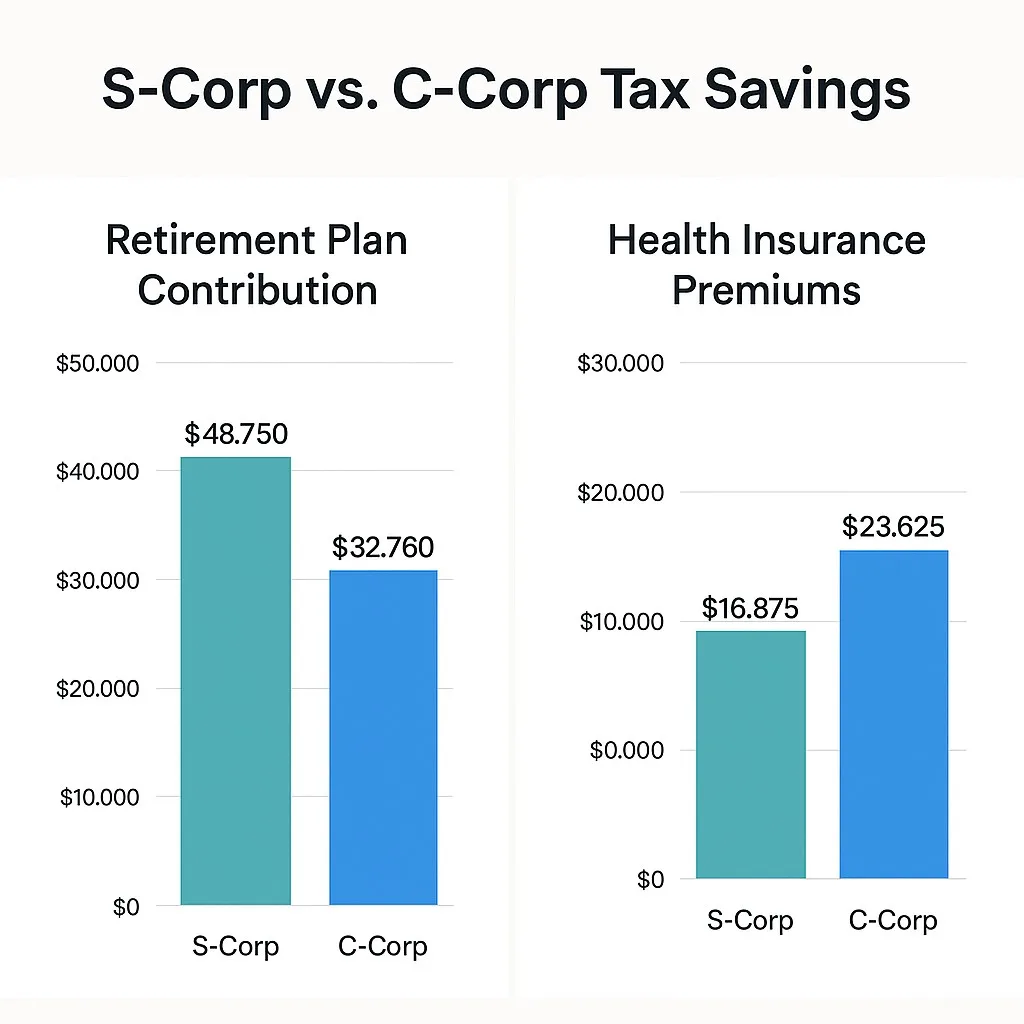
Example: Cost & Tax Impact – S-Corp vs. C-Corp
Scenario: 15 employees, $7,500 annual employer share of premiums per employee
- Total Employer Premium Cost: $112,500/year
S-Corp Tax Impact:
- Deduction reduces pass-through income.
- Owners with >2% ownership must include premiums in wages but can deduct them on personal return (self-employed health insurance deduction).
C-Corp Tax Impact:
- Premiums are fully deductible at the corporate level.
- No wage inclusion for owners; benefits are tax-free to employees.
Level-Funded Savings Example
- Fully-Insured Cost: $112,500/year
- Level-Funded Cost: $96,000/year (fixed)
- Year-End Claims Surplus Refund: $12,000
- Net Cost: $84,000 — 25% savings if claims are low.
Final Recommendations by Ownership Type
| Ownership Type | Retirement Best Pick | Health Insurance Best Pick | Key Reason |
|---|---|---|---|
| S-Corp | Safe Harbor 401(k) + Profit-Sharing | Level-Funded (if healthy group) or Standard Group | Reduces pass-through income; health insurance deduction applies |
| C-Corp | Safe Harbor 401(k) + Profit-Sharing or Cash Balance | Level-Funded or Standard Group | Direct corporate tax deduction; benefits tax-free to owners |
Bottom Line
At 10–20 employees, your benefit plan should be both a retention tool and a tax strategy.
- Retirement: Safe Harbor 401(k) + Profit-Sharing gives flexibility and compliance protection. Add a cash balance plan in high-profit years.
- Health Insurance: Level-funded if healthy group, standard fully-insured if not, ICHRA if your workforce is remote.
- Always model S-Corp vs. C-Corp deductions before finalizing — the tax outcome can differ significantly.
Need help getting started? Explore how Emergent Financial Group partners with Retirement Plan providers to bring you flexible, tax-smart options tailored for your business.
Please don’t hesitate to contact us here.
"Helping Businesses Build Better Benefits. Helping Employees Build Better Retirements. RIA in Buckhead. Benefit Planning. Wealth Management. Wills. Trusts. Estate Planning."