The Best Retirement & Health Insurance Plans for Small Businesses with 2–5 Employees

Comparing S-Corps vs C-Corps, Tax Implications, and Real-World Examples
Introduction
For small businesses with 2–5 employees, selecting the right retirement plan and group health insurance is a strategic decision that directly impacts:
- Tax savings for the business
- Owner’s personal retirement accumulation
- Employee retention and satisfaction
- Cash flow stability
The “best” choice isn’t one-size-fits-all — it depends heavily on business structure (S-Corp vs C-Corp), profitability, and the age/compensation profile of the employees.
We’ll break down retirement plan options and health insurance choices side-by-side, with tax impact examples for both S-Corps and C-Corps.

Part 1: Best Retirement Plans for a Small Business (2–5 Employees)
The Main Contenders
- SEP IRA
- SIMPLE IRA
- Solo 401(k) (for owner + spouse only)
- Safe Harbor 401(k)
- Traditional 401(k) with Profit Sharing
- Cash Balance Pension Plan (for high-income owners)
1. SEP IRA
Best for: Owner-dominated businesses where the owner earns much more than employees.
How it works:
- Employer-only contributions (up to 25% of compensation, capped at $69,000 in 2024).
- All employees (age 21+, worked 3 of last 5 years, and earned $750+) must receive the same percentage contribution.
- No annual IRS filings.
Pros:
- Easy to set up and maintain.
- High contribution limits.
- Big deduction for the business.
Cons:
- Employer must contribute equally for all eligible employees, which can be expensive if employee salaries are high.
Example (S-Corp, 2 employees):
Owner salary: $150,000
Employee 1: $50,000
Employee 2: $40,000
25% contribution rate → $37,500 for owner, $12,500 for E1, $10,000 for E2
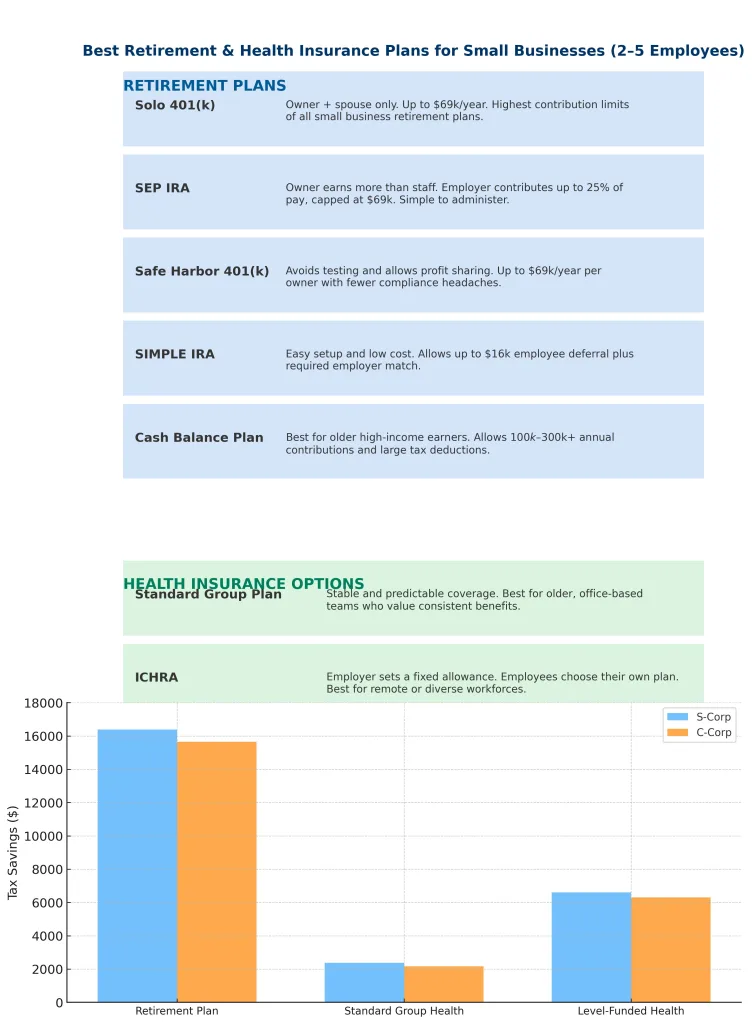
Tax savings (S-Corp): Deduct $60,000 from corporate taxable income, saving ~$13,200 in federal + state taxes at 22% combined.
Best for: High-margin businesses where the owner is okay funding employees generously.
2. SIMPLE IRA
Best for: Businesses that want to offer a retirement plan with lower cost and less commitment than a 401(k).
How it works:
- Employee deferrals up to $16,000 in 2024 (+$3,500 catch-up for age 50+).
- Employer must match up to 3% of pay or give 2% to all eligible employees.
Pros:
- Easy to administer, low cost.
- Employees can contribute their own funds.
Cons:
- Lower limits than SEP or 401(k).
- Mandatory employer contributions.
Example (C-Corp, 5 employees, average salary $50k):
If everyone defers and employer matches 3% → $7,500 in employer costs.
C-Corp deduction at 21% rate = $1,575 tax savings.
3. Safe Harbor 401(k) with Profit Sharing
Best for: Owners who want to maximize contributions without complex discrimination testing.
How it works:
- Employee deferrals up to $23,000 (2024) + $7,500 catch-up.
- Employer must contribute either 3% to all or match up to 4%.
- Can add profit sharing to reach up to $69,000 total (2024).
Pros:
- Higher limits.
- Avoids most compliance testing.
Cons:
- Higher cost than SIMPLE or SEP.
Example (S-Corp, 3 employees, owner age 55):
Owner defers $30,500 (with catch-up), profit share 25% → total $69,000.
Employees each get 3% of $50,000 salary = $1,500 each.
Employer deduction: $74,500 → ~$16,390 federal/state tax savings at 22%.
4. Cash Balance Pension Plan
Best for: High-income owners in their 50s+ wanting to defer $100k–$300k per year.
How it works:
- Defined benefit structure with large annual contributions based on age.
- Can be combined with a 401(k).
Pros:
- Massive tax deferral.
- Predictable funding for retirement.
Cons:
- Higher setup and maintenance cost.
- Requires annual contributions, even in down years.
Example: Owner age 60 can contribute $300k+ and deduct it against S-Corp or C-Corp income.

Retirement Plan Recommendation Summary (2–5 Employees)
| Plan Type | Best For | Max Owner Contribution (2024) | Employee Cost | Admin Effort | S-Corp Tax Benefit | C-Corp Tax Benefit |
|---|---|---|---|---|---|---|
| SEP IRA | Owner-heavy pay | $69k | High | Low | Deduct at owner’s pass-through rate | Deduct at 21% corp rate |
| SIMPLE IRA | Low admin cost | $16k deferral + match | Low-Moderate | Very Low | Same as above | Same as above |
| Safe Harbor 401(k) | Maximize w/o testing | $69k | Low | Medium | Same as above | Same as above |
| Cash Balance | Older high earners | $100k–$300k+ | Medium | High | Same as above | Same as above |
Part 2: Best Group Health Insurance Options for 2–5 Employees
The Main Contenders
- Standard Group Health Insurance
- ICHRA (Individual Coverage HRA)
- Level-Funded Health Plans
1. Standard Group Health Insurance
How it works:
- Employer chooses a plan from a carrier.
- Premiums based on group size, ages, and location.
- Employer must usually pay at least 50% of employee-only premium.
Pros:
- Predictable plan for all employees.
- May include dental/vision bundling.
- Pre-tax for both employer and employees.
Cons:
- Expensive for small groups, especially with older employees.
Example (S-Corp, 3 employees):
Premium $600/mo per employee → Employer covers 50% = $900/mo total ($10,800/year).
Tax savings at 22% = $2,376.

Strategically-Benefit Plans
2. ICHRA
How it works:
- Employer sets a fixed tax-free allowance.
- Employees buy their own ACA-compliant plan on the marketplace.
- Employer reimburses up to the allowance.
Pros:
- Flexible cost control.
- Employees choose their own plan.
- Works well for remote/dispersed teams.
Cons:
- Employees must navigate their own plan shopping.
- No group bargaining leverage.
Example (C-Corp, 4 employees):
Allowance $400/mo each → $19,200/year.
Deductible at 21% = $4,032 corporate tax savings.
3. Level-Funded Health Plans
How it works:
- Hybrid between fully-insured and self-insured.
- Employer pays a fixed monthly amount that includes claims funding + stop-loss insurance.
- Potential refund if claims are low.
Pros:
- Often cheaper than standard group plans.
- Refund potential.
- More plan design flexibility.
Cons:
- May require healthy employee group.
- Renewal rates can spike after high-claim years.
Example (S-Corp, 5 employees):
Level-funded premium $500/mo each = $30,000/year.
Potential refund: $5,000 if claims low.
Tax savings at 22% = $6,600.
Health Insurance Recommendation Summary (2–5 Employees)
| Option | Best For | Cost Predictability | Employee Choice | Potential Savings |
|---|---|---|---|---|
| Standard Group | Stable in-office teams | High | Low | Tax deduction + ACA compliance |
| ICHRA | Diverse/remote teams | Very High | Very High | Full control over budget |
| Level-Funded | Healthy younger groups | Medium | Medium | Refund potential |
We provide valuable employee benefits
that bring more success in business
S-Corp vs C-Corp Tax Impact Considerations
S-Corp:
- Retirement plan contributions reduce taxable business income (flows through to owner’s 1040).
- Health insurance premiums paid by S-Corp are deductible but must be included in owner’s W-2 (with offsetting personal deduction if eligible).
- Can be more tax efficient for owners in higher personal brackets.
C-Corp:
- Retirement and health plan contributions reduce corporate taxable income at flat 21% rate.
- No pass-through, but can stack with other fringe benefits like Section 105 medical reimbursement plans.
Final Recommendations
- If maximizing retirement savings is priority:
- Owner + spouse only: Solo 401(k) or Cash Balance Plan.
- 2–5 employees: Safe Harbor 401(k) with Profit Sharing.
- If minimizing health insurance cost volatility:
- Stable team, older avg age: Standard Group Plan.
- Healthy, younger team: Level-Funded Plan.
- Remote or diverse team needs: ICHRA.
- If C-Corp: Take advantage of fringe benefits that are 100% deductible at 21% rate, and consider higher employer contributions to retirement/health without impacting owner’s personal taxable income.
- If S-Corp: Focus on plans that maximize pre-tax deductions against pass-through income, especially for high-income owners.
Need help getting started? Explore how Emergent Financial Group partners with Retirement Plan providers to bring you flexible, tax-smart options tailored for your business.
Please don’t hesitate to contact us here.
"Helping Businesses Build Better Benefits. Helping Employees Build Better Retirements. RIA in Buckhead. Benefit Planning. Wealth Management. Wills. Trusts. Estate Planning."