Profit-Sharing Plans for Small Businesses: When They Are the Smartest 401(k) Strategy

What Is a Profit-Sharing Plan?
A profit-sharing plan is a type of defined contribution retirement plan where the employer makes contributions to employees’ retirement accounts—on a fully discretionary basis. Despite the name, contributions do not have to come from actual “profits.” Employers can contribute in years with a profit, a loss, or break-even—provided the business has the cash flow and follows the plan’s terms.
Key Characteristics:
- Employer-funded only – Employees cannot defer their own pay into the plan unless combined with a 401(k) option.
- Discretionary contributions – Employer decides annually how much to contribute, if anything.
- High limits – In 2024, up to the lesser of 100% of compensation or $69,000 ($76,500 if age 50+ with catch-up in a 401(k) combo).
- Tax-deductible contributions – Deductible up to 25% of total eligible payroll.
- Vesting schedules allowed – Employers can use cliff or graded vesting to retain talent.
- Flexible allocation methods – Contributions can be distributed evenly or favor certain groups (using “new comparability” or age-weighted formulas) as long as IRS nondiscrimination rules are met.

When a Profit-Sharing Plan Is the Best Fit
Profit-sharing plans aren’t the right choice for everyone—but they can be the most powerful and flexible option when certain financial, employment, incorporation, and tax reduction conditions are present.
1. Financial Conditions
A profit-sharing plan is often best when:
- Revenue is variable or seasonal
In industries like construction, professional consulting, and real estate, income can fluctuate dramatically. Profit-sharing allows you to contribute more in good years and scale back or skip in slow years—without penalties. - Need for year-end tax planning flexibility
Contributions can be decided after the year ends (up to the tax filing deadline, including extensions), allowing business owners to match contributions to actual financial results. - High profitability years
In especially profitable years, owners can make large contributions to shelter income from taxes—often significantly more than under SIMPLE 401(k) or Traditional 401(k) employee-only deferrals.
2. Employment Conditions
Profit-sharing is advantageous when:
- Small, stable workforce
A low headcount (often under 15 employees) keeps costs manageable while allowing larger allocations to owners without excessive contributions to staff. - Retention is a priority
Vesting schedules mean employees must stay for a set time (e.g., 3-year cliff or 6-year graded) before fully owning the contributions, reducing turnover. - Older or key employees
Age-weighted formulas can direct larger contributions to older, higher-paid employees—including owners—without violating IRS rules.
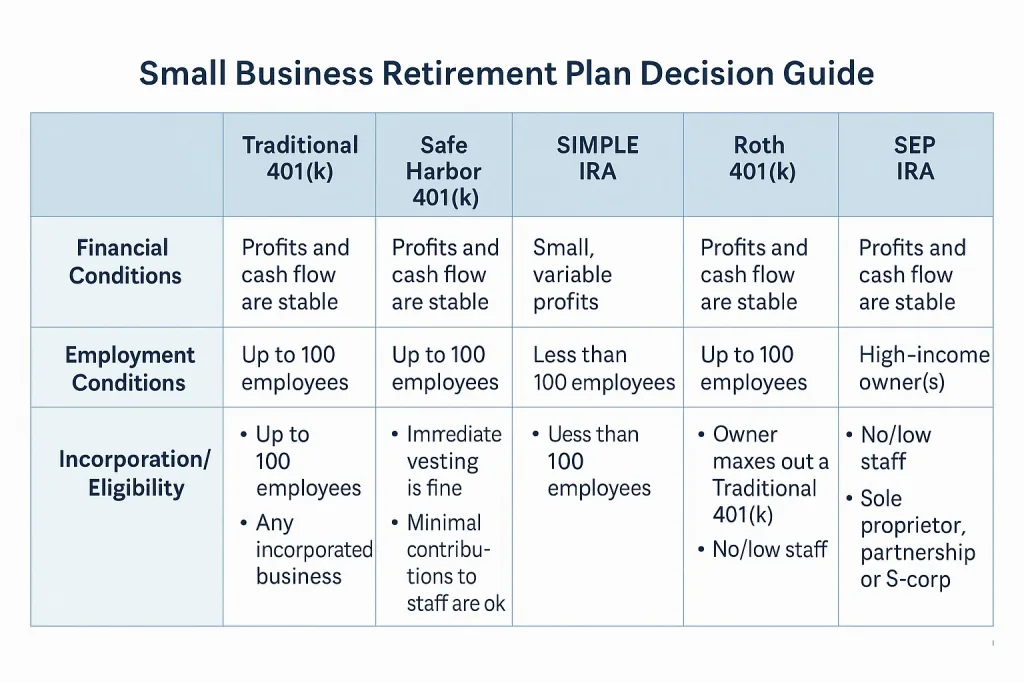
3. Incorporation & Business Structure Conditions
- S-Corporations
Contributions reduce pass-through income, lowering the owner’s personal tax liability. Ideal for S-Corp owners who already max out salary deferrals elsewhere but want extra employer-funded savings. - C-Corporations
Contributions are deductible at the corporate level, reducing taxable profit and thus corporate taxes. Can be used as part of executive compensation without raising W-2 wages. - Partnerships & LLCs
Contributions are based on net earned income, allowing strategic allocation between active partners and employees for tax efficiency.

We focus on the nitty-gritty
so you can relax.
✓ Empowering, game-changing conferences
✓ Schedule a consultation
4. Tax Reduction Conditions
- High federal and state tax brackets
Profit-sharing contributions can drop taxable income enough to move an owner into a lower bracket. - Avoiding payroll tax on additional compensation
Contributions aren’t subject to Social Security or Medicare taxes—unlike bonuses. - Offsetting one-time windfalls
Selling an asset or completing an unusually profitable project? A profit-sharing contribution can absorb taxable income quickly.

Why Choose Profit-Sharing Over Other 401(k) Plans?
| Condition | Profit-Sharing Advantage | Limitation of Other 401(k) Plans |
|---|---|---|
| Variable profits | Contributions are optional | Safe Harbor requires fixed contributions |
| Owner-focused savings | IRS-approved allocation formulas | Safe Harbor must treat all employees equally |
| Year-end tax planning | Decide after year-end | Employee deferrals must occur during payroll periods |
| Employee retention | Vesting schedules allowed | Safe Harbor requires immediate vesting |
| Max contribution potential | Higher limits than SIMPLE | SIMPLE 401(k) caps are much lower |
Example Scenarios
Scenario 1 – S-Corp with Variable Income
Owner earns $200,000 salary. In a strong year, they contribute $50,000 (25% of salary). Federal tax savings at 32% = $16,000+, plus state savings.
Scenario 2 – Professional Partnership
Two partners (ages 55 and 45) with three staff members. Age-weighted allocation allows $50,000 to older partner, $25,000 to younger partner—maximizing contributions where they matter most.
Scenario 3 – C-Corp Retention Strategy
Company contributes $100,000 total with a 6-year graded vesting schedule, aligning benefits with long-term employment.
Bottom Line
A profit-sharing plan is the best fit when:
- Your profits fluctuate but you want to save more in strong years.
- You want control over contribution amounts and timing.
- You need higher owner contributions than other plans allow.
- Retention and vesting strategies matter for your workforce.
- Tax savings are a primary goal.
When these conditions align, profit-sharing can outperform Safe Harbor, Traditional, and SIMPLE 401(k)s—offering more flexibility, bigger tax advantages, and a better fit for long-term business strategy.
Need help getting started? Explore how Emergent Financial Group partners with Retirement Plan providers to bring you flexible, tax-smart options tailored for your business.
Please don’t hesitate to contact us here.

"Helping Businesses Build Better Benefits. Helping Employees Build Better Retirements. RIA in Buckhead. Benefit Planning. Wealth Management. Wills. Trusts. Estate Planning."