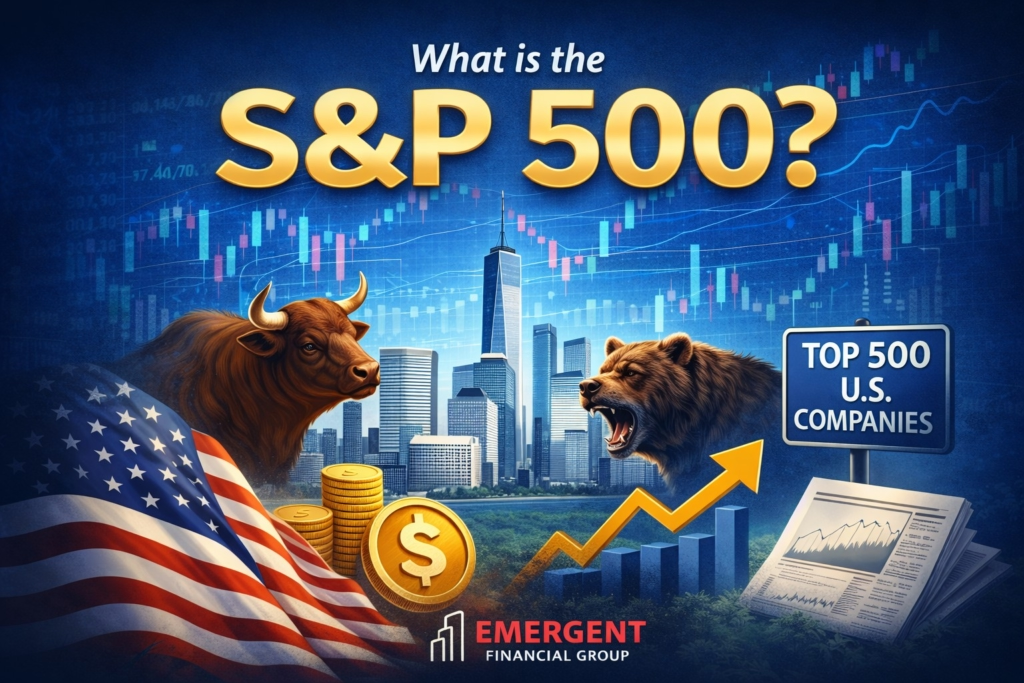
What Is the S&P 500?

History, Market Benchmarks, and Major Indices Across Stocks, Bonds, and Commodities
When people talk about “the stock market,” they are often referring to one index more than any other:
The S&P 500.
The Standard & Poor’s 500 Index, commonly called the S&P 500, is one of the most widely followed financial benchmarks in the world. It measures the performance of 500 of the largest publicly traded companies in the United States, representing a broad cross-section of the American economy.
For investors, the S&P 500 serves as a key reference point for answering a simple question:
How is the overall U.S. stock market doing?
What Is the S&P 500?
The S&P 500 Index tracks large-capitalization U.S. companies across all major sectors, including:
- Technology
- Healthcare
- Financial services
- Consumer goods
- Industrials
- Energy
Market-Cap Weighted Structure
The index is market capitalization weighted, meaning:
- Larger companies (like Apple or Microsoft) have a greater impact
- Smaller companies inside the index influence it less
This makes the S&P 500 a strong reflection of where the majority of U.S. equity value is concentrated.
✅ Official Index Page:
- S&P 500 Index (S&P Global)
https://www.spglobal.com/spdji/en/indices/equity/sp-500/
A Brief History of the S&P 500
The S&P 500 was introduced in 1957, expanding earlier versions of market averages into a broader and more systematic benchmark.
Why It Matters Historically
Since its launch, the S&P 500 has become the standard measure of:
- U.S. corporate growth
- Long-term equity performance
- Retirement portfolio benchmarks
- Index fund construction
It is now the foundation for trillions of dollars in investment products worldwide.
Other Major U.S. Stock Market Indices
While the S&P 500 is the most commonly referenced, several other indices provide additional insight into specific market segments.
1. Dow Jones Industrial Average (DJIA)
The Dow Jones Industrial Average, or the Dow, is one of the oldest indices in existence.
Key Facts
- Created in 1896 by Charles Dow
- Tracks only 30 large U.S. companies
- Is price-weighted, not market-cap weighted
Because of its structure, higher-priced stocks have outsized influence.
✅ Official Dow Index Page:
https://www.spglobal.com/spdji/en/indices/equity/dow-jones-industrial-average/
2. Nasdaq Composite
The Nasdaq Composite measures over 3,000 companies listed on the Nasdaq exchange.
Key Characteristics
- Introduced in 1971
- Heavy technology representation
- Market-cap weighted like the S&P 500
Investors often view the Nasdaq as a gauge of:
- Growth stocks
- Innovation sectors
- Tech-driven market cycles
✅ Nasdaq Index Information:
https://www.nasdaq.com/market-activity/indexes
3. Russell 2000 (Small-Cap Index)
The Russell 2000 Index tracks 2,000 smaller U.S. companies, making it the most common benchmark for small-cap stocks.
Why It Matters
Small companies often behave differently than large companies:
- Higher growth potential
- Higher volatility
- More sensitivity to interest rates and recessions
✅ Russell Index Overview:
https://www.lseg.com/en/ftse-russell/indices/russell-us
Beyond Stocks: Indices That Track Other Asset Classes
Investors often diversify beyond equities into other asset classes such as:
- Bonds
- Precious metals
- Energy
- Agricultural commodities
Fortunately, there are established indices for these markets as well.
Gold Indices
Gold is often viewed as a hedge against inflation and currency risk.
✅ LBMA Gold Price Benchmark:
https://www.lbma.org.uk/prices-and-data/gold-price
✅ SPDR Gold Shares ETF (GLD):
https://www.ssga.com/us/en/individual/etfs/funds/spdr-gold-shares-gld
U.S. Treasury Bond Indices

We focus on the nitty-gritty
so you can relax.
✓ Empowering, game-changing solutions
✓ Schedule a consultation
Treasuries are a core benchmark for conservative portfolios and interest-rate markets.
✅ ICE BofA U.S. Treasury Index:
https://www.ice.com/indices
✅ iShares 7–10 Year Treasury ETF (IEF):
https://www.ishares.com/us/products/239457/ishares-7-10-year-treasury-bond-etf
Oil Indices
Oil is one of the most important global commodity benchmarks.
✅ Brent Crude Benchmark:
https://www.ice.com/products/219/Brent-Crude-Futures
✅ United States Oil Fund (USO):
https://www.uscfinvestments.com/uso
Agricultural Commodity Indices
Commodities like corn, wheat, and soybeans are tracked through futures-based indices and benchmarks.
Corn
✅ CME Corn Futures Benchmark:
https://www.cmegroup.com/markets/agriculture/grains/corn.html
Wheat
✅ CME Wheat Futures Benchmark:
https://www.cmegroup.com/markets/agriculture/grains/wheat.html
Soybeans
✅ CME Soybean Futures Benchmark:
https://www.cmegroup.com/markets/agriculture/oilseeds/soybean.html
Broad Commodity Index (All Commodities)
For investors who want diversified commodity exposure:
✅ Bloomberg Commodity Index (BCOM):
https://www.bloomberg.com/professional/product/indices/bloomberg-commodity-index/
✅ Invesco DB Commodity Index ETF (DBC):
https://www.invesco.com/us/financial-products/etfs/product-detail?productId=DBC
How Investors Use Indices
Market indices are not just statistics. They form the foundation of modern investing through:
- Index funds
- Exchange-traded funds (ETFs)
- Portfolio benchmarks
- Risk and diversification planning
For example:
- SPDR S&P 500 ETF (SPY):
https://www.ssga.com/us/en/individual/etfs/funds/spdr-sp-500-etf-trust-spy - Invesco QQQ (Nasdaq-100):
https://www.invesco.com/qqq-etf/en/home.html - iShares Russell 2000 ETF (IWM):
https://www.ishares.com/us/products/239710/ishares-russell-2000-etf
Conclusion: Why the S&P 500 Matters
The S&P 500 remains the most widely used benchmark for U.S. stock market performance because it represents:
- Large, established American businesses
- Broad sector diversification
- Long-term economic growth trends
Understanding the S&P 500—and related indices across stocks, bonds, and commodities—helps investors make better decisions about:
- Diversification
- Risk management
- Portfolio benchmarks
- Long-term financial planning
At Emergent Financial Group, we help clients evaluate investments in the context of their broader goals—not just market headlines.
"Helping Businesses Build Better Benefits. Helping Employees Build Better Retirements. RIA in Buckhead. Benefit Planning. Wealth Management. Wills. Trusts. Estate Planning."