The Truth about Tariffs, GDP, and Strategic Planning

What High-Income Families Should Actually Be Paying Attention To
Tariffs dominate headlines. But for physicians, attorneys, executives, founders, and multigenerational families in Atlanta and beyond, the real question isn’t whether tariffs are “good” or “bad.”
The question is:
How do tariff policy, trade balances, and fiscal deficits affect taxes, asset values, liquidity events, and long-term estate planning?
To answer that properly, we need to separate politics from mechanics.
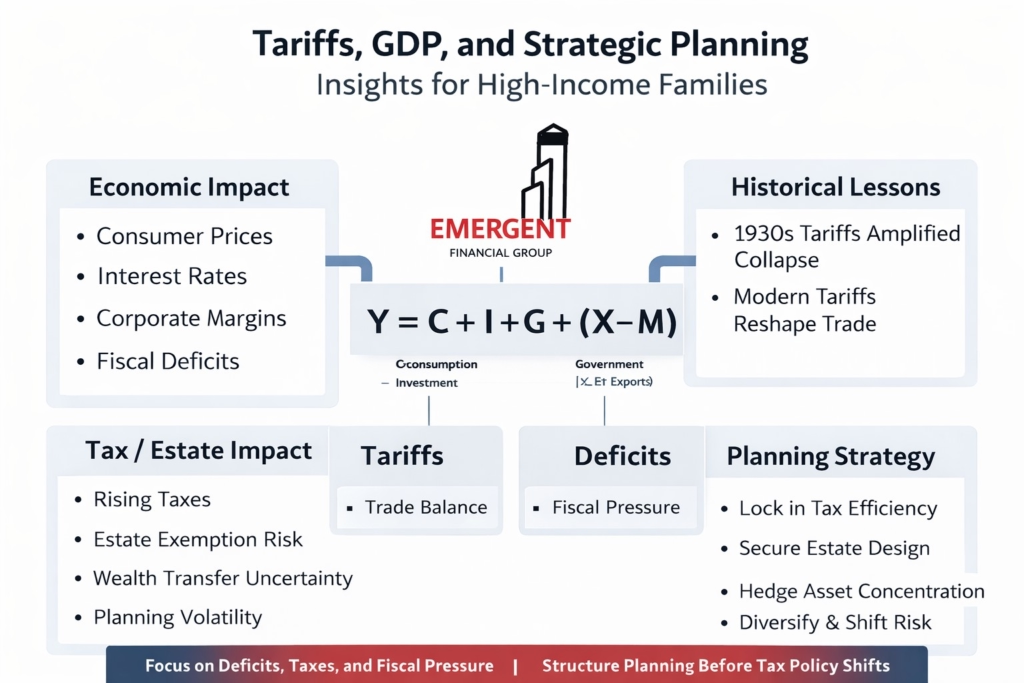
1️⃣ The GDP Identity — Why It Matters for Planning
At the national level, economic output is described by:Y=C+I+G+(X−M)
Where:
- C = Consumption
- I = Investment
- G = Government Spending
- (X − M) = Net Exports
Tariffs influence the final term — net exports — by raising the cost of imports and potentially shifting production domestically.
But for tax and estate planning clients, the key insight is this:
GDP growth is rarely driven by trade balance alone.
It is driven by consumption, investment, government policy, and productivity.
That distinction matters because:
- Tax policy follows fiscal deficits.
- Estate tax exposure follows asset inflation.
- Market returns follow productivity trends.
- Interest rates follow inflation and fiscal pressure.
Tariffs are one variable in a much larger system.
2️⃣ The Historical Warning — And Its Limits
The 1930 Smoot–Hawley Tariff Act is often cited as proof that tariffs cause economic collapse.
What actually happened:
- Tariffs rose to ~59% on dutiable goods.
- Imports fell sharply.
- Exports fell even more.
- Global trade contracted.
- The U.S. was under a rigid gold standard.
- Banking collapse and deflation were already underway.
The lesson for estate planners is not “tariffs cause depressions.”
The lesson is:
Economic fragility + monetary constraint + aggressive policy shocks can compound risk.
Modern tariff policy differs structurally:
- Targeted rather than broad.
- Implemented under floating currencies.
- Supported by aggressive monetary and fiscal stimulus.
- Occurring in a productivity environment driven by technology.
This distinction is crucial when modeling long-term estate outcomes.
3️⃣ Why This Matters for High-Income Tax Planning
Tariffs can influence:
• Inflation
Higher input costs can raise consumer prices.
• Interest Rates
If inflation rises, rates may stay elevated longer.
• Corporate Margins
Some sectors benefit from protection; others face higher costs.
• Fiscal Deficits
Tariff revenue increases government receipts modestly, but deficits are driven primarily by entitlement and spending growth.
For high earners, this translates into:
- Potential future tax increases
- Continued pressure for wealth transfer reform
- Higher estate tax exemption uncertainty after 2026
- Possible capital gains rate adjustments
In other words:
Tariffs are less about trade and more about fiscal trajectory.
And fiscal trajectory drives tax policy.
4️⃣ The Real Risk: Structural Deficits, Not Trade Deficits
The U.S. has run trade deficits for decades.
Yet GDP continued expanding because:
- Consumption remained strong.
- Investment persisted.
- The U.S. dollar remained the global reserve currency.
- Capital flowed into U.S. assets.
For estate planning clients, the larger issue is structural federal deficits — not trade deficits.
Persistent deficits can eventually lead to:
- Higher marginal income taxes
- Reduced estate exemptions
- Changes to GRAT/IDGT strategies
- Increased scrutiny of dynasty trusts
- Medicare means-testing expansion
That is where planning focus belongs.
We meticulously handle your finances
so you don’t have to worry.
We create unique estate plans
that combine your financial goals with our knowledge for notable success.
✓ Minimal risk, maximum return
✓ Over 1,000 financial products
5️⃣ Planning Implications for Affluent Families
Whether tariffs expand, contract, or shift sector performance, planning should assume:
1. Tax policy volatility
Lock in favorable structures while available.
2. Estate exemption uncertainty
Current federal exemption levels sunset in 2026 unless extended.
3. Asset concentration risk
Tariffs can disproportionately impact specific industries (manufacturing, tech hardware, agriculture).
4. Liquidity strategy
Reshoring and industrial policy may create private investment opportunities — but with illiquidity risk.
5. Inflation persistence
Inflation influences:
- Bond strategy
- Trust distribution modeling
- Long-term charitable planning
- Insurance design assumptions
6️⃣ Advanced Strategies in a Policy-Uncertain Environment
For high-income professionals and families, current macro uncertainty reinforces:
• Spousal Lifetime Access Trusts (SLATs)
Before exemption sunset risk.
• Dynasty Trust Funding
While exemption remains elevated.
• Charitable Remainder Trusts (CRT)
For concentrated equity in volatile sectors.
• Grantor Trust Strategies
To shift appreciation outside the taxable estate.
• Roth Conversion Windows
During volatility or lower market valuations.
• Cash Balance & Defined Benefit Plans
To shield high earned income from tax drag.
The macro environment doesn’t change the need for planning — it increases its urgency.

7️⃣ The Bigger Picture
Tariffs are not inherently recessionary.
Nor are they guaranteed growth catalysts.
They operate within:
- Monetary policy
- Fiscal policy
- Productivity trends
- Demographics
- Global capital flows
For estate planning clients, the most important reality is this:
Tax law responds to deficits.
Asset values respond to productivity.
Planning must respond before legislation does.
The GDP identity explains accounting:Y=C+I+G+(X−M)
But wealth preservation depends on:
- Structure
- Timing
- Tax coordination
- Asset protection
- Multigenerational design
Final Perspective for Clients
Economic headlines change quickly.
Tax structures change slowly — until they don’t.
Trade policy may shift margins.
Deficits will shape tax law.
The appropriate response is not political positioning.
It is structural preparation.
If you are a high-income professional, business owner, or multigenerational family, the focus should be:
• Tax efficiency before sunset risk
• Liquidity before policy shifts
• Trust architecture before valuation surges
• Diversification across asset classes and jurisdictions
Because while tariffs influence markets,
tax policy ultimately shapes legacy.
💼 How Emergent Financial Group Helps
At Emergent Financial Group, we help high-net-worth individuals and business owners:
• Structure private loans properly
• Coordinate tax strategy with estate planning
• Integrate gifting strategy with trust planning
• Protect generational wealth
Emergent Financial Group can help you evaluate where your strategy is strong—and where adjustments may be needed.
Need help getting started? Explore how Emergent Financial Group partners with Asset Managers and Strategic Accountants to bring you flexible, tax-smart options tailored to your situation..
Please don’t hesitate to contact us here

"Helping Businesses Build Better Benefits. Helping Employees Build Better Retirements. RIA in Buckhead. Benefit Planning. Wealth Management. Wills. Trusts. Estate Planning."