Could a Private Credit Collapse Trigger ETF and Mutual Fund Failures? What Atlanta Investors and Business Owners Need to Know in 2026

Over the past several months, private credit has moved from one of Wall Street’s favorite asset classes to one of its most closely watched sources of risk.
Recent headlines involving Partners Group, Blackstone, Morgan Stanley, Blue Owl, and other private-credit managers have caused investors to ask an important question:
Could problems in private credit spread into ETFs, mutual funds, retirement plans, and diversified investment portfolios?

For Atlanta investors, business owners, and retirees, understanding the distinction between private-credit stress and a broader ETF collapse is critical. While private-credit markets are experiencing liquidity challenges and redemption pressure, the evidence currently suggests that a repeat of 2008 remains unlikely. However, there are important risks that investors should understand.
What Is Happening in Private Credit?
The private-credit industry has grown from approximately $158 billion in 2010 to nearly $2 trillion globally today. Much of this growth occurred after banks reduced lending following the Global Financial Crisis. Private lenders stepped in to finance middle-market businesses, software companies, private-equity transactions, and other borrowers that traditionally relied on banks.
In 2026, several large private-credit vehicles experienced elevated redemption requests. Firms including Partners Group, Blackstone, and Morgan Stanley have limited withdrawals in certain semi-liquid funds after investors sought to redeem amounts exceeding fund redemption limits.
Importantly, most of these events involve:
- Liquidity concerns
- Redemption requests
- Valuation questions
- Software-sector loan exposure
- Higher refinancing costs
rather than widespread defaults comparable to the mortgage crisis of 2008.
Why Investors Are Comparing Private Credit to Previous Market Crises
The current concerns center on a classic financial-market problem:
Illiquid assets combined with investor liquidity expectations.
Private-credit funds often own loans that may take years to mature. Investors, however, frequently expect quarterly liquidity.
When redemption requests surge, managers may activate gates or redemption limits that are already disclosed in fund documents. Recent redemption restrictions at several large funds illustrate this mismatch.
This is different from insolvency.

A fund limiting withdrawals does not necessarily mean that its assets have become worthless.
Recent Examples of Investment Products That Actually Collapsed
To understand today’s risks, it helps to review situations where investment products genuinely failed.
XIV Volatility ETN (2018)
One of the most famous ETF-related failures occurred when the XIV inverse volatility product collapsed during the “Volmageddon” volatility spike of February 2018.
Why It Failed
- Extreme leverage
- Derivative exposure
- Daily reset mechanics
- Concentrated risk
What It Did Not Own
- Treasuries
- Investment-grade bonds
- Broad stock indexes
Woodford Equity Income Fund (2019)
The Woodford fund became one of the most significant mutual-fund failures in modern history.
Ready to invest?
Secure your financial future
with our professional guidance
Why It Failed
- Illiquid holdings
- Concentration risk
- Liquidity mismatch
Similarity to Private Credit
This is arguably a much closer comparison to today’s private-credit concerns than the Global Financial Crisis.
Could Bond ETFs Collapse Because of Private Credit?
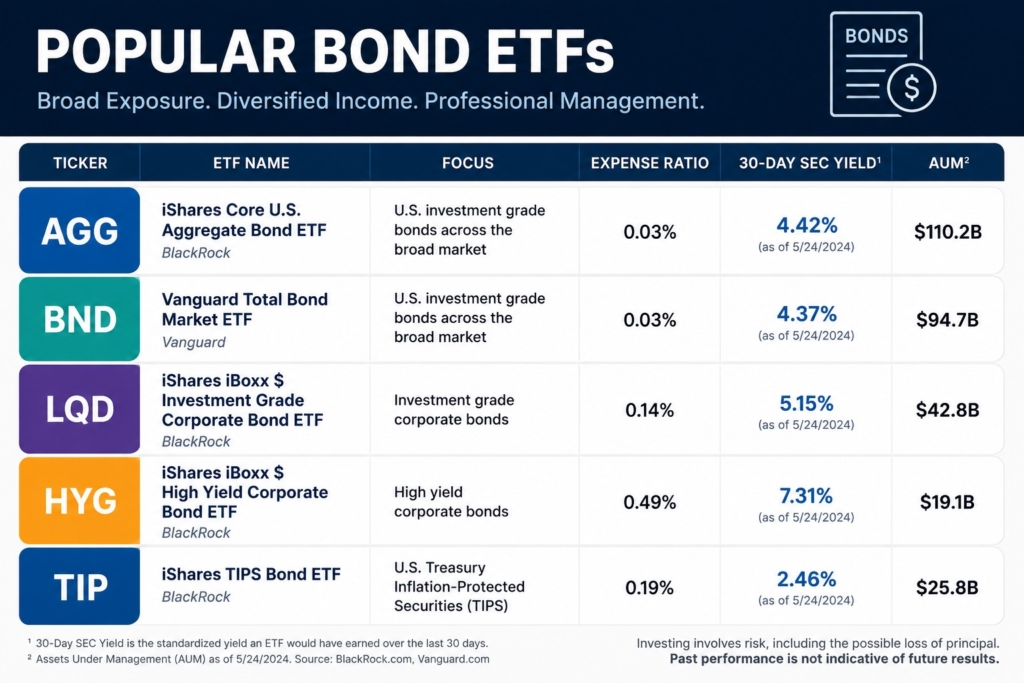
For most investors, the answer is likely no.
Many of the largest bond ETFs have little or no exposure to private credit.
Examples include:
- Vanguard Group Total Bond Market strategies
- BlackRock Aggregate Bond strategies
- State Street Global Advisors Aggregate Bond strategies
These funds primarily own:
- U.S. Treasuries
- Agency mortgage-backed securities
- Investment-grade corporate bonds
- Publicly traded fixed-income securities
Private loans generally do not comprise a meaningful portion of these portfolios.
As a result, a private-credit selloff would likely affect these funds indirectly through widening credit spreads rather than through direct asset impairment.
Which Funds Are Most Vulnerable?
The funds most exposed to a private-credit downturn include:
High Risk
- Business Development Companies (BDCs)
- Evergreen private-credit funds
- Interval funds
- Direct lending funds
- Private debt funds

Moderate Risk
Lower Risk
- Treasury ETFs
- Aggregate bond ETFs
- Municipal bond funds
- Broad-market index funds
- S&P 500 ETFs
- Nasdaq 100 ETFs
Could Technology ETFs Be Impacted?
Technology ETFs generally do not own private-credit loans.
However, they could experience indirect pressure.
If private-credit defaults increase significantly:
- Lending standards tighten.
- Financing becomes more expensive.
- Corporate borrowing slows.
- Economic growth weakens.
- Equity valuations compress.
This transmission mechanism would affect technology stocks through the economy rather than through direct private-credit exposure.
What About Leveraged and Inverse ETFs?
Leveraged ETFs deserve special attention.

Research continues to show that leveraged ETFs can underperform investor expectations over long holding periods because of volatility and daily rebalancing mechanics.
The primary risks involve:
- Counterparty exposure
- Derivatives
- Financing costs
- Volatility drag
- Daily reset structures
These risks differ substantially from private-credit risks.
A private-credit crisis alone would not necessarily cause leveraged ETFs to fail.
Could a Private Credit Collapse Trigger a Broader ETF Selloff?
A severe private-credit downturn could trigger:
- Wider corporate credit spreads
- Higher borrowing costs
- Reduced lending activity
- Slower economic growth
- Lower equity valuations
However, history suggests that broad ETF failures are rare.
Most ETF closures occur because:
- Assets are too small
- Investor demand disappears
- The strategy becomes uneconomic
rather than because the underlying securities become worthless.
Characteristics of More Secure ETFs and Mutual Funds

Investors seeking resilience during periods of market stress often prioritize:
Diversification
Funds holding thousands of securities typically experience less idiosyncratic risk.
Liquidity
Funds invested in highly liquid securities can generally meet redemption requests more efficiently.
Transparency
Daily disclosure of holdings allows investors to understand risks more clearly.
Scale
Larger funds generally benefit from greater trading volume and operational stability.
How Much of the Fund Industry Could Be Directly Affected?
Although private credit has grown dramatically, it remains a relatively small portion of the overall investment universe.
Most estimates suggest that direct private-credit exposure represents only a small percentage of total ETF and mutual-fund assets globally. The most significant risks remain concentrated among:
- BDCs
- Evergreen private-credit funds
- Direct-lending vehicles
- Alternative-credit strategies
rather than traditional stock and bond funds.
External References
- Reuters coverage of Partners Group redemption restrictions
- Reuters coverage of Blackstone private-credit redemption limits
- Financial Stability Board Report on Vulnerabilities in Private Credit
- JPMorgan Private Credit Under the Microscope
- Charles Schwab: Understanding Recent Developments in Private Credit
What Atlanta Investors Should Watch

For investors in Atlanta and throughout Georgia, the key indicators to monitor include:
- High-yield credit spreads
- Loan default rates
- BDC redemption activity
- Private-credit fund gating announcements
- Bank lending standards
- Corporate refinancing activity
These indicators may provide earlier warnings than stock prices alone.
Related Articles
- What Is Portfolio Rebalancing?
- Roth Conversions for Individuals and Business Owners
- The 3 Tax Buckets of Retirement Planning
- How Portfolio Risk Changes During Market Stress
- What Is the S&P 500?
Final Thoughts
Private credit is undergoing its first major stress test since becoming a trillion-dollar asset class.
While the current environment has created legitimate concerns surrounding liquidity, redemption requests, and valuations, there remains a substantial difference between stress in private-credit funds and a systemic collapse of ETFs and mutual funds.
Investors should focus less on sensational headlines and more on understanding exactly what their funds own, how liquid those holdings are, and whether the risks align with their long-term financial objectives.
For most diversified investors, the greatest threat is unlikely to be a collapse of Treasury ETFs or broad-market index funds. Instead, the larger risk is that a prolonged private-credit downturn could contribute to tighter financial conditions, slower growth, and wider credit spreads across the broader economy.
Need help getting started?
Explore how Emergent Financial Group partners with families, employees and small business owners for comprehensive wealth management and estate planning.
Helping Atlanta Businesses Build Stronger Financial Futures
If your company is reviewing employee benefits, executive compensation structures, or long-term wealth strategies, the advisors at Emergent Financial Group help Atlanta companies design benefit programs that strengthen employee loyalty and financial security.
Please don’t hesitate to contact us here

"Helping Businesses Build Better Benefits. Helping Employees Build Better Retirements. RIA in Buckhead. Benefit Planning. Wealth Management. Wills. Trusts. Estate Planning."