Generational-Skipping Trusts vs. Dynasty Trusts: How the Wealthy Build Enduring Legacies

Introduction
In advanced estate planning, a central goal is not only to transfer wealth but also to preserve it — across multiple generations — while minimizing taxes, maintaining control, and protecting assets from creditors or divorce. Two sophisticated strategies, the Generational-Skipping Trust (GST) and the Dynasty Trust, have become cornerstones of multi-generational wealth design.
Both were originally tools of the ultra-wealthy, but with today’s estate tax thresholds and state trust laws, these strategies are increasingly accessible to high-net-worth families and small-business owners seeking to create lasting family legacies.

1. The Generational-Skipping Trust (GST)
Definition and Purpose
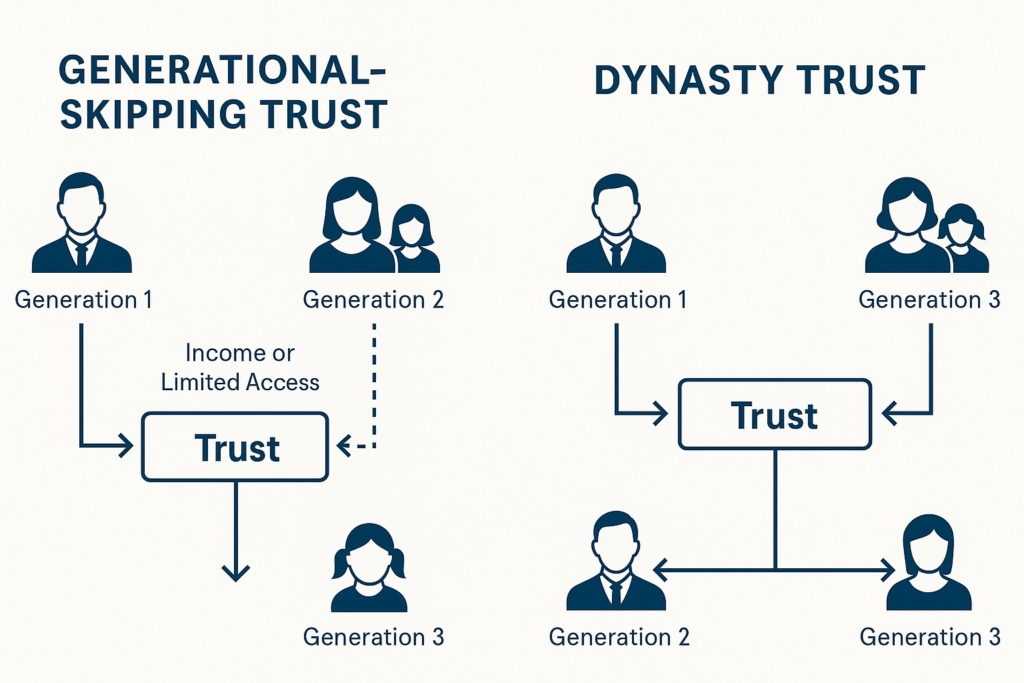
A Generational-Skipping Trust is an irrevocable trust designed to bypass one generation — usually the grantor’s children — and transfer wealth directly to the grandchildren (or later descendants). The key motivation is to avoid double taxation on estate transfers that would otherwise occur at each generational level.
Example:
If John transfers $5 million directly to his children, that amount may later be taxed again when those children pass wealth to their own heirs. But if John instead places $5 million into a GST benefiting his grandchildren, the assets skip the children’s taxable estate and continue growing for the next generation — avoiding estate tax once entirely.
Tax Mechanics
The trust takes advantage of the Generation-Skipping Transfer Tax (GSTT) exemption, which mirrors the federal estate tax exemption (in 2025, approximately $13.61 million per individual, or $27.22 million for married couples). Transfers beyond that exemption face a flat 40% GST tax, so the trust must be carefully drafted and funded within the limits.
Control and Flexibility
Although the trust “skips” a generation, the skipped generation (e.g., the children) can still receive income or limited access as beneficiaries — the IRS only cares that the principal ultimately passes outside their taxable estates. This allows families to balance flexibility with tax avoidance.
2. The Dynasty Trust
Definition and Purpose
A Dynasty Trust is an ultra-long-term trust — often designed to last centuries or indefinitely — that keeps assets within the trust structure for successive generations. Its goal is to create perpetual family wealth, where the trust, not individuals, owns the assets.
Legal Foundation
The Dynasty Trust depends on state law. Many states (such as Delaware, Nevada, South Dakota, and Alaska) have modified or abolished the Rule Against Perpetuities, allowing trusts to last hundreds of years. Georgia, for instance, allows trusts to continue for up to 360 years.
Tax Efficiency
Like a GST, a Dynasty Trust leverages the lifetime gift and GST exemptions upfront. Once funded, the trust avoids further estate and GST taxes forever, regardless of how large it grows — as long as it remains properly structured and the beneficiaries don’t take direct ownership.
Asset Protection and Growth
Because the assets stay inside the trust, they are shielded from:
- Divorce settlements
- Creditors and lawsuits
- Mismanagement by heirs
The trust can distribute income according to a Trustee’s discretion, often using “HEMS” (Health, Education, Maintenance, and Support) standards to keep distributions tax-efficient.
3. Comparing GSTs and Dynasty Trusts
| Feature | Generational-Skipping Trust | Dynasty Trust |
|---|---|---|
| Primary Goal | Avoid estate tax on skipped generation | Perpetual, tax-sheltered family wealth |
| Duration | Typically 2–3 generations | 100+ years or perpetual |
| Beneficiaries | Grandchildren or great-grandchildren | All future descendants |
| Tax Focus | Avoids double taxation | Avoids taxation forever (estate + GST) |
| State Law Dependency | Works in all states | Requires favorable state laws |
| Control | Moderate (children can benefit indirectly) | High, via trustee and governance documents |
4. How They Compare to Other Trust Strategies
Revocable Living Trust
- Designed for probate avoidance and privacy, not tax savings.
- Becomes irrevocable at death.
- Offers no GST or estate tax advantages.
Irrevocable Life Insurance Trust (ILIT)
- Holds life insurance policies outside the taxable estate.
- Often paired with a GST or Dynasty Trust to provide tax-free liquidity for estate taxes or to endow future generations.
Charitable Remainder Trust (CRT)

We focus on the nitty-gritty
so you can relax.
✓ Empowering, game-changing solutions
✓ Schedule a consultation
- Provides income to beneficiaries for life or a term, then passes remaining assets to charity.
- Useful for income tax deductions and capital gains deferral, but not a perpetual family wealth vehicle.
Spousal Lifetime Access Trust (SLAT)
- Allows one spouse to gift assets into an irrevocable trust benefiting the other spouse (and possibly descendants), maintaining indirect access.
- Often a complementary strategy to Dynasty or GST structures for married couples.
Family Limited Partnership (FLP) or Family LLC

- Used to centralize and control family assets while gifting interests at discounted valuations.
- Frequently integrated inside a Dynasty Trust for even greater tax and control advantages.
5. Real-World Example: A Three-Generation Strategy
Generation 1: A business owner contributes $10 million to a GST-Dynasty hybrid trust in Nevada.
Generation 2 (children): Receive income distributions for life but never own the assets outright.
Generation 3+ (grandchildren and beyond): Continue receiving distributions and education funding for centuries.
Meanwhile, the trust:
- Grows tax-free inside the structure
- Avoids probate, estate tax, and GST tax forever
- Maintains professional trustee oversight and investment management
6. Why Families Combine GSTs and Dynasty Trusts
In modern planning, these two structures often overlap. A Dynasty Trust funded using the GST exemption effectively becomes a Generation-Skipping Dynasty Trust, providing the best of both worlds:
- Long-term tax-free compounding
- Multigenerational protection
- Governance continuity (family council, trustee board, investment committee)
7. Key Takeaways
- The Generational-Skipping Trust avoids one round of estate tax.
- The Dynasty Trust avoids all future estate taxes by keeping wealth in trust indefinitely.
- Both require careful coordination of GST exemptions, state trust law, and trustee selection.
- When integrated with LLCs, ILITs, SLATs, or CRTs, these structures can form the core of a multigenerational family office strategy.
8. Conclusion
For families who wish to preserve wealth, values, and opportunity for future generations, Generational-Skipping and Dynasty Trusts are two of the most powerful tools available. They embody the principle of stewardship — ensuring that wealth serves as a foundation for education, enterprise, and philanthropy long after the original wealth creators are gone.
In the words of John D. Rockefeller, who used similar mechanisms over a century ago:
“The only question with wealth is, what do you do with it?”
Need help getting started?
Explore how Emergent Financial Group partners with Families and Small Business Owners for comprehensive Estate Planning.
Please don’t hesitate to contact us here

"Helping Businesses Build Better Benefits. Helping Employees Build Better Retirements. RIA in Buckhead. Benefit Planning. Wealth Management. Wills. Trusts. Estate Planning."