What Is ICHRA Group Health Insurance?

An Individual Coverage Health Reimbursement Arrangement (ICHRA) is not an insurance policy itself, but an employer-funded reimbursement mechanism that was established in 2020. Employers set a fixed amount of pre-tax dollars for employees to use toward individual health insurance premiums or qualified medical expenses. Employees must purchase their coverage on the individual market—through state or federal exchanges, brokers, or carriers.

Advantages of ICHRA:
- Predictable employer cost structure via fixed reimbursements
- Greater employee choice—individual plan selection tailored to their needs
- Tax advantages for both employers and employees
- ACA compliance and portability—especially valuable when employees leave
Comparing ICHRA vs. Other Group Health Models
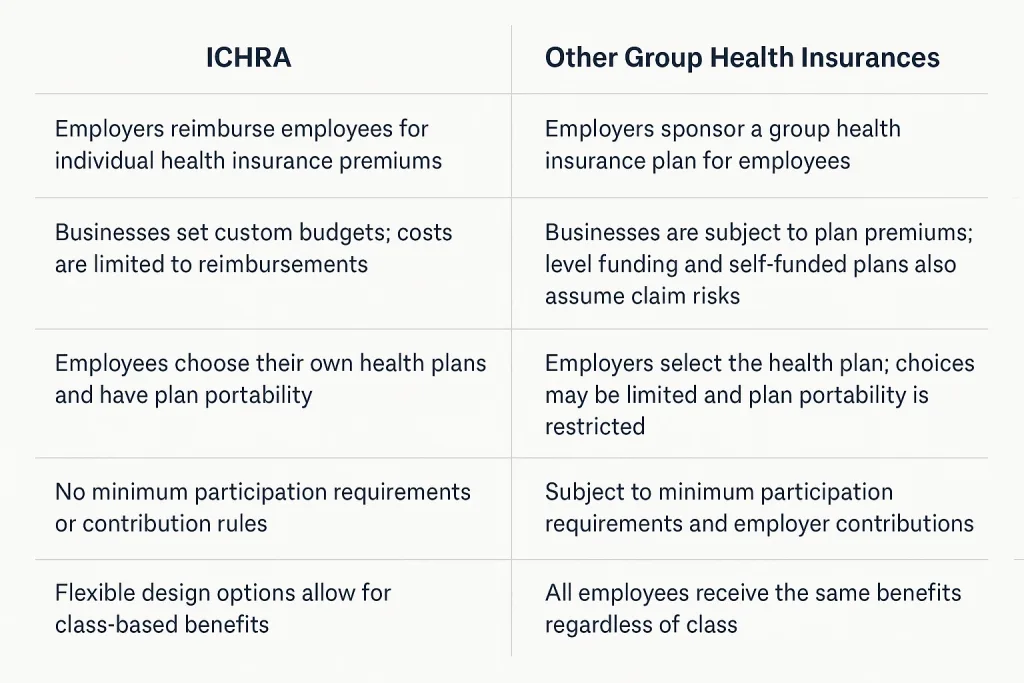
1. Level-Funded Group Health Insurance
A hybrid: employers pay a set monthly amount covering expected claims, admin fees, and stop-loss insurance (for catastrophic claims). At year’s end, unused funds may be refunded
Advantages:
- Predictable costs with potential refunds for low claims
- Risk protection via stop-loss insurance
- Access to wellness programs or customized benefits
Drawbacks:
- Requires minimum enrollment (often ~10+ employees)
- Exposure to rising stop-loss premiums
- Regulatory reporting under ERISA
2. Self-Funded Health Insurance
Advantages:
- Maximum plan design flexibility.
- Potential cost savings if claims are moderate.
Drawbacks:
- High financial risk if unexpected high claims occur.
- Stronger regulatory oversight and compliance burden (ERISA, HIPAA).
3. Traditional (Fully-Funded) Group Health Insurance
Employers purchase a group policy covering employees and share costs with them. The insurer assumes risk.
Advantages:
- Simplicity and familiarity.
- Comprehensive, standardized coverage.
- Employee loyalty and ease of administration ehealth.
Drawbacks:
- Rising and unpredictable premiums.
- Participation minimums required.
- Limited employee choice and portability.
Summary Table
| Plan Type | Cost Predictability | Employee Choice | Risk Exposure | Best Fit for Small Employers |
|---|---|---|---|---|
| ICHRA | High | High | Low (employer fixed) | 2–20 employees |
| Level-Funded | Moderate | Moderate | Moderate (stop-loss) | 10+ employees |
| Self-Funded | Low | High | High | Larger employers |
| Traditional Group | Low | None (preset options) | Low (insurer) | Larger or risk-averse firms |
Why ICHRA Works Especially Well for Small Businesses
Size Tier: 2–5 Employees
- ICHRA’s strengths shine here: No participation minimums means even tiny teams can access benefits.
- Traditional group insurance is costly and restrictive; level‑funded and self‑funded often require too much scale.
- ICHRA provides affordable, flexible coverage, enabling even 2–5 employee businesses to offer health benefits without large financial commitment.

We focus on the nitty-gritty
so you can relax.
✓ Empowering, game-changing conferences
✓ Schedule a consultation
Size Tier: 5–10 Employees
- ICHRA continues to offer better cost control and flexibility.
- Level‑funded may now be an option, but with complex setup and higher risk.
- Self‑funded still too risky at this scale.
- Traditional group plans still expensive and less flexible, making ICHRA a standout choice.
Size Tier: 10–20 Employees
- ICHRA remains competitively attractive due to predictability and personalization.
- Level‑funded plans become more accessible, but ICHRA still offers easier administration, more employee freedom, and no risk exposure.
- Self‑funded may be feasible, but requires substantial reserves and risk tolerance.
- Standard plans still lock employers into uniform offerings and rising premiums.
Market Trends: Usage in Georgia (GA)
I couldn’t locate Georgia‑specific percentages for ICHRA, level‑funded, self‑funded, or standard group insurance adoption compared to 5 years ago.
However, nationally:
- Level‑funded enrollment in small businesses increased from 6% in 2018 to 38% in 2023.
- One study noted employers with fewer than 200 employees offering level‑funded plans rose from 13% in 2020 to 42% in 2021.
- As for self‑funded plans, about 20% of workers at small organizations had self‑insured coverage in 2024.
- ICHRA adoption is growing—most new adopters (83%) previously offered no health benefits, suggesting it’s enabling benefits where none existed.
- Exact percentages for Georgia and change over time remain unavailable from publicly accessible sources.
State-Level Data: Availability & Gaps
1. UGE Small Businesses Offering Any Health Insurance (Georgia)
- As of 2023, only 30.1% of small businesses nationwide offer health coverage—a steep drop from 47.2% in 2000. While this is a national figure, it indicates broader downward pressure, especially in states like Georgia, which often fall below average for offerings.
2. ICHRA Adoption in Georgia
- Nationally, ICHRA adoption is growing fast—up 29% from 2023 to 2024, and over 1,000% since 2020. Over 13,000 U.S. businesses now offer ICHRA or QSEHRA, covering more than 260,000 employees.
- However, state‑specific (Georgia) breakdowns for ICHRA are not publicly available, including year‑over‑five‑years comparisons.
3. Level-Funded Plan Adoption in Georgia
- Nationally, small employers offering level‑funded health plans rose from 6% in 2018 to 35% in 2023.
- Some Georgia-based insurance providers (e.g., Blue Cross affiliates) promote level-funded plans for local small businesses, but none appear to publish statewide adoption rates or historical trends.
4. Self-Funded Group Health Insurance
- Generally used by larger employers, with only about 13% of firms with fewer than 100 employees offering self‑funded plans as of 2014 (national data).
- No Georgia-specific adoption percentages found.
5. Standard (Traditional Fully-Insured) Group Health Insurance
- Nationally declining trend; no specific Georgia data found.
- We only know overall small-business offering rates (see point 1), not by plan type.
Summary Table of Available Data
| Plan Type | Georgia-Specific Data Available? | Trends (U.S., if GA missing) |
|---|---|---|
| ICHRA | No | Adoption up 29% (2023–2024); over 1,000% since 2020 |
| Level-Funded Group Plans | No | Adoption rose from 6% (2018) to 35% (2023) |
| Self-Funded Health Insurance | No | ~13% of sub-100-employee firms (2014 data) |
| Standard (Fully-Insured) Group Plans | No | General decline in small-business offerings (to ~30% in 2023) |

Final Thoughts
ICHRA offers small businesses—from as few as 2 employees up to around 20—a powerful combination of budget control, employee autonomy, administrative ease, and insurance portability. It stands out where traditional, level-funded, or self-funded plans fall short due to cost, complexity, or scale requirements.
While Georgia-specific adoption data isn’t available, national trends show a clear shift: level-funded and self-funded options are growing, and ICHRA is empowering more small employers to finally offer benefits—many for the first time.
Need help getting started? Explore how Emergent Financial Group partners with Retirement Plan providers to bring you flexible, tax-smart options tailored for your business.
Please don’t hesitate to contact us here.
"Helping Businesses Build Better Benefits. Helping Employees Build Better Retirements. RIA in Buckhead. Benefit Planning. Wealth Management. Wills. Trusts. Estate Planning."