Welcome to our Knowledge Base
Types of Group Healthcare Plans

What Are the Differences Between Group Healthcare Plans
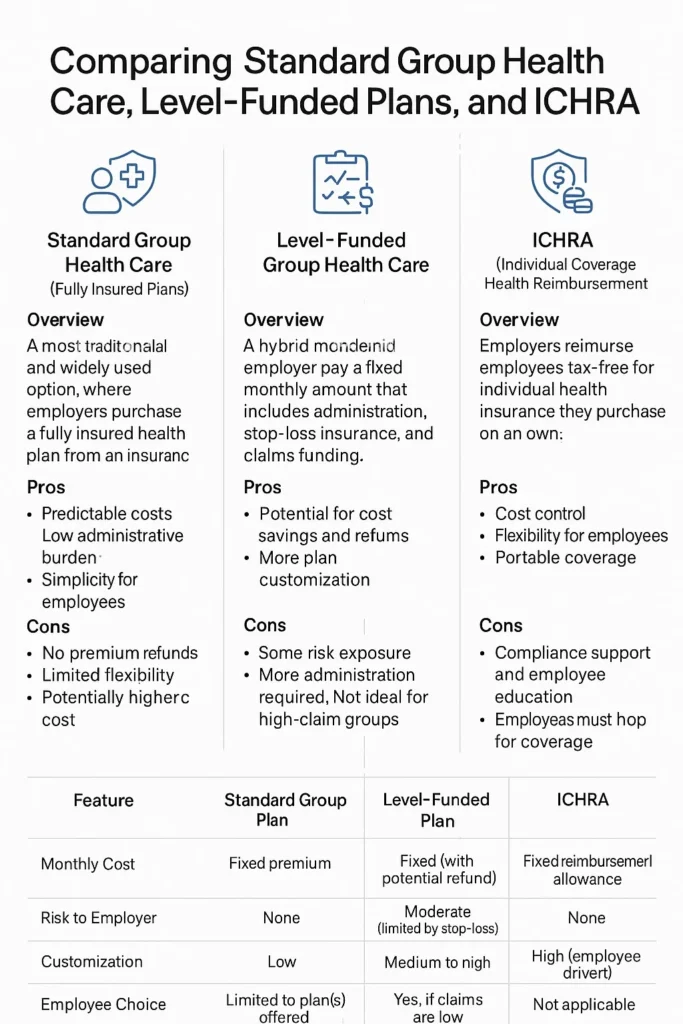
Here’s a breakdown of the differences between Standard Group Health Care, Level-Funded Group Health Care, and ICHRA (Individual Coverage Health Reimbursement Arrangement) Group Health Care — all of which are ways employers can offer health benefits, but they differ significantly in structure, risk, flexibility, and administration.

1. Standard Group Health Care (Fully Insured Plans)
Overview:
- Traditional employer-sponsored health insurance plan.
- Employer purchases a policy from an insurance carrier.
- Premiums are fixed and paid monthly regardless of claims.
Key Features:
- Premiums: Fixed monthly premium per employee.
- Risk: Insurance carrier assumes all risk.
- Simplicity: Easy to understand and administer.
- Regulation: Subject to state insurance mandates and ACA rules.
- Employee Choice: Limited to plan(s) the employer selects.
- Cost Predictability: High — costs are known in advance.
Best For:
- Employers who want simplicity and minimal financial risk.
- Small businesses that prefer predictability over customization.
2. Level-Funded Group Health Care
Overview:
- A hybrid between fully insured and self-funded plans.
- Employer pays a fixed monthly amount that includes:
- Administrative fees
- Stop-loss insurance
- Claims funding
Key Features:
- Premiums: Fixed monthly payment (level funding).
- Risk: Employer shares risk but protected by stop-loss coverage.
- Claims Surplus: Potential refund if claims are lower than expected.
- Customization: More plan design flexibility than fully insured.
- Underwriting: Often requires health questionnaires for pricing.
- Regulation: Often exempt from some state insurance mandates (ERISA governed).
Best For:
- Employers with 5–100 employees looking to control costs.
- Groups with healthier populations who may benefit from surplus refunds.

Strategically-Crafted Benefit Plans
3. ICHRA (Individual Coverage Health Reimbursement Arrangement)
Overview:
- Employer reimburses employees tax-free for health insurance they purchase individually (on the ACA marketplace or elsewhere).
- Employees choose their own plan.
Key Features:
- Premiums: No group plan premiums; employer sets a fixed reimbursement amount.
- Risk: No claims risk for employer — cost is capped at reimbursement.
- Flexibility: Employees choose any ACA-compliant plan.
- Portability: Plans stay with employees even if they leave the company.
- Administration: Requires substantiation of coverage and compliance support.
- Affordability Test: Subject to ACA rules for applicable large employers.
Best For:
- Employers who want predictable costs and flexible options.
- Businesses with remote or geographically dispersed employees.
- Startups or small businesses wanting to offer health benefits without managing a group plan.
Quick Comparison Table
| Feature | Standard Group | Level-Funded | ICHRA |
|---|---|---|---|
| Premium Type | Fixed | Fixed w/ potential refund | Fixed reimbursement limit |
| Risk to Employer | Low | Moderate (with stop-loss) | None |
| Customization | Low | Medium-High | High (individual choice) |
| Regulatory Oversight | State + ACA | ERISA + ACA | IRS + ACA (ICHRA rules) |
| Employee Plan Options | Employer-selected | Employer-selected | Employee-selected |
| Portability | No | No | Yes |
| Best for | Simplicity & predictability | Cost control & healthy groups | Flexibility & cost containment |
Please don’t hesitate to contact us here.
"Helping Businesses Build Better Benefits. Helping Employees Build Better Retirements. RIA in Buckhead. Benefit Planning. Wealth Management. Wills. Trusts. Estate Planning."