Best Retirement & Health Insurance Strategies for Small Businesses with 5–10 Employees

Small businesses with 5–10 employees are at the size where benefit planning has a big impact on employee retention, tax savings, and long-term business growth. The right retirement plan and group health insurance structure can create thousands in annual savings for the owner while offering competitive benefits to staff.
In this article, we’ll break down:
- Best retirement plan options for a C-Corp with 5–10 employees
- Best health insurance structure for an S-Corp with 5–10 employees
- Side-by-side examples with tax breakdowns
1️⃣ Best Retirement Plan for a C-Corp with 5–10 Employees
When you have 5–10 employees in a C-Corporation, you can take advantage of the ability to fully deduct employer contributions from corporate taxable income and avoid FICA payroll taxes on those contributions.
Common Retirement Plan Options
| Plan Type | Max Employer Contribution (2025) | Admin Cost | Employer Flexibility | Best For |
|---|---|---|---|---|
| SEP IRA | 25% of compensation up to $69,000 | Low | Low – must give same % to all | High owner contribution, simple admin |
| SIMPLE IRA | $16,000 + $3,500 catch-up | Low | Low – fixed 3% match or 2% nonelective | Businesses avoiding 401(k) testing |
| Safe Harbor 401(k) | $23,000 deferral + $7,500 catch-up + 3–4% match | Medium | Medium – fixed match but higher owner savings | Avoid IRS testing, attract employees |
| Traditional 401(k) + Profit Sharing | $69,000 total per person | Higher | High – allocate profit sharing strategically | Maximize owner + key employee savings |
| Cash Balance Plan | $100k–$300k+ (age-based) | High | High – complex | High earners wanting very large tax deductions |
Best Choice for 5–10 Employee C-Corp:
Safe Harbor 401(k) with Profit Sharing Add-On
Why?
- Avoids annual nondiscrimination testing so owners can contribute maximum amounts.
- Allows salary deferrals + employer contributions up to $69,000 per person (under age 50).
- Contributions are tax-deductible to the C-Corp at 21% corporate rate and not subject to FICA payroll taxes.
Example – C-Corp Safe Harbor 401(k) with Profit Sharing
Assumptions:
- Owner salary: $200,000
- 7 employees, avg salary $60,000
- Safe Harbor Match: 4% of pay
- Profit Sharing: 15% of owner salary, 8% of employee salary
| Contribution Type | Owner Contribution | Employee Total | Corporate Tax Deduction (21%) |
|---|---|---|---|
| Owner 401(k) Deferral | $23,000 | — | $4,830 |
| Owner Profit Sharing | $30,000 | — | $6,300 |
| Employee Safe Harbor Match | — | $16,800 | $3,528 |
| Employee Profit Sharing | — | $33,600 | $7,056 |
| Total | $53,000 | $50,400 | $21,714 |
Result:
- Owner saves $53,000 tax-deferred for retirement.
- C-Corp lowers its taxable income by $103,400, saving $21,714 in corporate taxes.
2️⃣ Best Group Health Insurance for an S-Corp with 5–10 Employees
Health insurance strategy for an S-Corp is different because:
- S-Corp shareholders owning >2% must include premiums in taxable income, but can deduct them personally.
- The business still deducts premiums as an expense.
The Three Main Options
1. Standard Small Group Health Insurance
- ACA-compliant, no medical underwriting.
- Employer typically pays 50%–75% of premiums.
- Predictable coverage, strong provider networks.
- Downside: Higher premiums; participation rules apply.
2. ICHRA (Individual Coverage Health Reimbursement Arrangement)
- Employer gives employees a tax-free allowance to buy their own ACA plan.
- Flexible budgets; no participation requirements.
- Employees choose their own plan — better for geographically spread-out teams.
- Downside: Employees must shop individually.

Strategically-Crafted Benefit Plans
3. Level-Funded Health Plans
- Hybrid of self-insured and fully insured plans.
- Potential refund of unused claim funds if the group is healthy.
- Can be cheaper than ACA group plans for young/healthy employees.
- Downside: Underwriting required; rates can spike after bad claim years.
Best Choice for S-Corp with 5–10 Employees:
- ICHRA if employees live in areas with strong ACA plan options and want flexibility.
- Level-Funded Plan if the group is healthy and wants lower premiums with potential refunds.
Example – S-Corp Health Plan Cost Comparison
Assumptions:
- 8 employees (including owner)
- Standard group premium: $7,200/year per employee
- ICHRA allowance: $500/month per employee ($6,000/year)
- Level-funded premium: $6,600/year per employee
- S-Corp marginal rate: 22%
| Plan Type | Annual Employer Cost | Tax Deduction (22%) | Net Cost |
|---|---|---|---|
| Standard Group | $57,600 | $12,672 | $44,928 |
| ICHRA | $48,000 | $10,560 | $37,440 |
| Level-Funded | $52,800 | $11,616 | $41,184 |
Result:
- ICHRA saves ~$7,500/year compared to standard group insurance.
- Level-funded can save ~$3,700/year and offers refund potential.
How to choose—5–10 employees
First, align on goals & constraints
- Owner goals: shelter how much this year? predictable vs. flexible spend? reward a few key people?
- Workforce shape: average age, pay skew (owner vs. staff), turnover risk.
- Admin appetite: DIY/light vs. full-service TPA/recordkeeper.
- Cash-flow stability: safe-harbor promises and health plan renewals require consistency.
- Compliance & credits: SECURE 2.0 startup credits, PCORI fee (level-funded), ERISA notices.
Retirement plan—best fit logic (5–10 employees, usually a C-Corp in this scenario)
Why SEP/SIMPLE often lose at 5–10 employees
- SEP IRA: same % to everyone. To get the owner 25% of comp, you must give the same 25% to all employees—fast becomes the most expensive option.
- SIMPLE IRA: low admin, but low caps and a mandatory 3% match/2% nonelective every year.
Why a Safe Harbor 401(k) + Profit Sharing usually wins
- Max owner savings with minimal testing pain. Use either 3% nonelective or basic match to “buy” testing relief, then layer profit sharing (often “new comparability”) to tilt dollars to owners/key staff while still passing.
- All employer dollars are deductible to the C-Corp and not subject to FICA.
- Add a Cash Balance only when profits are steady and the owner wants $100k–$300k+ additional deductible contributions (age and demographics matter).
Quick cost contrast (clean math)
Assume owner comp $200,000, seven employees avg $60,000.
Goal: give owner a ~25% employer contribution.
- SEP IRA (25% uniform):
- Owner: 25% × $200k = $50,000
- Staff: 25% × 7 × $60k = $105,000
- Employer outlay = $155,000 (big, and no salary deferral feature).
- Safe Harbor 401(k) (3% nonelective) + profit sharing:
- SH nonelective to all: 3% × total payroll [$200k + $420k] = $18,600
- Profit sharing: allocate ~15% to owner ($30,000), ~5–8% to staff (say 6% average → 0.06 × $420k = $25,200)
- Employer outlay ≈ $73,800 (vs. $155,000 for SEP)
- Owner can also defer $23,000 (+$7,500 catch-up if 50+) on top of employer dollars.
Result: 401(k) + PS delivers similar owner benefit at ~½ the employer cost of a SEP in a typical 5–10 person team.

We focus on the nitty-gritty
so you can relax.
✓ Empowering, game-changing conferences
✓ Schedule a consultation
When to add a Cash Balance (CB)
- Owner age 45+, stable profits, low turnover.
- Pair SH 401(k) + CB to push total deductible owner dollars well above DC plan caps.
- Watch gateway & cross-testing: CB designs still require meaningful allocations to non-HCEs; model it with a TPA.
Implementation checklist (retirement)
- Choose SH formula: 3% nonelective (most flexible) vs. basic match (popular with staff).
- Adopt new comparability PS with a TPA who will test scenarios before plan year.
- Add auto-enrollment to boost participation and reduce refund noise.
- SECURE 2.0 credits can offset admin/startup and some employer contributions (verify with your CPA).
- Bond + 5500 + SPD: don’t skip the blocking and tackling.
Group health—best fit logic (5–10 employees, put this one on the S-Corp)
You’re choosing among Standard Small Group, ICHRA, and Level-Funded. For 5–10 lives, all three can work—the right pick depends on health risk, local market strength, and employee preferences.
Standard small-group (fully insured)
- Pros: ACA-compliant, no medical underwriting, predictable benefits/networks, easy to explain.
- Cons: Often the highest premium at this size; participation rules apply (e.g., 70%).
ICHRA (individual coverage HRA)
- Pros: Employer sets a clean monthly allowance; no participation requirement; employees pick any ACA plan (great if they’re spread across counties/states).
- Cons: Each employee shops their own plan; affordability rules interact with premium tax credits (an “affordable” ICHRA makes employees ineligible for PTC).
- S-Corp wrinkle: >2% S-Corp owners have special rules—coordination with §162(l) deduction matters; handle owner reimbursement carefully with your CPA.
Level-funded
- Pros: Underwritten pricing can beat small-group if your team is younger/healthier; potential surplus refund; better reporting and plan design control.
- Cons: Needs medical questionnaires; bad claim years can hit renewals; you’ll owe PCORI (and often state fees). Some carriers require 5+ enrolled.

Sensitivity check (illustrative)
- Team of 8.
- Standard group $7,200 PEPM annual; Level-funded $6,600; ICHRA allowance $6,000.
- Employer tax rate 22% (for “net cost” comparison only).
| Option | Gross Annual | After-tax “net”* |
|---|---|---|
| Standard group | $57,600 | $44,928 |
| ICHRA | $48,000 | $37,440 |
| Level-funded (no surplus) | $52,800 | $41,184 |
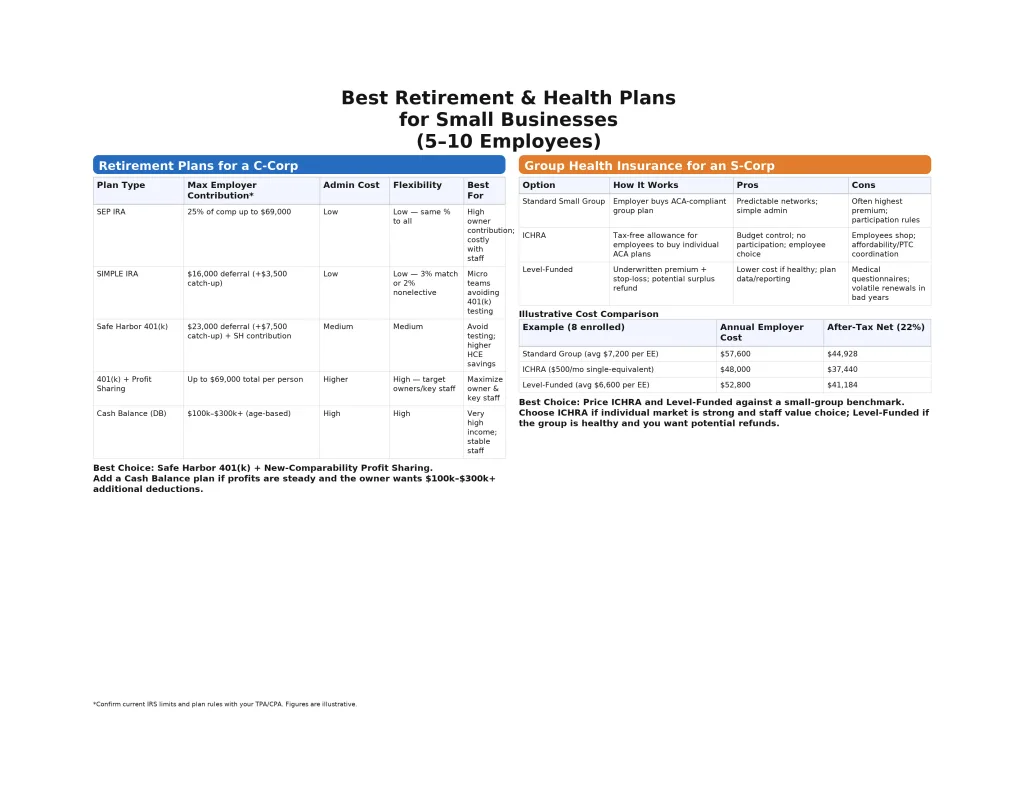
*All employer health spend is deductible; table simply shows relative cost after a 22% deduction effect.
Level-funded upside/downside year:
- Good year: claims run 70% of expected → surplus refund (often 50% of $10,000–$15,000 range at this size).
- Bad year: claims 140% → no refund; expect steeper renewal next year.
Practical chooser
- If your individual market is strong (broad choices, good networks) and employees value choice: lean ICHRA with a clear allowance grid (single/EE+S/EE+CH/Family).
- If the team is healthy and you want savings + data: price level-funded with at least two carriers; ask for surplus rules and renewal caps in writing.
- If you want “set it and forget it” and consistent networks: standard small-group remains the simplest.
Implementation checklist (health)
- Cafeteria plan: for fully-insured group, use §125 to pre-tax employee share. With ICHRA, employees typically pay and get tax-free reimbursement—don’t route individual Exchange premiums through §125.
- ICHRA: run affordability test against the employee’s lowest-cost silver plan at their home rating area; document offers and substantiation.
- Level-funded: confirm stop-loss terms, run-out rules, surplus split %, and who owns the data; budget for PCORI.
- Mini-COBRA/state continuation may apply <20 employees—check your state.
Pulling it together—recommended baselines
| Scenario | Recommendation | Why |
|---|---|---|
| C-Corp, 5–10 employees (retirement) | Safe Harbor 401(k) + New-Comparability Profit Sharing; evaluate Cash Balance if owner wants $100k–$300k more | Maximizes owner benefit with far lower staff cost than SEP; avoids testing friction; scalable |
| S-Corp, 5–10 employees (health) | Start with ICHRA or Level-Funded, price both against a fully-insured benchmark | ICHRA controls budget and offers choice; Level-funded can undercut premiums and return surplus if group is healthy |
📌 Final Recommendations
| Business Type | Best Retirement Plan | Best Health Insurance | Why |
|---|---|---|---|
| C-Corp, 5–10 Employees | Safe Harbor 401(k) + Profit Sharing | N/A (C-Corp scenario for retirement) | Maximize owner tax deferrals and avoid testing |
| S-Corp, 5–10 Employees | SIMPLE IRA or 401(k) Safe Harbor (if admin budget allows) | ICHRA or Level-Funded | Control health costs, maintain flexibility |
✅ Action Plan
- Get quotes for all health plan types — cost differences can be 20–40% depending on workforce health and geography.
- Model retirement plan contributions for both owner and staff to ensure compliance with IRS rules and to optimize tax savings.
- Review 3-year projections to see how stable these benefits are under different business growth scenarios.
Need help getting started? Explore how Emergent Financial Group partners with Retirement Plan providers to bring you flexible, tax-smart options tailored for your business.
Please don’t hesitate to contact us here.
"Helping Businesses Build Better Benefits. Helping Employees Build Better Retirements. RIA in Buckhead. Benefit Planning. Wealth Management. Wills. Trusts. Estate Planning."