Why Today’s “Inflation” May Not Actually Be Inflation

And Why That Matters for Your Business, Portfolio, and Long-Term Planning
Executive Summary
Many business owners and investors are being told a simple story:
“Prices are rising because of inflation.”
But that explanation is increasingly incomplete—and in many cases, incorrectly applied.
What we are seeing today is not always classical inflation. Instead, a significant portion of price increases appears to be driven by:
- Margin expansion
- Pricing power
- Supply chain inefficiencies
- Strategic price anchoring
—not rising raw input costs.
This distinction is not academic. It directly affects:
- Business pricing strategy
- Portfolio construction
- Retirement income planning
- Estate transfer assumptions

Step 1: What “Real Inflation” Actually Means
In classical economics, inflation is defined as:
- A broad increase in the general price level
- Typically driven by:
- Demand-pull (too much demand)
- Cost-push (rising input costs)
- Monetary expansion
Critically:
👉 True cost-driven inflation starts at the input level
That includes:
- Raw materials (commodities, energy)
- Labor
- Transportation
- Core production inputs
When those rise, businesses are forced to raise prices.
This is known as cost-push inflation.
Step 2: Where Prices Are Actually Rising Today
Here’s where things get interesting.
Recent data and research show a disconnect between input costs and final prices:
- Input prices often do not rise proportionally
- In some sectors, they have stabilized or even declined
- Yet consumer prices remain elevated
Why?
Because pricing pressure is showing up in the middle of the production chain, not at the beginning.
Step 3: The Role of Intermediate Goods

We focus on the nitty-gritty
so you can relax.
✓ Empowering, game-changing employee benefits
✓ Schedule a consultation
To understand this, we need to understand:
👉 Intermediate goods = goods used to produce final goods
(e.g., components, processing, logistics, packaging)
Modern supply chains are layered:
- Raw materials
- Intermediate production
- Final assembly
- Distribution
- Retail pricing
The price increases we’re seeing are often concentrated in:
- Processing layers
- Distribution layers
- Service-based inputs
- Margin-added stages
—not raw materials.
Step 4: The Key Insight — Price ≠ Inflation
This is the most important distinction for your clients:
👉 Rising prices do not automatically mean inflation
Even the Federal Reserve Bank of St. Louis emphasizes:
- Individual prices can rise or fall independently
- Inflation refers to the overall price level across the economy
👉Use our Small Business Inflation Optimizer tool
Step 5: The Profit & Margin Expansion Effect
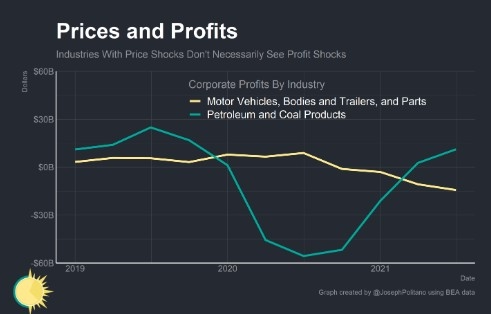
A growing body of research and reporting shows:
- Corporate profits have contributed significantly to recent price increases
- In some cases, prices rose even as input costs declined
One analysis found:
- Input costs rose only modestly
- But consumer prices continued rising
- Corporations maintained or expanded margins
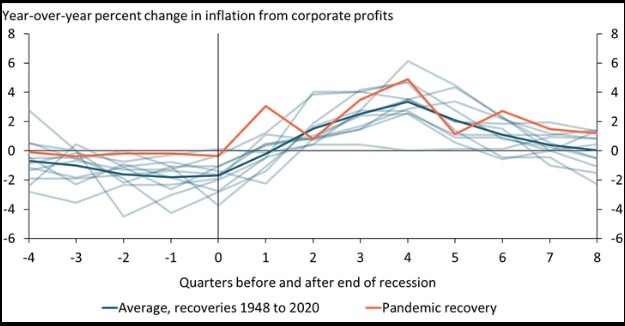
This phenomenon is often referred to as:
“Margin Expansion” or “Greedflation” (controversial term, but useful concept)
What’s happening:
- A shock occurs (COVID, supply chain disruption)
- Firms raise prices (justified initially)
- Costs normalize…
- Prices do not come down
Step 6: Supply Chain Complexity Creates Pricing Distortion
Modern economies are deeply interconnected.
Research shows:
- Intermediate goods pricing is increasingly global
- CPI (consumer prices) and PPI (producer prices) are diverging
This means:
👉 You can have stable input costs
while still seeing rising final prices
Why?
Because:
- Each layer adds margin
- Each layer has its own supply/demand dynamics
- Each layer may exercise pricing power independently
👉Use our Small Business Inflation Optimizer tool
Step 7: Why This Looks Like Inflation (But Isn’t Pure Inflation)
From a consumer perspective:
- Prices are higher → feels like inflation
But structurally:
| True Inflation | What We’re Seeing |
|---|---|
| Starts at raw inputs | Starts mid-supply chain |
| Broad-based | Sector-specific |
| Driven by money supply or costs | Driven by margins & structure |
| Sustained across economy | Uneven and distorted |
Step 8: What This Means for Business Owners
If you run a business, this is critical:
1. Your cost structure may not be the problem
- Your suppliers may be increasing prices beyond their cost increases
2. You may have more pricing power than you think
- Competitors are raising prices—even without cost pressure
3. Margin discipline matters more than ever
- This is a margin environment, not just a cost environment

Step 9: What This Means for Investors
If this is not purely inflation:
Traditional assumptions may be wrong
- Bonds reacting to “inflation” may be mispriced
- Equities with pricing power outperform
- Margin expansion becomes a key driver of returns
Key investment implication:
👉 Focus on pricing power + supply chain control, not just inflation hedges
Step 10: What This Means for Retirement & Estate Planning
This distinction matters long-term:
If this were true inflation:
- You’d expect persistent erosion of purchasing power
If it’s margin-driven:
- Price increases may stabilize
- But remain permanently elevated
That creates:
- Sticky cost-of-living assumptions
- Potential overestimation of long-term inflation rates
- Mispricing of retirement income needs

Final Takeaway
The narrative that “everything is inflation” is overly simplistic.
A more accurate framework:
“We are experiencing a hybrid environment—where some inflation exists, but a meaningful portion of price increases is driven by margin expansion and supply chain dynamics, not raw input cost inflation.”
Strategic Positioning for Clients
For your clients, the real takeaway is this:
- Don’t blindly react to “inflation headlines”
- Understand where pricing pressure originates
- Align strategy around:
- Pricing power (business + equities)
- Margin durability
- Supply chain positioning
Closing Thought
In prior cycles, inflation was:
👉 A monetary and cost phenomenon
Today, it is increasingly:
👉 A structural and behavioral phenomenon
And that changes everything—from how you run a business…
to how you build a portfolio…
to how you plan your estate.
The Key Insight: It’s Not About More Benefits
Many businesses make the mistake of stacking benefits without a strategy.
The goal is not to offer more—it’s to offer the right combination, structured effectively.
How to Choose the Right Employee Benefits
A strong benefits strategy should:
- Align with company goals
- Reflect workforce demographics
- Optimize tax efficiency
- Control long-term cost exposure
👍For a deeper strategic framework:
The Future of Employee Benefits
In 2026 and beyond, benefits are becoming a core business strategy—not just an HR function.
Companies that adapt will:
- Attract higher-quality talent
- Retain employees longer
- Operate more efficiently
👍Explore the full trend breakdown:
Final Thoughts
Employee benefits are one of the most powerful—and underutilized—tools available to business owners today.
When designed correctly, they do more than support employees.
They strengthen the entire business.
If you’re evaluating your current structure, start here:
👍https://emergentfingrp.com/benefits-planning-contact-form/
Frequently Asked Questions About Employee Benefits
What are the most important employee benefits in 2026?
The most important benefits include health insurance, retirement plans, flexible work options, and financial wellness support.
What benefits do employees value most?
Employees value benefits that improve financial security, flexibility, and overall well-being.
How can small businesses afford employee benefits?
Small businesses can use tax-advantaged strategies, level-funded health plans, and targeted benefits to control costs.
Need help getting started?
Explore how Emergent Financial Group partners with families, employees and small business owners for comprehensive wealth management and estate planning.
Helping Atlanta Businesses Build Stronger Financial Futures
If your company is reviewing employee benefits, executive compensation structures, or long-term wealth strategies, the advisors at Emergent Financial Group help Atlanta companies design benefit programs that strengthen employee loyalty and financial security.
Please don’t hesitate to contact us here
"Helping Businesses Build Better Benefits. Helping Employees Build Better Retirements. RIA in Buckhead. Benefit Planning. Wealth Management. Wills. Trusts. Estate Planning."