77% Tax! The U.S. “Temporary” Tax of 1913

Was It the Greatest Wealth Transfer in American History?
In 1913, the United States fundamentally changed how it funds government. With the ratification of the Sixteenth Amendment to the United States Constitution, Congress gained explicit authority to levy a federal income tax without apportioning it among the states.
Later that year, President Woodrow Wilson signed the Revenue Act of 1913, formally establishing the modern federal income tax.

At the time, many lawmakers described it as modest and targeted primarily at the wealthy. Few predicted that this “temporary” or limited tax would become the central engine of federal finance for the next century.
But was it truly the greatest wealth transfer in U.S. history?
Let’s break it down.
What Happened in 1913?
Before 1913:
- The federal government relied mainly on tariffs and excise taxes.
- There was no permanent federal income tax (earlier attempts had been struck down or expired).
- Federal spending was relatively small compared to GDP.
After 1913:
- Congress gained permanent constitutional authority to tax income.
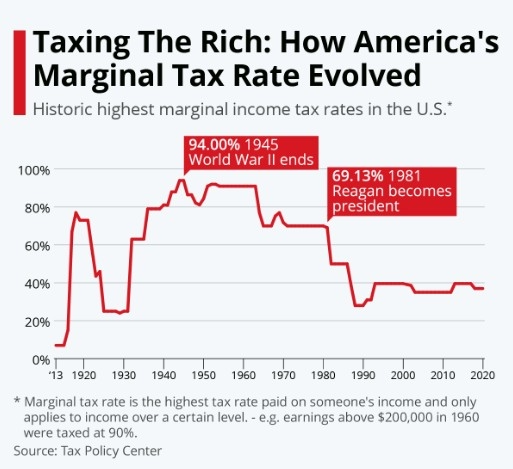
- The top marginal tax rate started at just 7%, and only on very high incomes (roughly the top 1%).
- Most Americans paid nothing.
In other words:
This was not initially a mass tax on middle-income Americans.
But the structure mattered more than the initial rates.
How It Evolved
Once the income tax framework existed, it expanded:
World War I
Top rates surged to 77%.
The Great Depression
Rates rose again to fund expanding federal programs.
World War II
The income tax became a mass tax:
- Withholding was introduced.
- Millions of middle-class Americans began paying income taxes.
- Top rates exceeded 90% during parts of the 1940s–1960s.
The key shift:
The income tax moved from a narrow levy on the wealthy to a broad-based tax affecting wage earners nationwide.
Why Some Call It the “Greatest Wealth Transfer”
The phrase is usually used rhetorically, but here’s the logic behind it:
1️⃣ Permanent Revenue Stream
The 16th Amendment created an elastic revenue system.
As incomes grew, tax revenue grew automatically.
Ready to invest?
Secure your financial future
with our professional guidance
Over time, trillions of dollars flowed from private citizens to the federal government.
2️⃣ Financing the Modern State
Income tax revenues funded:
- Social Security
- Medicare
- Medicaid
- Defense expansion
- Infrastructure
- Education
- Welfare programs
- Debt servicing
Whether viewed positively or critically, this represented a massive redirection of private income into public spending.
3️⃣ Intergenerational Redistribution
The income tax helped finance:
- Transfer programs to retirees
- Social insurance systems
- Wartime expenditures
- Federal debt that future taxpayers service
In that sense, it enabled large-scale redistribution across:
- Income brackets
- Generations
- Regions
- Economic classes
Was It Truly the Largest Wealth Transfer?
It depends how you define “wealth transfer.”

If You Mean:
A legal mechanism allowing the federal government to collect and redistribute income permanently?
→ Yes, 1913 was foundational.
If You Mean:
A one-time event where wealth shifted dramatically overnight?
→ Not exactly. The expansion happened gradually over decades.
Other contenders for “largest wealth transfer” might include:
- New Deal-era fiscal expansion
- Post-WWII entitlement growth
- Modern federal deficit spending
- Monetary policy and inflation cycles
But none of those would have been structurally possible without the constitutional shift in 1913.
The Structural Impact
The most important takeaway isn’t the initial 7% tax.
It’s this:
The Sixteenth Amendment permanently altered the relationship between citizens and the federal government.
It:

- Shifted power toward centralized fiscal authority
- Reduced dependence on tariffs
- Enabled progressive taxation
- Allowed federal spending to scale with economic growth
This was less about a “temporary tax” and more about the creation of a permanent fiscal architecture.
Lessons for Modern Investors & Business Owners
For wealth builders and small business owners, 1913 teaches several enduring lessons:
1️⃣ Tax Structures Expand
Temporary or targeted taxes often broaden over time.
2️⃣ Policy Risk Is Real
Tax policy evolves across decades — not election cycles.
3️⃣ Wealth Planning Must Be Structural
High-net-worth families and business owners should:
- Diversify tax character (ordinary, capital gains, tax-free)
- Consider entity structure
- Understand intergenerational planning
- Anticipate legislative shifts
The real story of 1913 isn’t about outrage — it’s about permanence.
Final Thought
The “temporary” income tax of 1913 became the backbone of the modern federal government.
Whether viewed as:
- Necessary modernization
- Progressive reform
- Or the greatest wealth transfer in American history
…it undeniably reshaped the economic landscape of the United States.
And once a structural tax authority exists, it rarely disappears.
History suggests:
What begins narrowly can evolve dramatically.
Understanding that dynamic is critical for anyone building long-term wealth today.
Need help getting started?
Explore how Emergent Financial Group partners with Individuals, Families and Small Business Owners for comprehensive Financial Planning.
Please don’t hesitate to contact us here

"Helping Businesses Build Better Benefits. Helping Employees Build Better Retirements. RIA in Buckhead. Benefit Planning. Wealth Management. Wills. Trusts. Estate Planning."