Roth 401(k) Plans for Small Businesses

When They’re the Best Fit — Financial, Employment, and Incorporation Conditions
1. What is a Roth 401(k)?
A Roth 401(k) is an employer-sponsored retirement plan that allows employees to make after-tax contributions—meaning taxes are paid upfront rather than at withdrawal. In retirement, qualified distributions are completely tax-free (including investment earnings).
Employers can still make pre-tax matching or profit-sharing contributions, which grow tax-deferred but will be taxable upon withdrawal. Both employee Roth contributions and employer pre-tax contributions are tracked separately within the same plan.
Key 2025 Limits:
- Employee contribution: Up to $23,000 ($30,500 with age 50+ catch-up)
- Combined employer + employee: Up to $69,000 ($76,500 with catch-up)
- No income limits for participation (unlike Roth IRAs)
2. Financial Conditions Where a Roth 401(k) Excels
A. You Expect Higher Taxes in Retirement
If the business owner and key employees expect to be in equal or higher tax brackets later, paying tax now (via Roth contributions) locks in today’s rates and shields all future growth from taxation.
Example:

- 40-year-old owner earns $200,000
- Contributes $23,000 to Roth 401(k) now at 22% tax rate
- Retires at 65 with assets doubled and in 32% bracket — withdrawals are completely tax-free.
B. Younger Workforce with Long Investment Horizon
A Roth 401(k) works best when employees have decades to let tax-free growth compound. Small businesses with younger staff can market this as a powerful benefit.
C. Variable or Unpredictable Income Years
In low-income years, Roth contributions may be more tax-efficient because the immediate tax cost is smaller. Business owners can toggle between Roth and traditional contributions annually.
3. Employment Conditions Where It’s a Strong Choice
- Attracting Top Talent: Many younger or higher-earning employees value tax diversification in retirement accounts. Offering both Roth and pre-tax options is increasingly seen as a modern benefit.
- Retention of Key Employees: Combining Roth contributions with a generous employer match (even if match is pre-tax) can make the package highly competitive.
- Low Turnover / Long Tenure: The longer employees stay, the more they benefit from compound tax-free growth.
4. Incorporation Conditions and Tax Planning Fit
A. C-Corporations
- Roth deferrals don’t reduce corporate taxable income, but the after-tax nature benefits high-growth companies whose owners expect much higher wealth in retirement.
- Employer match (pre-tax) still offers corporate tax deductions.
B. S-Corporations
- Owners paying themselves W-2 wages can contribute to the Roth 401(k) portion.
- Since S-Corp owners avoid self-employment tax on distributions, combining Roth contributions with pass-through income can create a balanced tax strategy.
C. LLCs Taxed as S-Corp or C-Corp
- Same benefits as above, with flexibility to blend Roth and pre-tax contributions depending on annual profitability.
5. Why Choose a Roth 401(k) Over Other Small Business Plans
| Plan Type | Why Roth 401(k) Wins in Specific Conditions |
|---|---|
| Traditional 401(k) | Roth wins if expecting higher tax rates later or seeking tax diversification; no RMDs after SECURE 2.0 for Roth accounts in 2024 onward. |
| SEP IRA | SEP is pre-tax only; all withdrawals are taxable. Roth 401(k) offers tax-free growth and higher employee contribution flexibility. |
| SIMPLE IRA | Lower contribution limits and no Roth option; Roth 401(k) allows much higher after-tax contributions and better recruiting appeal. |
| Roth IRA | Roth IRA has income limits and much lower contribution caps; Roth 401(k) has no income cap and far higher limits. |
6. When a Roth 401(k) is the Strategic Choice
A Roth 401(k) is typically best for a small business when:
- Owner and key employees are in low-to-moderate current tax brackets but expect higher taxes in retirement.
- Workforce is young or mid-career, with long time horizons for tax-free growth.
- The business wants to stand out in competitive hiring markets.
- Owner values flexibility — being able to contribute to both Roth and traditional 401(k) buckets in the same plan year.
- Incorporation allows mix of wages and pass-through income for tailored tax optimization.
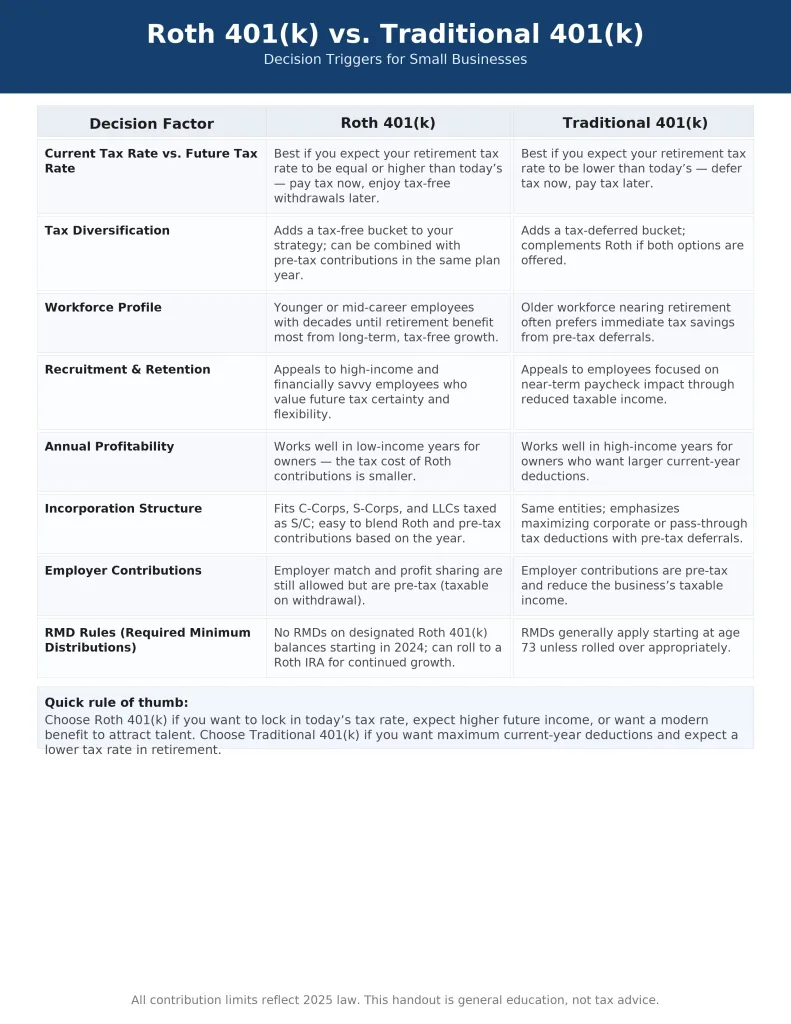
Quick Rule of Thumb
- Choose Roth 401(k) → If you want to lock in today’s tax rate, expect higher future income, or want to offer a modern benefit to attract talent.
- Choose Traditional 401(k) → If you want maximum current-year deductions and expect a lower tax rate in retirement.
Need help getting started? Explore how Emergent Financial Group partners with Retirement Plan providers to bring you flexible, tax-smart options tailored for your business.
Please don’t hesitate to contact us here.
"Helping Businesses Build Better Benefits. Helping Employees Build Better Retirements. RIA in Buckhead. Benefit Planning. Wealth Management. Wills. Trusts. Estate Planning."