SEP IRA Plans for Small Businesses: When They’re the Best Choice

A Simplified Employee Pension Individual Retirement Account (SEP IRA) is a retirement plan designed for small business owners and self-employed individuals who want an easy, flexible, and tax-efficient way to save for retirement—while still offering benefits to employees.

What is a SEP IRA?
A SEP IRA allows the employer to contribute directly to traditional IRAs set up for each eligible employee. These contributions are tax-deductible for the business and grow tax-deferred until the employee withdraws funds in retirement.
Key features:
- Employer-funded only – Employees cannot make salary deferrals.
- High contribution limits – Up to 25% of an employee’s compensation or $69,000 in 2024 (whichever is lower).
- No annual filing – No IRS Form 5500 requirement.
- Flexible funding – Contributions are not mandatory every year.
When a SEP IRA is Best for Small Businesses
A SEP IRA shines when a small business meets certain financial, employment, and incorporation conditions.
1. Financial Conditions
A SEP IRA is often the best choice when:
- Variable income: The business has fluctuating profits and doesn’t want the obligation of fixed contributions like a Safe Harbor 401(k).
- Desire for large deductions: The owner wants to contribute a high percentage of earnings in profitable years.
- Low administrative budget: The business wants to avoid the costs of complex plans (recordkeeping, compliance testing).
- Tax reduction priority: Large pre-tax contributions help reduce taxable income significantly.
2. Employment Conditions
SEP IRAs work best when:
- Few or no employees: The owner is self-employed or has 1–3 employees, making equal percentage contributions manageable.
- Stable, long-term employees: Because the employer must contribute the same percentage for all eligible employees, this is easier with a small, stable team.
- High owner-to-staff pay ratio: Since contributions are a percentage of salary, the plan is most tax-efficient if the owner’s compensation is high relative to staff.

3. Incorporation Conditions
SEP IRAs are a strong fit for:
- Sole proprietors, partnerships, or S-Corps: Particularly those without many employees.
- Professional service firms: Consultants, independent contractors, or small practices with high margins.
- C-Corps with minimal staff: Can still deduct contributions as a business expense.
Why Choose a SEP IRA Over Other Plans
Here’s how a SEP IRA stacks up against common small business retirement plans:
| Plan Type | Employee Contributions | Employer Contributions | Max 2024 Limit | Admin Complexity | Best When… |
|---|---|---|---|---|---|
| SEP IRA | None | 100% employer-funded (same % for all) | $69,000 | Very low | Few employees, variable profits, want high deductions |
| SIMPLE IRA | Yes, up to $16,000 | 2% nonelective or 3% match | ~$26,000 | Low | Steady contributions, more employees |
| Safe Harbor 401(k) | Yes, up to $23,000 | 3% nonelective or 4% match | $76,500 (with catch-up) | Medium–high | Larger staff, avoid discrimination testing |
| Solo 401(k) | Yes, plus employer contributions | Flexible | $76,500 | Low–medium | No employees (other than spouse) |
Advantages of SEP IRA over others:
- Higher limits than SIMPLE IRA
- Less paperwork than 401(k)
- No fixed annual match requirement
- Perfect for irregular cash flow
Example Scenario: When SEP IRA Wins
Business: Single-owner S-Corp consulting firm with 2 part-time employees earning $20,000 each.
Owner Salary: $200,000
Profitability: High but varies year-to-year.
Why SEP IRA works:
- The owner can contribute 25% of salary ($50,000) in profitable years.
- Required contributions for staff are only $5,000 each (25% of $20k).
- No annual administration or testing costs.
- In lean years, contributions can be reduced or skipped entirely.
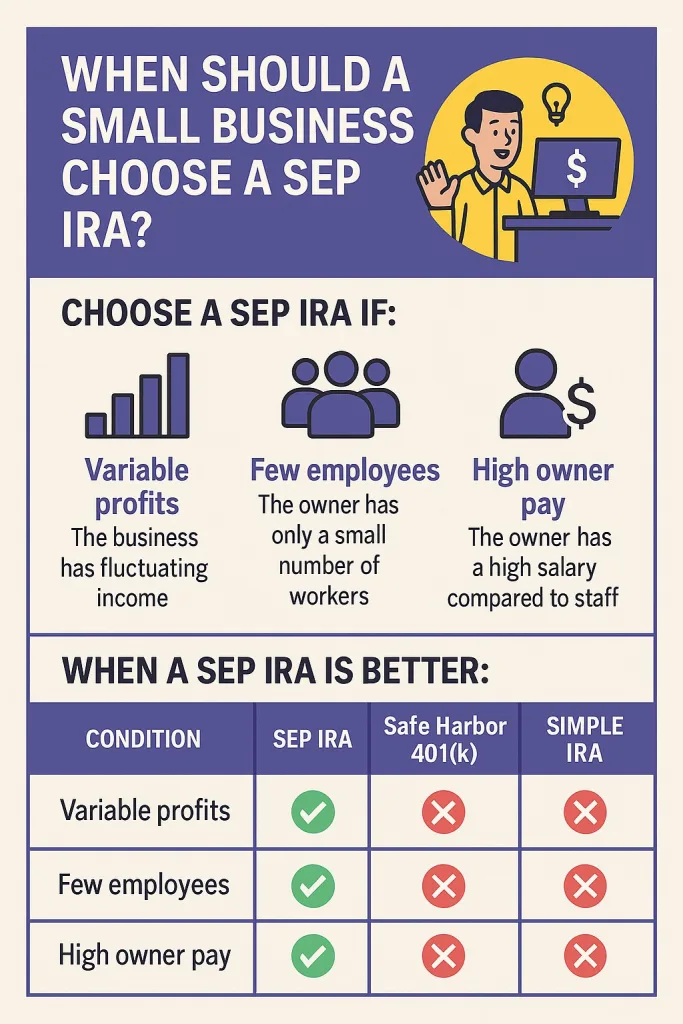
Key Takeaways
- Best for: Self-employed or very small businesses with few employees and high owner compensation.
- Avoid if: You have many employees or want employees to contribute.
- Biggest benefit: Flexibility + high deduction potential without compliance headaches.
Need help getting started?
Explore how Emergent Financial Group partners with small-business owners to compare employee benefits, health insurance, retirement plans, and protection strategies.
Please do not hesitate to contact us or schedule a consultation.

"Helping Businesses Build Better Benefits. Helping Employees Build Better Retirements. RIA in Buckhead. Benefit Planning. Wealth Management. Wills. Trusts. Estate Planning."