Safe Harbor 401(k) vs. Profit-Sharing Plan: Which is Right for Your Small Business?

The Best 401(k) Plan Depends on the Situation
Choosing the right retirement plan can have a major impact on your business’s taxes, employee satisfaction, and long-term financial strategy. Two of the most popular options for small businesses are the Safe Harbor 401(k) and the Profit-Sharing Plan (a type of flexible 401(k) structure).
While both offer valuable tax advantages and retirement savings potential, the best choice depends heavily on your financial situation, staffing profile, business structure, and tax reduction goals.
What is a Safe Harbor 401(k)?
A Safe Harbor 401(k) is a retirement plan designed to automatically meet IRS nondiscrimination testing requirements by offering mandatory employer contributions. This ensures that highly compensated employees (HCEs) can maximize their contributions without being limited by annual compliance testing results.
Key Features:
- Mandatory employer contributions – Either:
- Basic match: 100% match on first 3% of employee pay + 50% match on the next 2% of pay, or
- Enhanced match: 100% match on first 4% of pay, or
- Non-elective: 3% contribution to all eligible employees, regardless of participation.
- Immediate vesting – Employees own employer contributions right away.
- Automatic IRS compliance – No annual ADP/ACP nondiscrimination testing needed.
- Best for: Companies with high-earning owners who want to max out contributions without testing restrictions.
What is a Profit-Sharing Plan?
A Profit-Sharing Plan is a type of 401(k) feature that allows the employer to make discretionary contributions to employee retirement accounts—based on company profits or a chosen formula.
It can be a stand-alone plan or combined with a traditional or Safe Harbor 401(k).
Key Features:
- Fully discretionary – Employer chooses whether to contribute each year.
- Flexible allocation methods – Can reward employees differently (age-weighted, new comparability, or pro-rata).
- High contribution potential – Combined with employee deferrals, total contributions can reach $69,000 per employee in 2024 ($76,500 for age 50+).
- Custom vesting schedules – Typically 3–6 years.
- Best for: Businesses wanting flexibility in contributions and the ability to reward certain groups of employees or owners more heavily.
When a Profit-Sharing Plan is the Better Choice
While a Safe Harbor 401(k) is attractive for avoiding compliance testing, there are several situations where a Profit-Sharing Plan provides greater strategic and tax advantages—especially when paired with a standard (non-Safe Harbor) 401(k).
1. Financial Conditions
- Business profits fluctuate – You don’t want to be locked into mandatory contributions every year like in Safe Harbor.
- High profitability years – You can make large tax-deductible contributions to lower taxable income, then contribute less in lean years.
- Need maximum tax sheltering – Especially for S-Corps, C-Corps, or partnerships wanting to shift profits into retirement accounts.
We provide valuable employee benefits
that bring more success in business
Example:
A C-Corp with $800,000 in net profit contributes $200,000 into a profit-sharing plan for owners and select key staff. This reduces corporate taxable income and increases retirement savings without being obligated to repeat it annually.
2. Employment Conditions
- Uneven employee ages or salaries – Profit-sharing allows age-weighted or new comparability allocations, giving more to older or highly compensated staff while staying compliant.
- Low employee turnover – You can use a vesting schedule to retain employees and protect contributions if someone leaves early.
- Smaller number of employees – Easier to direct more contributions toward owners/key employees.
Example:
A 5-person engineering firm uses profit-sharing with a new comparability allocation so the two 55-year-old owners each receive $40,000, while the younger employees receive smaller proportional amounts.

3. Incorporation & Ownership Conditions
- S-Corp owners – Can shift more pre-tax income into retirement and reduce personal taxable income.
- C-Corp owners – Contributions are deductible at the corporate level, lowering corporate tax and potentially shareholder dividend taxes.
- Partnerships/LLCs – Can allocate based on ownership percentages or strategic retention needs.
Example:
An S-Corp with two owners (ages 58 and 60) structures profit-sharing to give each $50,000 in contributions, allowing them to save aggressively in the years before retirement.
4. Tax Reduction Conditions
- High current tax liability – Profit-sharing lets you contribute more than the Safe Harbor minimum, potentially doubling or tripling tax deductions.
- Desire to control timing of deductions – You can decide late in the year how much to contribute after knowing your profits.
- Coordinating with other plans – Pair with Cash Balance Plans for even greater tax deferral.
Why Choose Profit-Sharing Over Safe Harbor in These Cases?
- Flexibility – You’re not locked into mandatory contributions when cash flow is tight.
- Higher potential contributions – Safe Harbor limits employer contributions, while profit-sharing can push owners to the $69,000 limit.
- Targeted benefit allocation – Reward key employees or owners strategically.
- Tax optimization – Contributions are fully deductible, reducing taxable income more substantially than Safe Harbor minimums.

We focus on the nitty-gritty
so you can relax.
✓ Empowering, game-changing conferences
✓ Schedule a consultation
Quick Comparison Chart – Safe Harbor 401(k) vs. Profit-Sharing 401(k)
| Feature | Safe Harbor 401(k) | Profit-Sharing 401(k) |
|---|---|---|
| Employer Contribution | Mandatory (match or non-elective) | Discretionary |
| IRS Testing | Automatically passes | Must pass unless combined with Safe Harbor |
| Vesting | Immediate | Can be immediate or graded up to 6 years |
| Max Employer Contribution | Usually ~3–4% of payroll | Up to $69,000 total per person (2024) |
| Best For | Owners who want to max personal deferrals without testing | Owners wanting flexibility, higher deductions, or targeted allocations |
| Risk | Locked into contributions every year | Must pass compliance testing if no Safe Harbor |
| Tax Planning | Moderate deductions | Potentially large deductions, especially in high-profit years |
Key Points
- If you want simplicity, guaranteed compliance, and consistent contributions for all employees—Safe Harbor 401(k) is often best.
- If you want flexibility, higher contribution limits, targeted allocations, and greater tax deductions in profitable years—Profit-Sharing is a stronger strategic choice.
Many small businesses combine the two: a Safe Harbor 401(k) to satisfy testing + a Profit-Sharing feature for high-profit years. This gives the best of both worlds—automatic compliance and maximum tax efficiency.
Safe Harbor 401(k) vs. Profit-Sharing Plan: Key Differences for Small Businesses
Focus: Tax Benefits (deductions, eligibility, owner advantages) and Contribution Flexibility (discretionary vs. mandatory, limits, allocation options).
| Feature | Safe Harbor 401(k) Plan | Profit-Sharing Plan |
|---|---|---|
| Employee Contributions | Allowed: Employees (including owners) can contribute pre-tax or Roth salary deferrals up to IRS limits (e.g. $22,500 plus $7,500 catch-up for age 50+ in 2023). This lets participants lower current taxable income and grow savings tax-deferred. | Not Allowed: Only employer contributes; employees cannot defer their own salary into a standalone profit-sharing plan. (In a 401(k) profit-sharing combo, employees could defer, but a pure profit-sharing plan has no employee deferrals.) |
| Employer Contribution Requirement | Mandatory Contributions: To qualify for safe harbor (and avoid discrimination testing), employer must make annual contributions for all eligible employees – either a 3% of pay nonelective contribution to everyone or a matching contribution (e.g. up to 4% of pay) for those who contribute. wipfli.com. These contributions are required every year regardless of business profits (with very limited ability to suspend mid-year) and ensure the plan automatically passes key IRS nondiscrimination tests. | Discretionary Contributions: Completely optional each year – the employer decides if a contribution is made and how much. Contributions can be skipped in unprofitable years or adjusted based on business conditions (no obligation to contribute in a given year). This offers maximum flexibility in managing cash flow and profit-based rewards for employees. |
| Contribution Limits & Tax Deductions | Higher Personal Deferrals: Participants can defer a high amount of salary (safe harbor allows the maximum 401(k) salary deferral, subject to annual limits) in addition to employer contributions. Total contribution per person (employee + employer) is capped by the IRS annual addition limit (e.g. $66,000 for 2023). Employer contributions are tax-deductible to the business up to 25% of aggregate participant compensation, and employee deferrals do not count against that 25% limit (the company can deduct those separately). This means owners and employees can potentially save more overall in a safe harbor 401(k) plan (via both deferrals and employer funds) while the business enjoys a deduction for all contributionsdol.gov. | Employer-Funded Only: Total contribution per participant is likewise limited (e.g. $66,000 annual cap in 2023), but all of it must come from employer contributions since employees cannot add their own money. The employer’s tax deduction is limited to 25% of the total eligible payroll for all participants. (Contributions are tax-deductible to the business and not counted as employees’ income in the year contributed, deferring taxes until withdrawal.) Because no employee deferrals are involved, the only way to reach the maximum per-person limit is through substantial employer contributions. |
| Allocation Flexibility | Fixed Formula Contributions: Safe harbor contributions follow set formulas defined by law – every eligible employee must receive the 3% nonelective contribution or the same matching formula, with no favoritism. There’s no flexibility to allocate different percentages to different groups under the safe harbor requirement (all get the required minimum contribution uniformly). Employers can add a separate profit-sharing feature on top of safe harbor, but the safe harbor itself must be uniform for all. This simplicity ensures rank-and-file employees benefit equally, but it limits the employer’s ability to direct more to certain employees. | Highly Customizable Allocation: Profit-sharing plans offer multiple ways to allocate contributions. Employers can give an equal percentage of pay to everyone, a flat dollar amount to each, or use “new comparability” (cross-tested) formulas to favor certain groups (like owners or older employees) while still meeting IRS nondiscrimination tests. In practice, this means a profit-sharing plan can be designed so that owners or key employees receive a larger share of the contribution pie (within legal limits). The allocation method is defined in the plan, but employers have the flexibility to choose a formula that best fits their goals (and can amend the plan in future years to change it, if needed). |
| Vesting & Eligibility Conditions | Immediate Vesting, Broad Eligibility: Safe Harbor employer contributions must be 100% immediately vested for the employees (employees own those contributions right away, no forfeitures). Also, safe harbor rules prohibit imposing additional eligibility conditions on these contributions – for example, you cannot require an employee to work a full year or be employed on the last day of the year to get the safe harbor contribution. Essentially, all employees who meet the basic plan eligibility (often age ≥21 and 1 year of service) and who participate are entitled to the safe harbor money, even if they leave the company mid-year. This maximizes employees’ benefit but gives the employer little leeway to limit costs for short-term workers. | Vesting Schedules Allowed: Profit-sharing contributions often come with vesting schedules (e.g. 3-year cliff or 6-year graded vesting) to encourage retention. Employees earn ownership of contributions over time – if someone leaves early, unvested portions can be forfeited, which can then reduce plan costs or be reallocated to others. Employers can also set allocation conditions in the plan (since it’s not safe harbor): for example, requiring that an employee work at least 1,000 hours in the year and/or be employed on the last day of the plan year to receive that year’s contribution. This means an owner can avoid giving profit-sharing contributions to employees who quit mid-year or short-term hires. Such tools (vesting and eligibility conditions) give businesses more control over who ultimately benefits from employer contributions, potentially saving costs and rewarding longer-term employees. |
| Owner’s Benefit Strategies | Maximize Owner Deferrals: A safe harbor 401(k) is very owner-friendly if you are a highly compensated owner-employee looking to maximize retirement savings. Because the plan automatically satisfies ADP/ACP nondiscrimination tests, owners and other HCEs can contribute the maximum 401(k) salary deferral allowed by law without fear of refunds or penalties. In addition, the owner will receive the required safe harbor employer contribution (match or 3%), which is fully vested. The net result is that the business owner can put away a large amount pre-tax (or Roth) each year for themselves – potentially reaching the combined limit (over $60k per year) when adding up deferrals, safe harbor match, and any additional profit-sharing – while the plan remains compliant. The trade-off is the cost of guaranteeing contributions to employees annually, but this cost is often about the same as the minimum contributions required if the plan were top-heavy anyway. Safe harbor is ideal for owners who want to maximize their personal retirement contributions and not be limited by low employee participation. | Strategic High Contributions (with Flexibility): A profit-sharing plan can be a powerful tool for owners to receive large contributions in profitable years. Because employer contributions are discretionary, a business owner can decide at year-end how much to contribute to the plan (up to the max) based on the company’s profits and tax planning needs – effectively using contributions to reduce taxable income for the business/owner. With the right allocation formula, owners can legally allocate themselves a higher percentage of the contribution (while still giving employees an appropriate minimum share to pass testing). This means an owner could potentially reach the full annual contribution limit (e.g. ~$69,000 in 2024) mostly via employer contributions to their own account, especially if the plan is designed to favor older or key employees. For example, an owner might end up with far more in total contributions using a profit-sharing plan than they would relying on a simple 4% match alone. Importantly, profit-sharing plans still must pass nondiscrimination tests, so an owner can’t contribute only to themselves – they will need to share a portion with employees (often a well-designed plan might give staff a smaller percentage, like 5%, while the owner receives a larger percentage) to satisfy rules. Nonetheless, for a small business owner who wants flexibility and the ability to make large deductible contributions in good years (and skip in bad years), a profit-sharing plan provides a tailored approach. |
Practical Implications: Safe Harbor 401(k) plans offer simplicity and assured compliance – they let owners max out personal contributions and avoid complex testing, but require committing to a fixed level of employee contributions each year. This is great for owners who anticipate consistently high contributions and want to reward employees with a guaranteed benefit (while gaining personal tax-deferred savings). On the other hand, Profit-Sharing plans offer ultimate flexibility – contributions can align with business performance and can be allocated in favor of key people within legal limits. Owners can use profit-sharing to adjust their outlay annually, and even reach the maximum contribution limits for themselves in banner years, but they must ensure the plan remains fair to employees through vesting schedules and minimum allocations to pass testing. In summary, choose Safe Harbor 401(k) if you want to guarantee owner/HCE maximum deferrals and straightforward compliance at the cost of mandatory employer contributions, or choose Profit Sharing if you prefer discretionary contributions and creative allocation to potentially favor owners, with the trade-off of administering nondiscrimination tests and forgoing employee salary deferrals. Both plan types confer significant tax benefits to the business and participants – the best choice depends on your small business’s cash flow consistency, workforce makeup, and retirement savings goals for the owner.
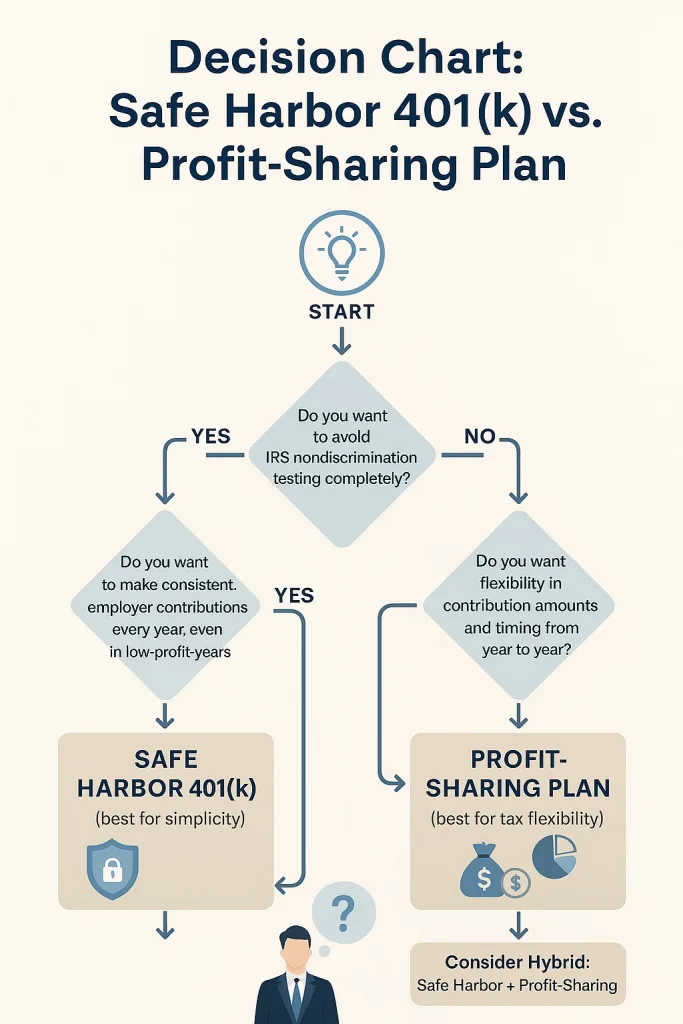
Best Practice: Hybrid Plans
Some businesses combine the Safe Harbor 401(k) with a profit-sharing feature to get:
- Automatic compliance for deferrals (Safe Harbor)
- Flexible, high-limit employer contributions (Profit-Sharing)
This hybrid design can be the best of both worlds for businesses with steady profits but a desire to maximize owner benefits.
Conclusion
A Safe Harbor 401(k) is best when you want simplicity, guaranteed owner deferral maxing, and predictable contributions.
A profit-sharing plan is superior when you want flexibility, higher potential contributions, and targeted tax strategy benefits—especially if your profits fluctuate or you have a small number of highly compensated employees.
Carefully analyzing your company’s profit patterns, employee demographics, and incorporation structure is key to deciding which plan delivers the greatest retirement savings and tax advantages.
Need help getting started? Explore how Emergent Financial Group partners with Retirement Plan providers to bring you flexible, tax-smart options tailored for your business.
Please don’t hesitate to contact us here.
"Helping Businesses Build Better Benefits. Helping Employees Build Better Retirements. RIA in Buckhead. Benefit Planning. Wealth Management. Wills. Trusts. Estate Planning."